Showing posts with label ballpoint pen. Show all posts

Monday, June 6, 2022

REVIEW: WINGBACK MECHANICAL PEN & PENCIL

REVIEW: WINGBACK MECHANICAL PEN & PENCIL

From the UK comes Wingback, a small and relatively young EDC-focused brand with a strong focus on creating sustainable, durable products that last, manufactured on UK soil! 

Wingback's commitment to sustainability and durability is immediately noticeable when unpacking their flagship writing products: the Wingback Mechanical Pen and Mechanical Pencil. No materials are wasted on packaging, as the pens come wrapped in a simple but durable Wingback-branded cloth sleeve - ecological, saves on shipping, and practical too. I like it! 

In the hand, the solid metal construction of both pen and pencil immediately gives off a feeling of longevity. Though small in size, the pen and pencil have a surprising amount of density  (especially the Mechanical Pen!) and substance to them, in part due to the all-custom, fully metal internal mechanisms. 
REVIEW: WINGBACK MECHANICAL PEN & PENCIL
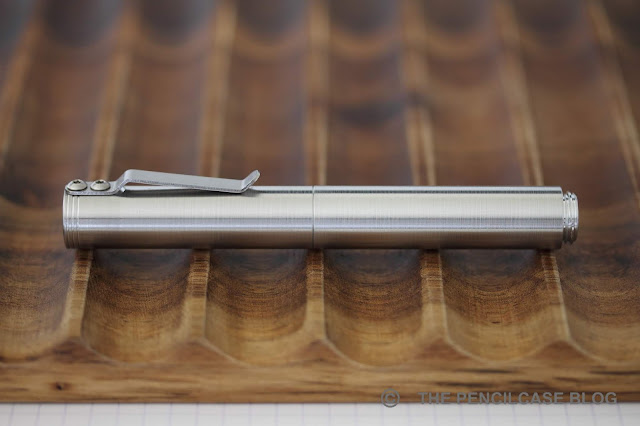
The design is kept very minimal, with a clear industrial and rugged look due to the knurled elements and pronounced, crisp chamfered edges all around. The surface of the mechanical pen(cil) is kept in its 'raw' machined state, you'll still be able to pick up on the CNC machining lines - which are extremely clean and precise. Going clipless is the only option here, so some uncontrolled rolling around on your desk is to be expected.

Wingback's entire product portfolio (which isn't super extensive, but still) is characterized by the same design language. Pronounced knurling, industrial rugged designs, and three distinct colorways to choose from: raw brass, raw stainless steel, or black-coated steel (a tough tungsten-carbide coating). Even some of their leather goods feature machined metal accents that tie their product designs together. I quite enjoy that level of consistency.
REVIEW: WINGBACK MECHANICAL PEN & PENCIL
... Although there's also one inconsistency on the Mechanical Pen that does look somewhat out of place. There's a subtle, yet noticeable (both tactile and visual) difference between the knurling on the section and the twist mechanism of the pen. The section's texture is less deeply cut and less aggressive to your fingers. It still adds some grip (though not as much as with more pronounced knurling), and it's more comfortable to hold for longer periods of time. Yet I don't quite understand why they didn't just match the texture on the twist mechanism.
REVIEW: WINGBACK MECHANICAL PEN & PENCIL
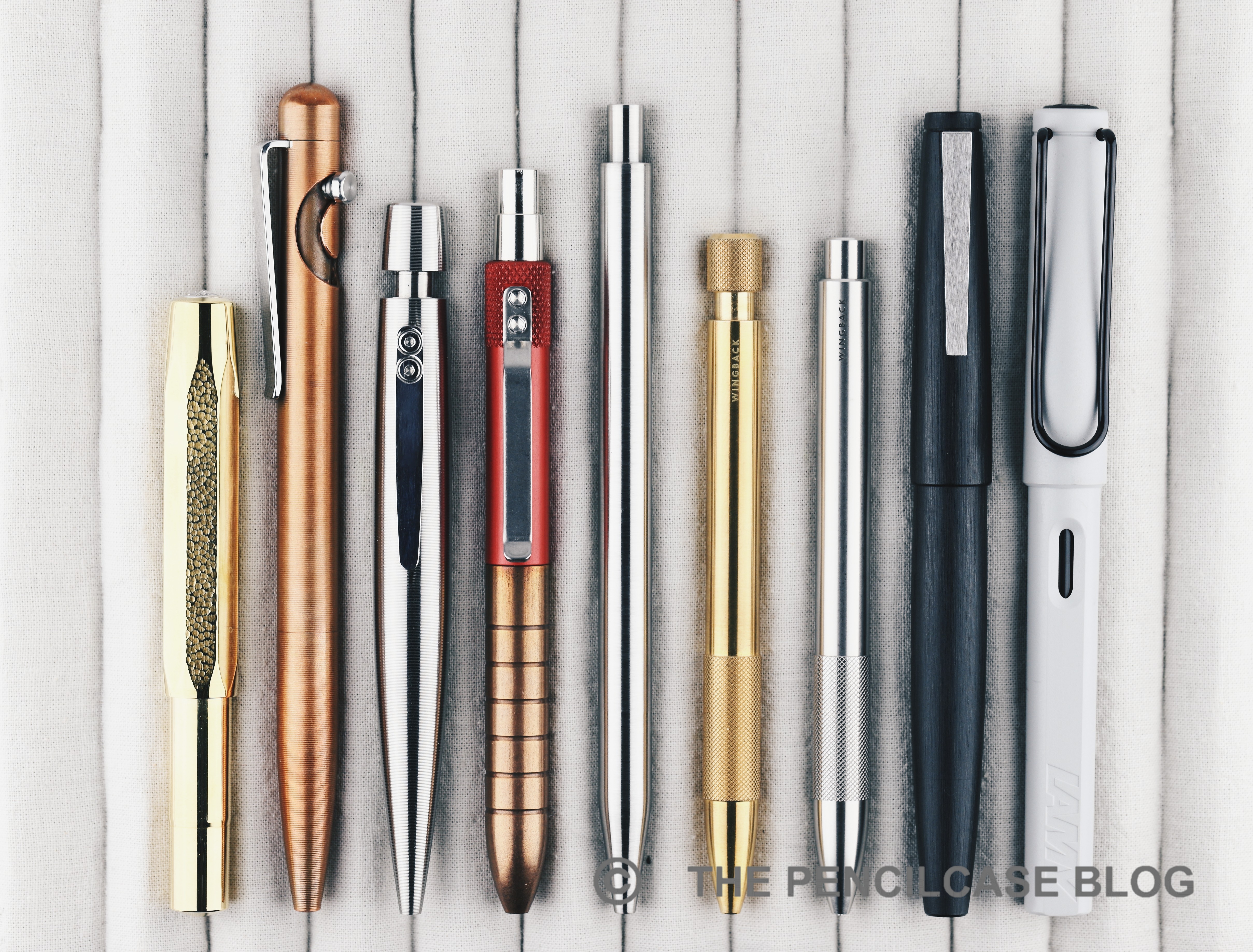
L to R: Kaweco Sport, Tactile Turn Glider, Ensso Giro, Karas EDK, Modern Fuel Pen, Wingback Mechanical Pen, Wingback Mechanical Pencil, Lamy 2000, Lamy Safari
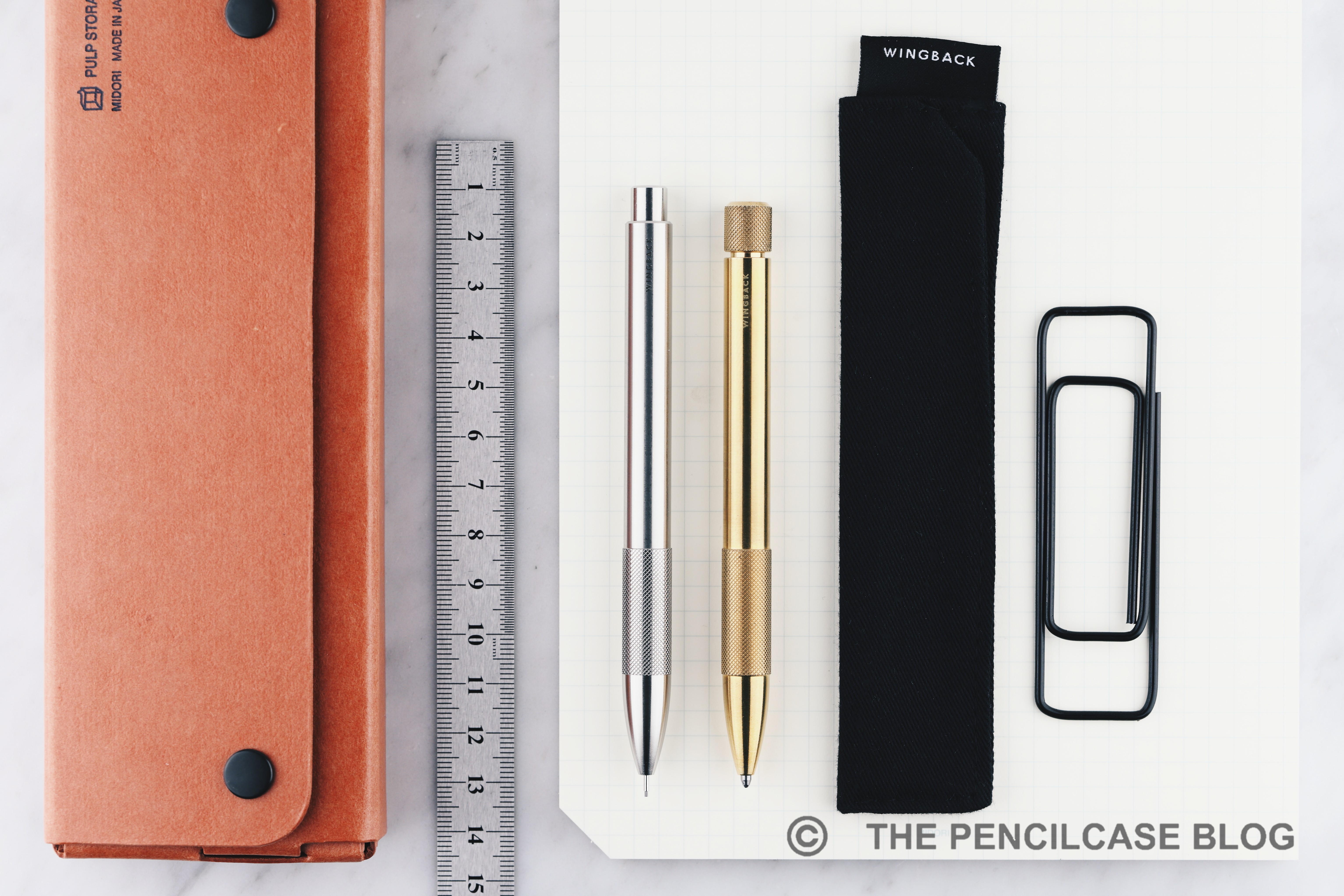
The Wingback Mechanical Pen and Pencil are much smaller than I originally anticipated. I guess it's just one of those designs that don't really convey scale very well in pictures. Hence, the above size comparison ought to bring some clarification. As you can see, Wingback's pen design is quite compact in nature, hovering in-between full-sized and truly pocket-sized pens.
REVIEW: WINGBACK MECHANICAL PEN & PENCIL
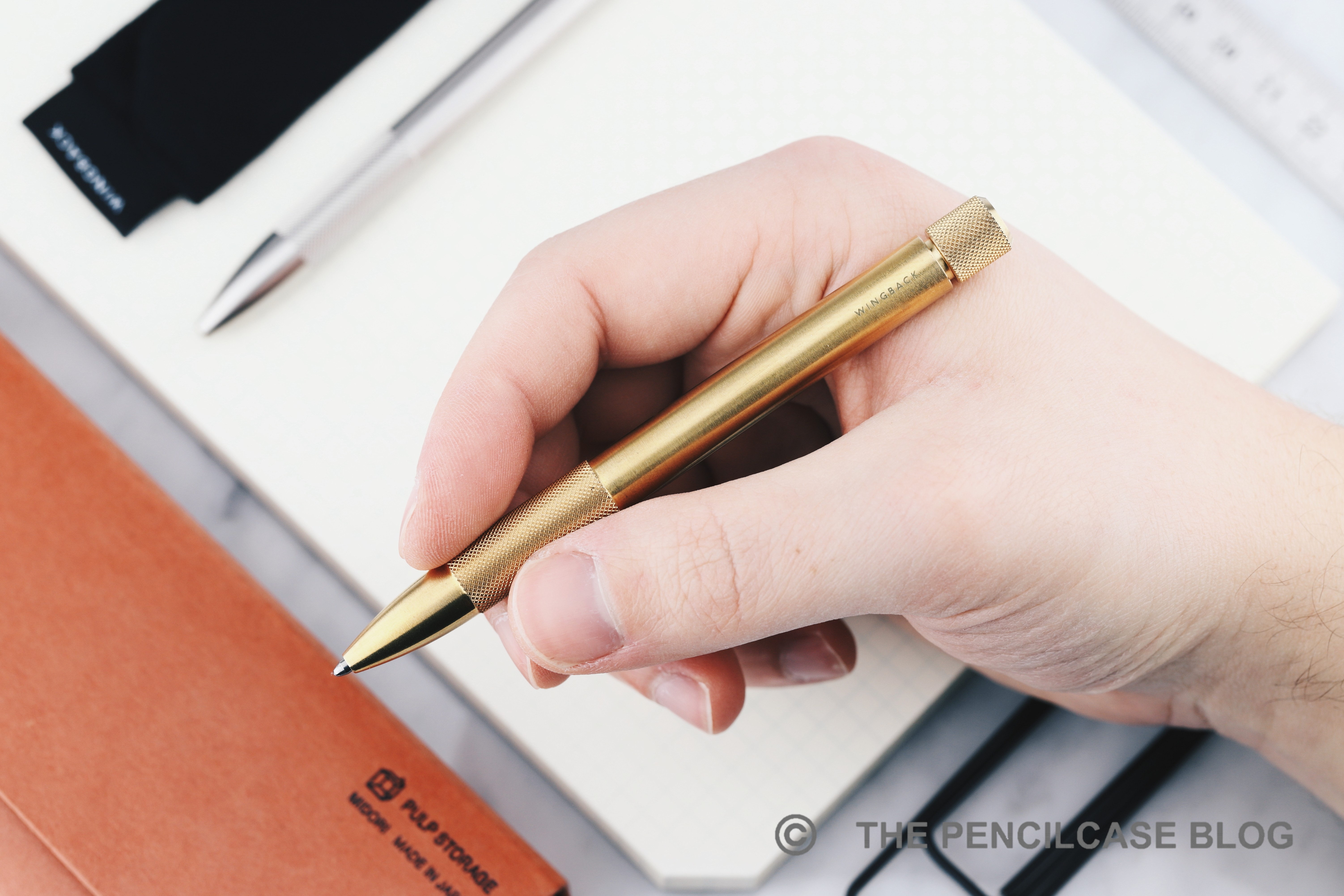
So, how 'pocketable' are we talking then? Both Mechanical Pen and Pencil share identical dimensions: 11.8cm (4.64") in length and 10 mm (0.39") in diameter. They do differ in weight, though. The pencil is the lightest, as the much larger mechanism takes up most of the internal space, whereas the pen is machined much thicker on the inside (which is what gives the pen that very dense feeling!). This translates into a weight of around 37 grams for the pencil (still by no means light for such a compact pencil!) and 50 grams for the pen. Of course, the choice between steel or brass will also make a slight difference (the brass options being heavier), though it'll only differ a few grams.

In terms of comfort, the more compact size of the Mechanical Pen and Pencil is noticeable but not bothersome. For my average-sized hands, neither pen nor pencil felt too short or uncomfortable to hold. You still get a writing experience similar to that of a full-sized pen. It's worth pointing out that the knurled section - while comfortable in diameter - sits quite far back on the barrel, so you'll tend to grip the pen a bit further back. For people with larger hands, that may make the difference between a comfortable pen, and one that disappears in your hand.
REVIEW: WINGBACK MECHANICAL PEN & PENCIL
The Wingback Mechanical Pen is outfitted with a custom-made, solid metal, twist mechanism. It unscrews at the back (which is also how you change the refill) and is held securely in place with a rubber o-ring. The mechanism turns smoothly without play and has a very satisfying snap when it clicks into place. 
REVIEW: WINGBACK MECHANICAL PEN & PENCIL
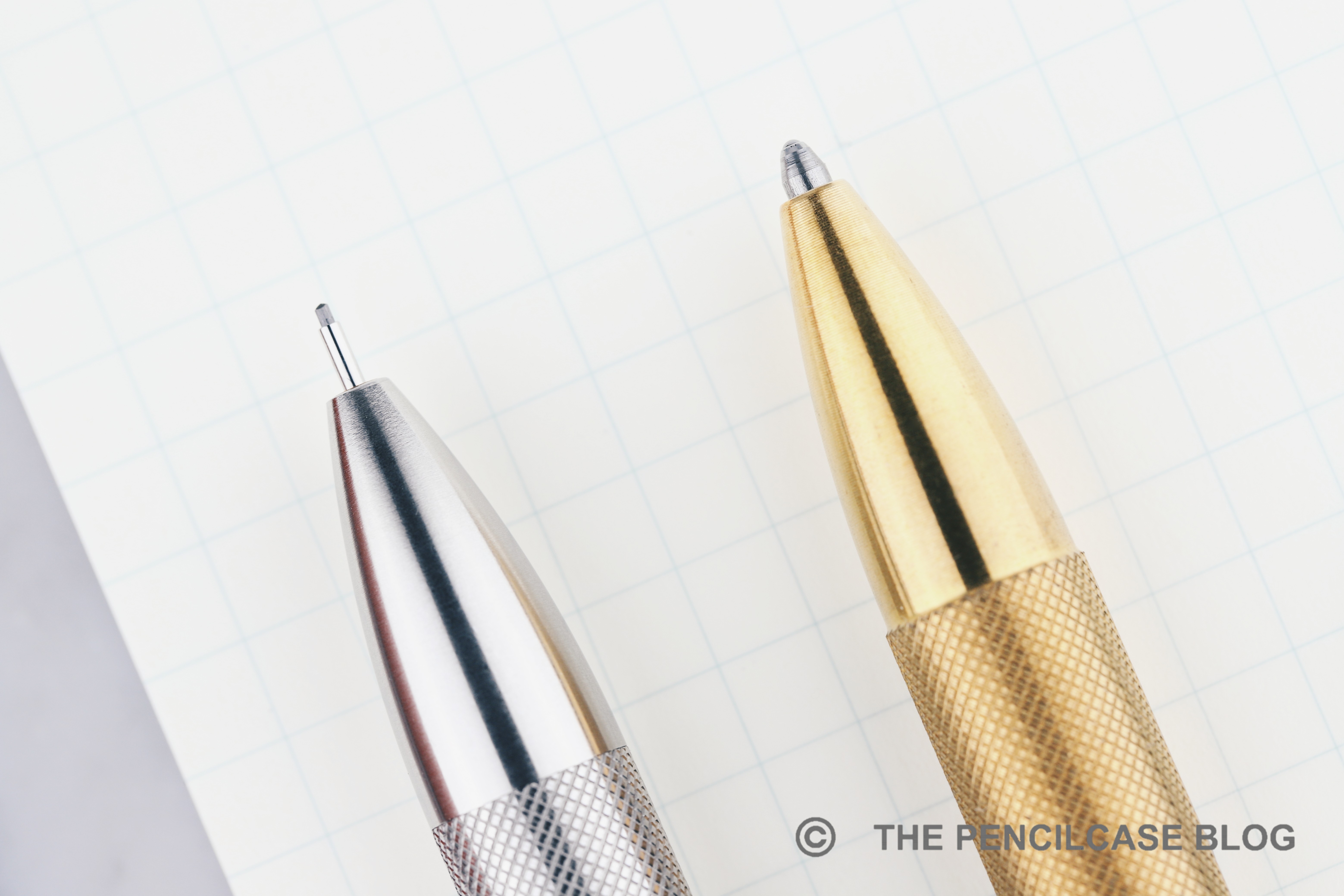
The Pen comes equipped with a pressurized ("writes in all conditions") Fisher Space pen refill, and I have to say either Fisher upped their game or I've become more lenient towards ballpoint refills because I'm quite enjoying the writing experience. Granted, I'm still not a huge fan of ballpoint refills, but this one does lay down a smooth and relatively dark line of ink. Perhaps a bit more consistent than the average ballpoint pen, though still not quite as consistent as I'd like (hence, why I gravitate towards gel refills most of the time). Unfortunately, the Fisher Space refill is proprietary, so there's not a lot of leeway in terms of alternatives that will fit in the Wingback Mechanical Pen.
REVIEW: WINGBACK MECHANICAL PEN & PENCIL
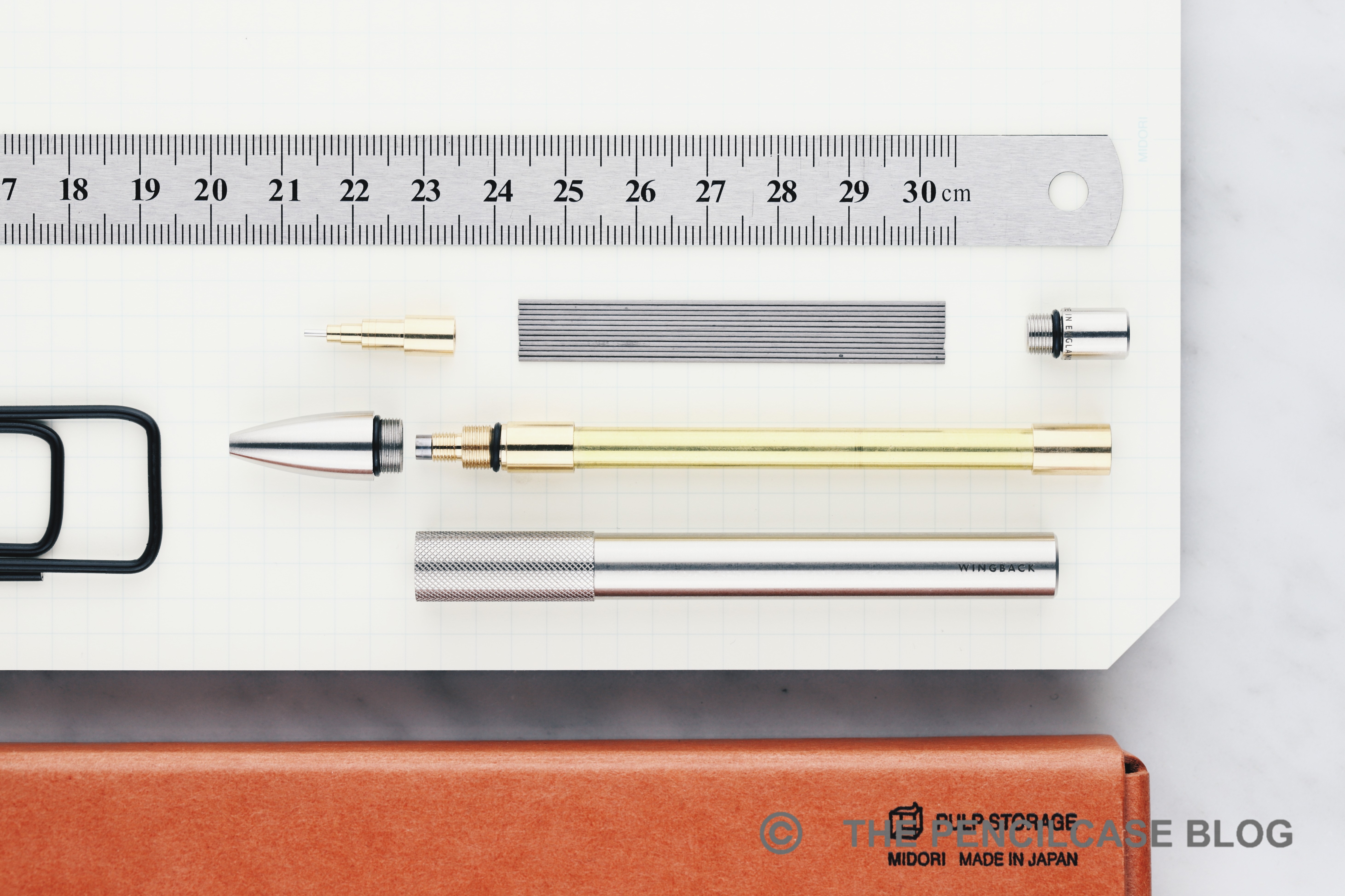
The Mechanical Pencil - just like the pen - also comes with an impressive custom-made internal mechanism. All-metal parts, again solidly put together with little to no play or rattle between the parts, and the knock has a nice soft click action. The tip also has a retractable lead pipe, an essential feature for an EDC pencil that's bound to live in your pocket. 

Refilling the pencil requires some disassembly, but Wingback deliberately designed the mechanism so that you don't have to refill it very often. The large mechanism holds an absurd amount of spare leads inside (the website says 40 pieces for the 0.7mm mechanism, which seems about right), so you can basically drop in an entire tube of fresh leads and be good to go for ages... well, depending on how much you write or sketch of course! 
REVIEW: WINGBACK MECHANICAL PEN & PENCIL
So there you have it: my first encounter with Wingback's products, and quite a positive one I must add. I appreciate their "Buy once" philosophy, and find that it is truly reflected in the impeccable production quality of their Mechanical Pen and Pencil. In terms of EDC, I have no doubt these pens will serve well for years to come. 

Pricing starts at 95 GBP (around 110€/ 120$) for either Pen or Pencil. A substantial price tag, but one that I feel is justified by the excellent build quality, and the fact that these products are made locally in the UK. The black steel version adds a specialized tungsten-carbide coating, which ups the price to a rather hefty 140 GBP (165€/ 175$)! 

As it stands, the Mechanical Pen and Pencil are the only writing-related products in Wingback's catalog, though I hope they'll expand the range further in their design style... perhaps with a full-sized pen, or even a fountain pen? That'd be neat.

Note: This product was provided by Wingback, free of charge, so I could write this review.  I was in no way influenced in the making of this review, the opinions shared in this review are completely my own! This post does not contain affiliate links.
REVIEW: WINGBACK MECHANICAL PEN & PENCIL

Monday, December 3, 2018

REVIEW: STILFORM KOSMOS TI PEN

Review: Stilform Kosmos Ti ballpoint pen
My first encounter with the German brand Stilform -a couple months ago when I reviewed the Stilform Ink (read my review HERE)- was a very positive one. And it got me really excited to try out the ballpoint pen version of Kosmos as well! 
Review: Stilform Kosmos Ti ballpoint pen
The names of both the fountain pen and ballpoint pen are quite similar, which makes sense because both the Kosmos and Kosmos Ink are based on the same concept: to build a pen around a magnetic mechanism! The design language of both Kosmos products is also quite similar. Both are characterized by a minimal design, rounded finials and cleanly chamfered edges... The result is a simple but very well-executed design. 
Review: Stilform Kosmos Ti ballpoint pen
Contrary to the Ink, it lacks the flat sides that prevents it from rolling, which I actually think could've been helpful because it rolls around like crazy (needless to say this one saw some abuse, and visited the floor a couple times). Stilform does offer a walnut pen rest, but you have to buy it separately and it's not particularly travel-friendly.

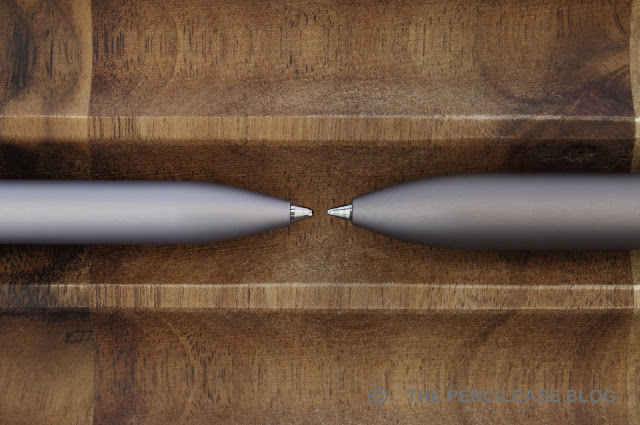
The Kosmos comes in two metal options: aluminium or titanium. I received the Kosmos Ti to review, which has a bit more heft than the aluminium option, and it comes in two finishes: polished or matte. The polished version I received is sleek and shiny, and has a very space-age feel to it. Being mirror-polished, it does pick up scratches and scuffs quite easily. After a few months of playing around with it, it's quite battle-worn, so if you don't like that, the matte version is supposedly more resistant to scratches. The two titanium parts (front section and barrel) are spaced with a black metal inner sleeve, which is part of the mechanism. When the pen is opened, it retracts, and the chamfered edges of the two titanium halves meet neatly.
Review: Stilform Kosmos Ti ballpoint pen
L to R: Baron Fig Squire Click, Karas Pen Co. Retrakt, Stilform Kosmos Ti, Lamy Safari, Lamy 2000
The Kosmos is a nicely sized pen. It feels small in comparison to other ballpoint pens, but in reality it is far from small. Measuring 13.7 cm (5.4") 'closed' and 13.4 cm (5.27") 'open', it's a decently sized pen in the hand. The profile is fairly slim, with a constant diameter of 11 mm across the entire barrel, the front section narrowing down towards the tip of the pen. The slick finish of this particular polished titanium finish in combination with the streamlined profile makes this pen somewhat slippery to hold at times, which I think may be better with the matte aluminium or sandblasted titanium options. The Kosmos Ti feels solid in the hand, at 42g. I personally like heavier pens, but if you don't, the aluminium version is a good bit lighter at 26g.
Review: Stilform Kosmos Ti ballpoint pen
The way this pen works is really cool. They have a diagram on their Kickstarter page (unfortunately I couldn't find it on their website) that shows the guts of the Kosmos, and it's actually surprisingly simple: a magnet connected to the front section and the black 'inner tube' is pushed and pulled by magnets on either side that are fixed to the barrel. When operating the mechanism, the magnets pull on the moving magnet and keep the barrel in either extended (closed) or retracted (open) position. When it works, it works really well. The magnets are really strong and you need a tight grip to open and close the pen. The action works with a very satisfying (and very loud) snap. 

But unfortunately... it doesn't always work. I tested one of the pre-production prototypes of the Stilform Ti about a year ago, and the mechanism failed after a couple days so I never got around to actually reviewing it. Luckily they seem to have fixed the issue in the production model that I have in my hands right now, which has clicked satisfyingly for months and still works just fine.

Writing with the Kosmos pen is smooth and hassle-free. I have a strong suspicion that they utilize Schmidt easyflow 9000 Parker-style refills, but it's just branded 'Kosmos' so I'm not entirely sure. In any case, it's an extremely pleasant refill, and it actually made me want to use this pen all the time. It's dark and smooth, lays down a consistent medium line. 
Review: Stilform Kosmos Ti ballpoint pen
The Kosmos Ti is an interesting piece of functional design. It's a pure, minimal pen, built around a really interesting and unique mechanism. It ticks a lot of the right boxes for me. The polished titanium finish is perhaps a bit too slick for my liking, but the excellent refill (and compatibility with a bunch of other refills) pulls the whole experience up a notch. 

The Stilform Kosmos Ti comes in at a retail price of 120€ (136$), which is exactly double the price of the aluminium Kosmos. I'm usually a big fan of titanium pens, they are strong, have a nice heft and look good while at it. But in this case, while I think the aluminium Kosmos is a pretty good deal for what you get, the premium for the titanium version might be a bit steep. 

This product was sent to me by Stilform, so I could write this review. I was in no way influenced in the making of this review, the opinions shared in this review are completely my own! This post does not contain affiliate links.

Sunday, October 21, 2018

PENS FOR SALE!

If anything, I am a straight up pen hoarder. It's true, I admit it. But the collection gets out of hand sometimes, and now is the time to do something about that. 

I listed roughly 50 fountain pens, multipens, ballpoints and pencils on my for sale page. You can check it out HERE, or under the tab 'FOR SALE'.

Feel free to contact me if you have any questions or want to make an offer, you can get in touch through email (use the email widget at the bottom of this website), or on instagram DM!

Wednesday, September 5, 2018

REVIEW: SCHON DSGN CLIP PEN

Pen review: The Schon DSGN Clip pen
I was sceptical about the Schon DSGN pen. More than sceptical really. Judging from pictures, it looked clunky and crude. Especically the section seemed like it would never in a million years be comfortable in the hand. Yet, I kept reading positive things about it online, what was it about this pen that I didn't see? 

After getting one in hand for this review, I found out what's so special about this little pen, and I had to thoroughly re-evaluate my opinion (this seems to be a recurring trend with many products I review...). 
Pen review: The Schon DSGN Clip pen
The Schon DSGN Classic pen (or Clip, depending on your choice of clipped/clipless) in a neat box that folds open to reveal the pen with its 'buyer's card' accompanying it. I had a little WOW moment when I first opened it, because the pen itself is sooo much tinier than I expected! It's often quite difficult to judge a pen based on measurements you find online, but in this case I completely missed the ball. 

Anyway, we'll come back to the size later. Let's focus first on the design, because the moment I held the Schon Clip pen in my hands, I started to appreciate the design choices that Ian (founder of Schon DSGN) made. It doesn't look crude or clunky in person. Very industrial, yes, but you can clearly see the thought that went into this -seemingly- simple pen. 
Pen review: The Schon DSGN Clip pen
Symmetry is key!
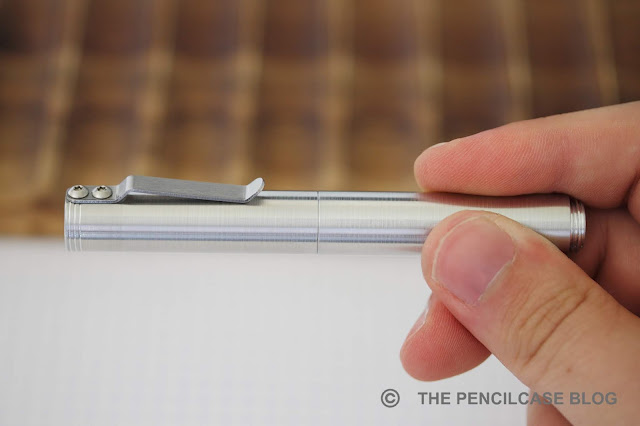
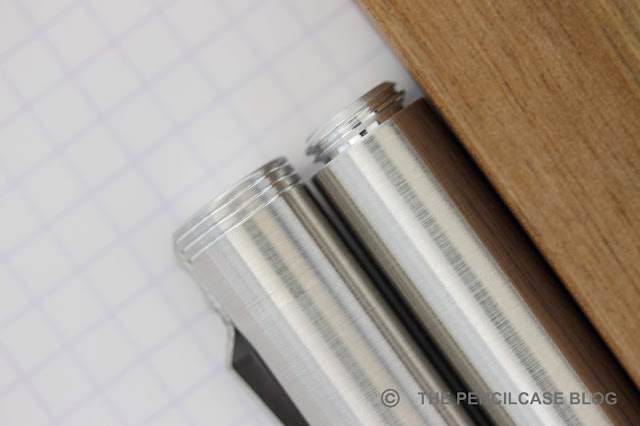
It's a straight, flattop, cylindrical pen from the outside, so nothing too spectacular per se. But as is the case so very often: the devil is in the details! The body of the pen is equal in length to the the cap, and to enhance the symmetry between both parts, the three grooves near the cap finial mimic the the threads at the back of the barrel. Nifty!
Pen review: The Schon DSGN Clip pen
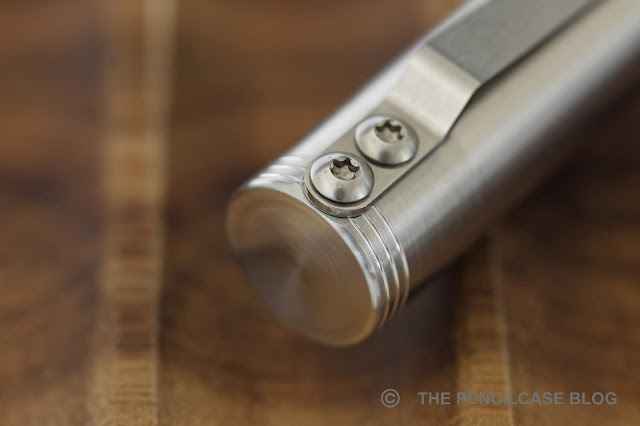
The folded steel clip is very similar to those used by Karas Pen Co., which is a sound choice for EDC-focused pens, and continues the industrial look. Different to the one found on Karas pens, the Schon pen features a narrower clip, which looks elegant but is also a bit easier to use because it's less stiff. The clip is bolted to the top of the pen, almost flush with the cap finial, so the pen doesn't stick out too far if you wish to pocket carry. 
Pen review: The Schon DSGN Clip pen
Underneath the cap, you'll find a slender but very long section, which ends in a short and stubby nose cone. The block threads are really short and placed towards the back of the section, closely followed by a rather large step. All these aspects together make for a rather interesting section that looks a bit out of proportion, but it really isn't. My only gripe would be that the nose cone is a bit too stubby, making it hard sometimes to see what you are writing.

The back of the barrel has the same short block threads which allow the cap to post. It looks like a cross-threading nightmare, but to my surprise that only happened occasionally. Most of the time, the cap and barrel align itself quite well and thread together smoothly. 
Pen review: The Schon DSGN Clip pen
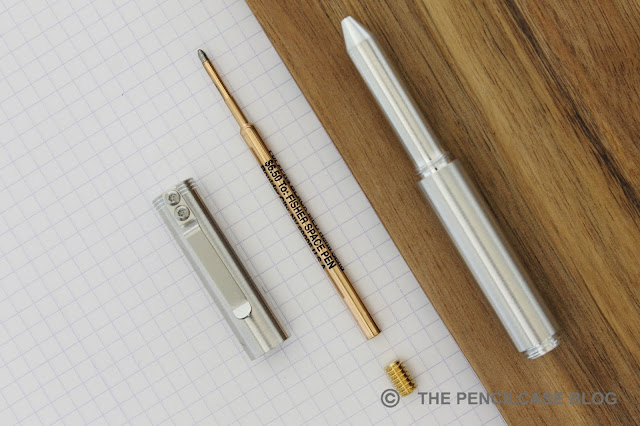
The Schon DSGN pens don't dissasemble near the section, like most pens do. Instead, you'll find a brass set screw at the back finial, which you have to unscrew to change the refill. I like this quirky design element, and I particularly like that all pens (various different materials, from stainless steel, brass or copper to annodized aluminium) come with the same brass screw, almost like a maker's signature.
Pen review: The Schon DSGN Clip pen
The set screw has one downside however: changing the refill means you have to have a flathead screwdriver handy. The Clip pen takes care of that, as the the tip of the clip is pointed upwards just enough to use it as a screwdriver! I wouldn't suggest using the clip for DYI jobs, but just for this task, it works perfectly. 
Pen review: The Schon DSGN Clip pen
L to R: Kaweco Al Sport, Lamy Pico, Baron Fig Squire Click, Inventery Pocket fountain pen, Schon DSGN Clip pen, Lamy Safari, Lamy 2000
At 10.2 cm (4") closed, 14.6 cm (5-3/4") posted and with a diameter of 1.3 cm (1/2"), these are definitely pocket pens. They have a surprisingly good heft to them, at 34g (1.2 oz) for the aluminium Clip version (up to 93g/3.3 oz for the solid copper versions!). 

It's obviously not meant to be used unposted, because it will literally dissapear in your hand. But with the cap posted, it transforms into a surprisingly comfortable full-sized writer. The section may be slender, but because it's long, it does a good job keeping my grip away from the threads and step. So while it may not seem comfortable at first, it's actually quite enjoyable to use for such a compact pen.
Pen review: The Schon DSGN Clip pen
The refill closes the deal for me, as Ian chose to make his pens compatible with the popular Fisher Space gas pressurized refill. These are excellent ballpoint refills. They are well-behaved and put down a smooth and relatively dark line that is as consistent as ballpoint pens go. Apart from that, it obviously has the advantage of being perfectly usable in wet, cold or hot environments, on difficult surfaces or even upside down. The choice of refill makes this pen all the more appropriate for EDC use. The only downside is that the refills are smalL, and quite expensive.
Pen review: The Schon DSGN Clip pen
To round up, the Schon DSGN Clip is a pen that does things right; It's clear aim at EDC use reflects in every aspect, from the durable build, practical size, strong clip,...all the way to the quality Fisher Space refills. I've followed Ian and his brand for many years (despite never pulling the trigger on one of his pens) and I know how anal retentive he is about quality and even the smallest of details (Talking about details: check out his drop-dead gorgeous handmade watches at Schon Horology! Expensive, but holy cow they are cool!). 

Ian persuaded me about his product, I have to admit I'm now one of the bloggers that will tell you this is an amazing pen. Yes, the price is a bit higher compared to the rest of the market, but that seems to be a recurring theme with made in the USA, EDC goods, and there is clearly a market for these high-quality products. If you want an excellent EDC pocket pen, and are willing to invest, watch the Schon DSGN pen!

This product was sent to me by Schon DSGN so I could write this review. I was in no way influenced in the making of this review, the opinions shared in this review are completely my own! This post does not contain affilate links.
Pen review: The Schon DSGN Clip pen

Saturday, September 1, 2018

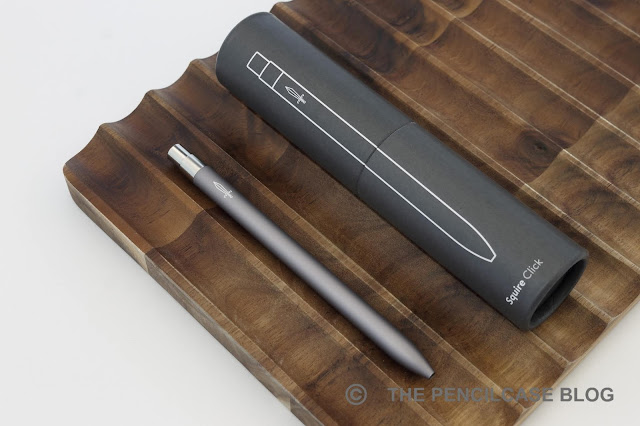
REVIEW: BARON FIG SQUIRE CLICK BALLPOINT PEN

Review: Baron Fig Squire Click ballpoint pen
The Squire from Baron Fig (read my review here) has quickly become a staple within the community. For good reason of course, as it is a superb pen all around. But when Baron Fig announced a new iteration of the Squire: the Squire Click, I was left with slightly mixed feelings. I loved the idea of a knock mechanism, but at the same time it seemed to lose a bit of the clean look of the Squire's design.

But as always, it's quite difficult to assess a product just from photos online. So my thoughts changed when I got one in hand for review -thanks Baron Fig!
Review: Baron Fig Squire Click ballpoint pen
I was still a bit unsure about how I felt about the design choice of using a standard Schmidt knock mechanism, although I do like that the barrel and knock sit flush against each other. When you pick up the pen, you'll notice that it slimmed down a bit compared to the regular Squire. Basically what they did is remove the taper towards the front of the pen so the diameter is now uniform across the entire length of the pen. Without that teardrop shape, the Squire click lost some of the character that the original Squire had, but it's still a good looking minimal pen.
Review: Baron Fig Squire Click ballpoint pen
L to R: Kaweco Al Sport, Riind The Pen, Karas Pen Co. Retrakt, Baron Fig Squire, Baron Fig Squire Click, Lamy 2000, Lamy Safari
At 12.7 cm (5"), it's the same length as the Squire. The barrel diameter was reduced from 10 mm (0.40") to 9 mm (0.35"), which doesn't sound like a lot but it's easily noticeable when you hold them side by side. They also cut the weight by 4 grams, from 24g to 20g. Overall the differences are relatively small, but surprisingly they create a very different experience in use.
Review: Baron Fig Squire Click ballpoint pen
The Click lost a little weight around the front of the pen
Whereas the regular Squire is IMHO a 'comfortably slim' pen, the click is a bit narrow for my taste. I did get used to it after a while, but I won't say it's the most comfortable pen ever. The size makes it ideal as an agenda pen, and it fits perfectly into a journal pen loop without adding bulk. 

Now here's the weird part: after a good while of use, the Squire Click actually grew on me...a lot! So get this, the size may make it a bit less comfortable, but it also makes it extremely versatile in use: Throw it in a backpack, pants pocket, notebook pen loop,... it's small and thin but still long enough to sit comfortably in the hand. 
Review: Baron Fig Squire Click ballpoint pen
Frankly, the stock Schmidt knock mechanism is a lot easier and faster to operate than the custom machined twist mechanism on the Squire. The obvious trade-off is that it doesn't look as clean and minimal.
Review: Baron Fig Squire Click ballpoint pen
The Schmidt Easyflow 9000 may be one of the greatest parts about the Click!
Surprisingly, the Click comes with a different refill, which helps differentiate it from the regular Squire in the Baron Fig lineup. Inside the Click, you'll find a Schmidt Easyflow 9000 ballpoint refill (instead of the rollerball refills in the regular Squire). I really enjoy the change, especially because the Easyflow 9000 is a fantastic refill that combines the good sides of both ballpoint and rollerball refills. It lacks the bleedthrough issues that rollerball refills sometimes have, but the medium line is dark, consistent and smooth. Only issue I found is that it sometimes seems a bit more prone to smudging.
Review: Baron Fig Squire Click ballpoint pen
It honestly took me a while to make up my mind on the Squire Click. The slimmer barrel is not my favorite, and the design is a bit less sleek because of the standard knock mechanism (maybe something to custom-machine in the future?).

On the plus side, the slimmer form factor makes it even more portable than the regular Squire, and the knock mechanism is more practical in use. Oh, and the ballpoint refill it comes with is straight up fantastic. The price point of the Squire Click is very reasonable too. At 45$ it's not too precious for everyday use, and it's an ideal pen to throw into your bag, purse, pants pocket...

This product was sent to me by Baron Fig so I could write this review. I was in no way influenced in the making of this review, the opinions shared in this review are completely my own! This post does not contain affilate links.
Review: Baron Fig Squire Click ballpoint pen

Monday, August 6, 2018

REVIEW: KARAS PEN CO. REAKTOR GALAXIE (XL) & STARLINER (XL)

Karas Pen Co. Reaktor Galaxie ballpoint, Galaxie XL rollerball & Starliner (XL) fountain pen review and comparison post
As you've most likely seen more and more reviews of the brand spanking new line of Karas Pen Co. products -The Reaktor (Stage 1) pens- pop up, I figured it was about high time to drop in my own 2 cents about them. I was lucky enough to get their entire product line sent over, and I think by now I've spent enough time with them to give you my final verdict. The Reaktor product line can be broken up into four products (for now, as there will likely be more products added later on): the Galaxie, Starliner, Galaxie XL and Starliner XL. 

I'll be doing things a bit differently than most other reviewers who discussed each pen separately. Instead, this post will be both a review and comparison of all four models, to show the differences and similarities between the various types. This might become a rather lengthy review... so let's get right to it!
Karas Pen Co. Reaktor Galaxie ballpoint, Galaxie XL rollerball & Starliner (XL) fountain pen review and comparison post
Karas Pen Co. (aka. Karas Kustoms) has had quite an impressive track record so far, with some hugely popular pens like the Render K, Retrakt (reviewed HERE) or Ink. But looking at their latest releases, they are clearly taking a new direction to diversify their offerings. They used to focus primarily on the EDC community, with big, heavy and tough machined metal pens. Since last year they threw in the new Signature line of pens, with the fantastic Decograph (that I reviewed HERE) and now the Vertex (which premiered at the DC pen show last weekend). A third line was launched last week with the Reaktor and its first two products: the Galaxie XL and Starliner XL (the regular Galaxie and Starliner pens will be released later this month).

With stage 1 of the Reaktor pens, they are filling a gap in the lower-end product lineup, providing a cheaper alternative that retains the 'made in the USA' quality. Sort of a gateway drug into the hobby. As I mentioned earlier, the first stage of the Reaktor product line includes four different pens available in four colorways, making for a total of 16 different configurations. 
Karas Pen Co. Reaktor Galaxie ballpoint, Galaxie XL rollerball & Starliner (XL) fountain pen review and comparison post
Interestingly, the fountain pens (Starliner) and rollerball/ballpoint pens (Galaxie) each have their own design style, although they follow the same general form factor for the most part. Karas relies heavily on vintage 'Americana' influences for the Reaktor series. Both the Galaxie and Starliner found their inspiration in the space race and automotive industry (both pens being named after Ford cars), which reflects in certain prominent design features, as well as more subtle details.
Karas Pen Co. Reaktor Galaxie ballpoint, Galaxie XL rollerball & Starliner (XL) fountain pen review and comparison post
Cap and barrel details of the Galaxie
The Galaxie and Galaxie XL are immediately recogniseable by its intricately CNC'd cap finial, which represents hose fixtures found on space suits (take a look at this space suit from Buzz Aldrin, and you'll also see where they got the inspiration for the anodizing colors, not coincidentally also the colors of the US flag!). 
Karas Pen Co. Reaktor Galaxie ballpoint, Galaxie XL rollerball & Starliner (XL) fountain pen review and comparison post
3...2...1 LIFTOFF!
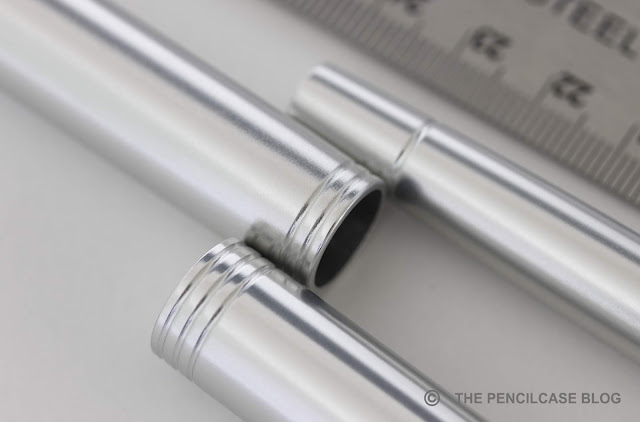
The Starliner and Starliner XL have a more subtle, but stately flat-top design. The cap and barrel finials have a subtle point machined in them, which bounces off the light to mimic the glint of a star (I think it kind of looks like the gravitational field of a star... I'm a geek, lol). The Starliner also includes a cool reference within the rings engraved all over the pen: 3 on the cap finial, 2 at the base of the cap and 1 at the back of the barrel. 3...2...2 LIFTOFF!

The overall shape of the pens is the same for both models: flattop with an oversized cap and narrower, strongly tapered barrel. The proportions are admittedly a bit quirky and unusual, which makes these pens immediately recognizable. 
Karas Pen Co. Reaktor Galaxie ballpoint, Galaxie XL rollerball & Starliner (XL) fountain pen review and comparison post
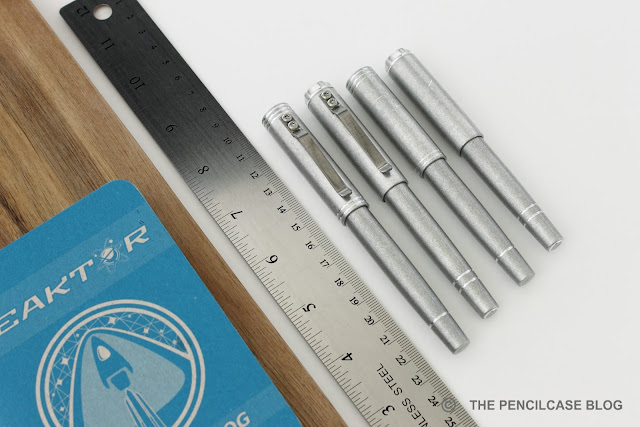
Then there's the two sizes that you can choose from: regular or XL. Apart from the obvious difference in size, the XL also differs because of the sprung steel clip. The smaller size is made to carry inside your pocket, while the XL can be attached to your pocket. Both pens are actually fairly compact. But the smaller model is a 'true' pocket pen that is extremely comfortable to just throw in your pocket and always have with you, whereas the XL is a more full-sized pen.

The Galaxie and Starliner are the first Karas pens that feature a snap cap. The mechanism is simple: a rubber o-ring inside the cap provides a 'bump' on which the flared edge of the section catches. Even though it's a somewhat unconventional mechanism, it works surprisingly well. The cap opens and closes with a reassuring 'snap' and I never worried that the cap may pop off inside my pants pocket. Worth pointing out is that the closure mechanism does allow for some side-to-side wiggle. The cap rattles a tiny bit, although I expected much worse.
Karas Pen Co. Reaktor Galaxie ballpoint, Galaxie XL rollerball & Starliner (XL) fountain pen review and comparison post
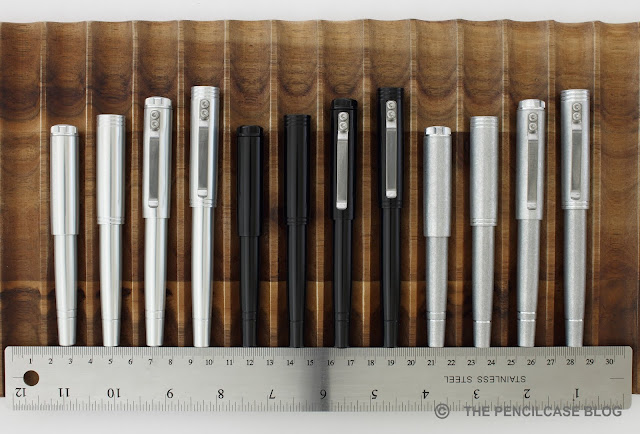
Silver - Black - Tumbled Raw
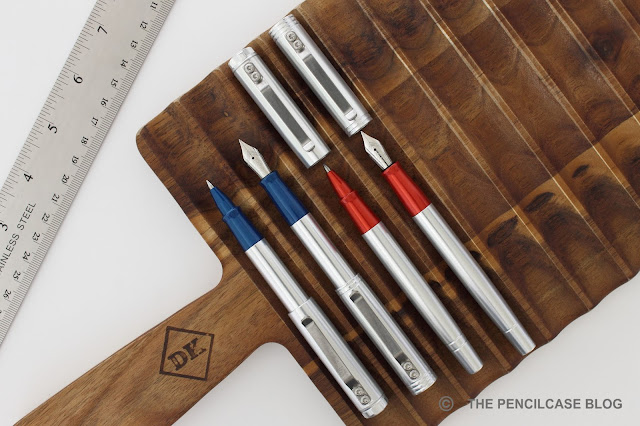
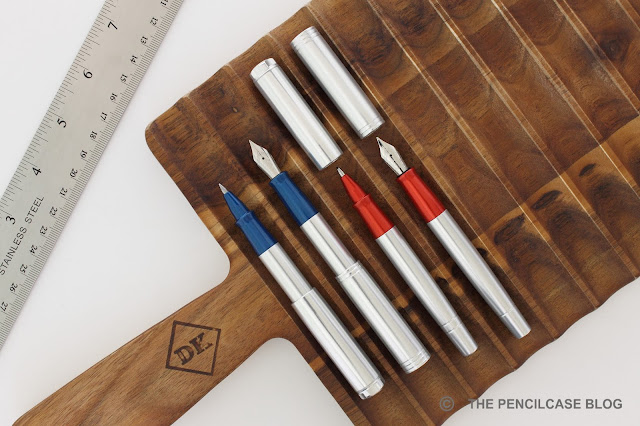
Because these pens sit at an entry-level price point, the material and finish options are restricted to aluminium in either silver or black anodized finish, or a tumbled finish. The silver annodised version is available with a blue or red anodized grip section to give a total of four colorways to choose from. I'm personally a big fan of the tumbled and black anodized finishes. The reasoning behind this narrowed down offering is simply to cut on production costs.
Karas Pen Co. Reaktor Galaxie ballpoint, Galaxie XL rollerball & Starliner (XL) fountain pen review and comparison post
L to R: Schon DSGN The Clip, Karas Pen Co. Fountain K, Karas Pen Co. Retrakt, Karas Pen Co. Galaxie XL/Starliner XL/ Galaxie/Starliner, Lamy Safari, Lamy 2000
Karas Pen Co. Reaktor Galaxie ballpoint, Galaxie XL rollerball & Starliner (XL) fountain pen review and comparison post
Galaxy and Starliner, posted and unposted
Karas Pen Co. Reaktor Galaxie ballpoint, Galaxie XL rollerball & Starliner (XL) fountain pen review and comparison post
L to R: Galaxie, Starliner
The Galaxie ballpoint pen and Starliner fountain pen are pocket-sized pens, and measure 11cm (4.3") and 11.5cm (4.5") respectively when closed. Uncapped, both pens drop below 11cm, which is too short for anything but a quick jot. The cap posts securely with a firm push, and the o-ring inside the cap holds it in place. The cap posts deeply onto the barrel, making for a total length of 11.5cm (4.5") for the Galaxie and 12.5cm (4.9") for the Starliner. Both pens weigh in at 24g total, which is not particularly heavy, but enough to give a solid feel in the hand.
Karas Pen Co. Reaktor Galaxie ballpoint, Galaxie XL rollerball & Starliner (XL) fountain pen review and comparison post
Galaxie XL and Starliner XL
The larger Galaxie XL rollerball and Starliner XL fountain pen receive a modest bump in length: 12.3cm and 12.8cm respectively. Uncapped, the Galaxie XL rollerball is a bit short for me, measuring 11.6cm (4.56"), but the Starliner XL fountain pen has a slightly longer section which brings up to a more comfortable length of 12.5cm (4.9"). Posted, both pens have a comfortable length (12.9cm/5.1" for the Galaxie XL and 13.7cm/5.4" for the Starliner XL), and the oversized cap gives it a more central-weighted feel in the hand. The clip and slightly larger dimensions increase the total weight to 29g, which is still relatively lightweight.
Karas Pen Co. Reaktor Galaxie ballpoint, Galaxie XL rollerball & Starliner (XL) fountain pen review and comparison post
L to R: Galaxie XL, Galaxie XL posted, Starliner XL, Starliner XL posted
All four pens have a similar section shape, but the Starliner fountain pens have the advantage of a slightly longer section. The widest part of the section measures 1.1cm (0.43"), and tapers down strongly towards the nib, where it flares out again to provide a secure grip. The section design, combined with the lack of threads and a smooth transition from barrel to section, makes the Galaxie and Starliner pens all extremely comfortable and balanced writers. Granted, the regular Galaxie and Starliner HAVE to be posted to comfortably fit my hand, whereas the XL's are comfortable either way.
Karas Pen Co. Reaktor Galaxie ballpoint, Galaxie XL rollerball & Starliner (XL) fountain pen review and comparison post
The Starliner pens use 076 nib units from Bock. L to R: Bock #5, Bock 076, Bock #6
New for Karas pens are the Bock 076 nibs used on the Starliner fountain pens. Up until a month or two ago, I had only seen this nib size on the TWSBI 580. And now in a relatively short time, both the Stilform Kosmos Ink (reviewed HERE) and these Starliners make use of them. In size, the 076 sits in between the #5 and #6, but shares the housing with the #5 nibs so these are interchangeable.
Karas Pen Co. Reaktor Galaxie ballpoint, Galaxie XL rollerball & Starliner (XL) fountain pen review and comparison post
In terms of performance, I'd also rate them in between the #5 and #6. I'm not a huge fan of the small #5 because I find the ink flow can sometimes be a bit unpredictable. The nibs on the Starliner are smooth and responsive, all the way from EF to B. The ink flow seems better and more consistent than on the #5's. I really enjoyed using these pens for EDC, and never had issues with any of them (the rubber o-ring also does a pretty good job keeping the nib from drying out). Bock nibs are often criticized for being lackluster, but they get the job done just fine. 
Karas Pen Co. Reaktor Galaxie ballpoint, Galaxie XL rollerball & Starliner (XL) fountain pen review and comparison post
The Galaxie and Galaxie XL use different refills. Where the Galaxie is meant as a ballpoint, and utilizes the Parker-style G2 refills, the XL can accomodate the larger Pilot G2 rollerball refills. The Galaxie comes loaded with a Schmidt Megaline P950 medium refill in black. This pressurized refill works well and lays down a line that is relatively dark and consistent. I personally prefer the Schmidt Easyflow 9000 which are smoother and darker (although more prone to smearing). But of course you can swap the refill out for whatever suits you best. 
Karas Pen Co. Reaktor Galaxie ballpoint, Galaxie XL rollerball & Starliner (XL) fountain pen review and comparison post
The Galaxie XL comes with a 0.5mm Pilot G2 refill in black, which is an excellent refill for my taste. It works consistently in my hands , and lays down a crisp line that suits my needs just fine (some prefer the finer 0.38mm tip size). 
Karas Pen Co. Reaktor Galaxie ballpoint, Galaxie XL rollerball & Starliner (XL) fountain pen review and comparison post
Karas wanted to fill a gap in the low end of their catalog. And if you ask me, they did a great job filling the vacancy with this new Reaktor line. The Reaktor pens start at 40$ for the Galaxie, and go up from there (45$ for the Galaxie XL, 50$ for the Starliner and 55$ for the Starliner XL), which even includes domestic shipping! These pens offer incredible value for money at a price point previously unseen on the market of USA-made metal pens. 

Does that mean they had to chimp on quality? I don't think so. They managed to cut costs by implementing some clever tricks: a smaller nib, only one material and four finishes (specifically those finishes that are easiest to manufacture consistently, to minimize losses through faulty parts). You also won't find the regular packaging here, but instead the pens will come in color-coded pen tubes, which are cheaper and easier to ship because they are smaller.

Along with the recent Signature line, the new Reaktor pens prove that the people at Karas Pen Co. are working hard to bring products to the market that diversify their offerings, which will appeal to a wider audience. In this case, the Galaxie and Starliner are fantastic options for people that are just starting out in the hobby, or if you are looking for a cheap but durable EDC option.

This product was sent to me by Karas Pen Co. so I could write this review. I was in no way influenced in the making of this review, the opinions shared in this review are completely my own! This post does not contain affilate links.
Karas Pen Co. Reaktor Galaxie ballpoint, Galaxie XL rollerball & Starliner (XL) fountain pen review and comparison post