Showing posts with label made in USA. Show all posts

Wednesday, September 7, 2022

REVIEW: MODERN FUEL BOLT ACTION PEN

REVIEW: MODERN FUEL BOLT ACTION PEN, THE PENCILCASE BLOG
Several years ago I reviewed (HERE) a then-Kickstarter project for what was - and continues to be - arguably the most overengineered mechanical pencil I've ever seen, by US-based brand Modern Fuel. The precise machining and meticulous details of the Modern Fuel Pencil got me hooked. While their products aren't exactly cheap, I do feel confident that they are as close to heirloom quality as they get. I was really curious to find out if the same would hold true for their newer products, in particular the Modern Fuel Bolt Action pen. (Spoiler alert: it does!)
REVIEW: MODERN FUEL BOLT ACTION PEN
Designwise, Modern Fuel has a set-in-stone design language: sleek and clean aesthetic that runs across all of their products. While I compared mechanical pencil to an overengineered version of the Bic pencil, that comparison obviously doesn't hold true for the Bolt Action pen, but through the same, straight cylindrical profile, same thickness, tip shape and almost identical length, it's not hard to see where the design inspiration comes from. The entire pen received a hand-brushed finish, which adds a bit of random texture to the otherwise clean and modern look of the pen.
REVIEW: MODERN FUEL BOLT ACTION PEN
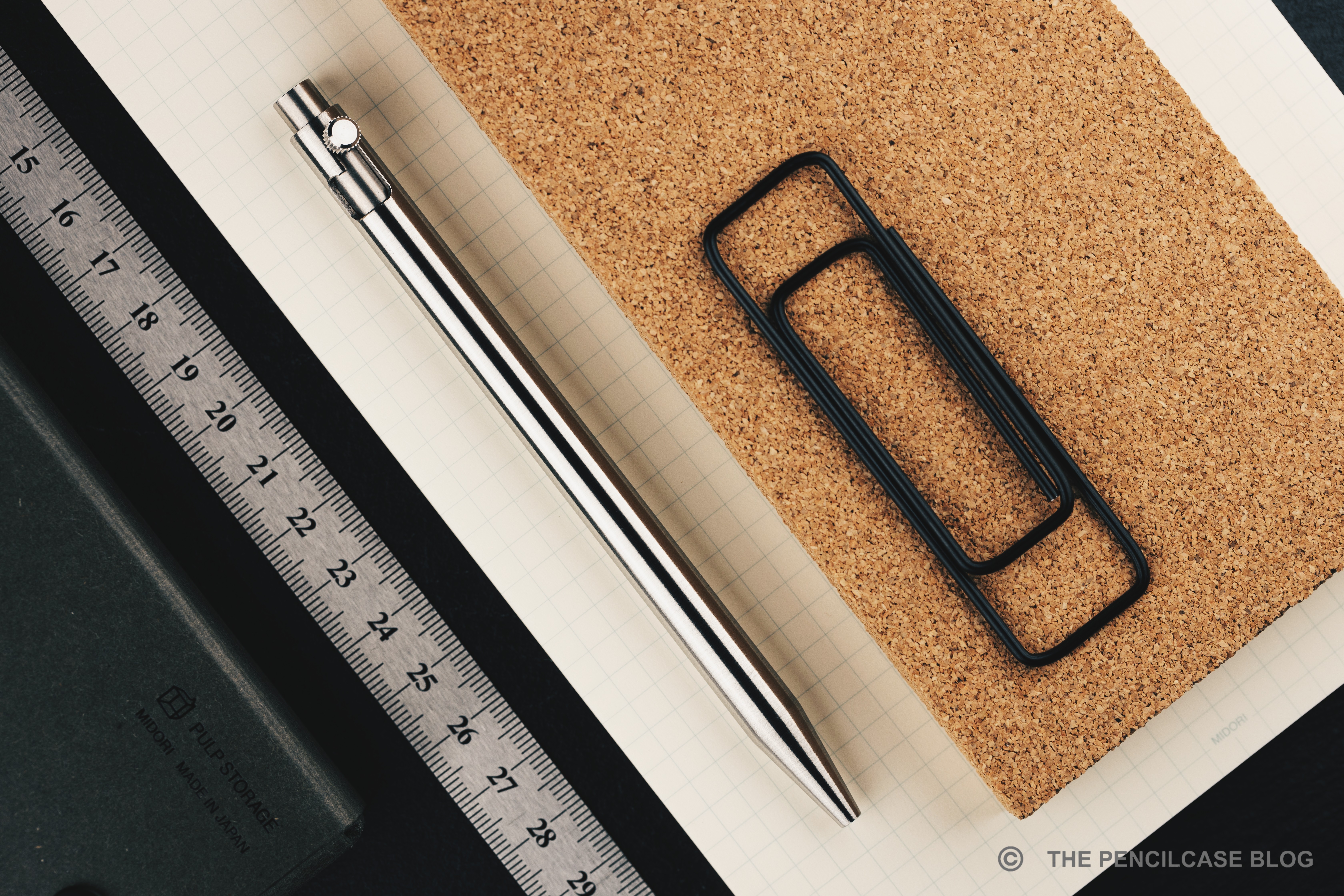
Other than that, the Bolt Action shares a very similar shape with Modern Fuel's own ballpoint 'Pen'. It has a j-shaped cutout for the bolt mechanism (obviously), but also a knock button on the back. 
REVIEW: MODERN FUEL BOLT ACTION PEN
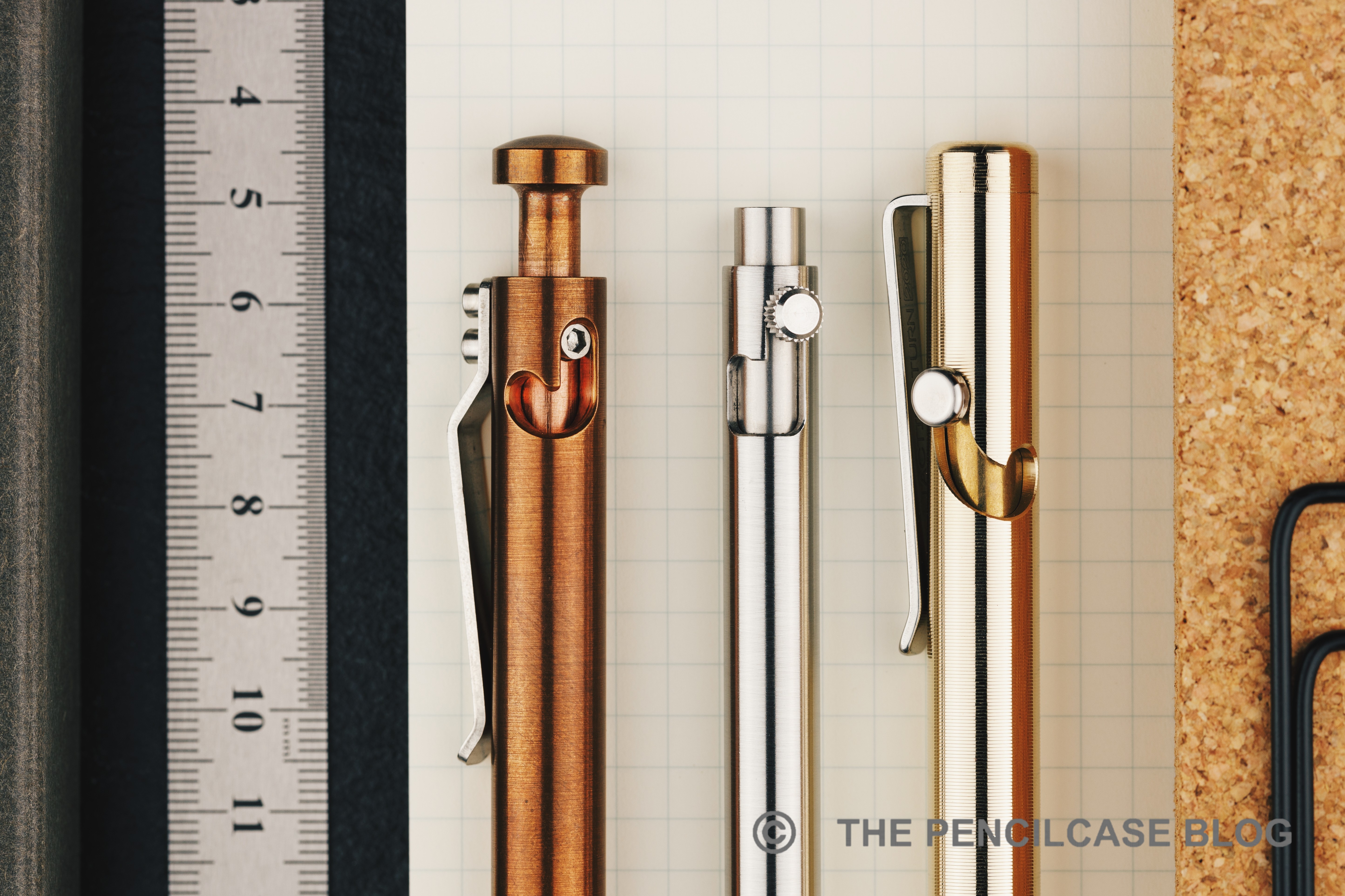
The Modern Fuel Bolt Action's mechanism is essentially a hybrid between those found on the Karas and Tactile Turn Bolt Action pens
However, unlike the Karas Bolt Action pen, the knock doesn't serve an actual purpose (other than aesthetics). It completely retracts into the body when you engage the pen (and sits perfectly flush - a really nice detail!), making it impossible to activate the bolt-action mechanism just by pressing the knock. You'll really want to use the actual bolt for that. The bolt itself is a small cylindrical button with very crisp knurling on the side, almost like a small cog (The knurling actually serves a dual purpose!). The mechanism has surprisingly little travel, so it engages quickly with one swift motion.
REVIEW: MODERN FUEL BOLT ACTION PEN
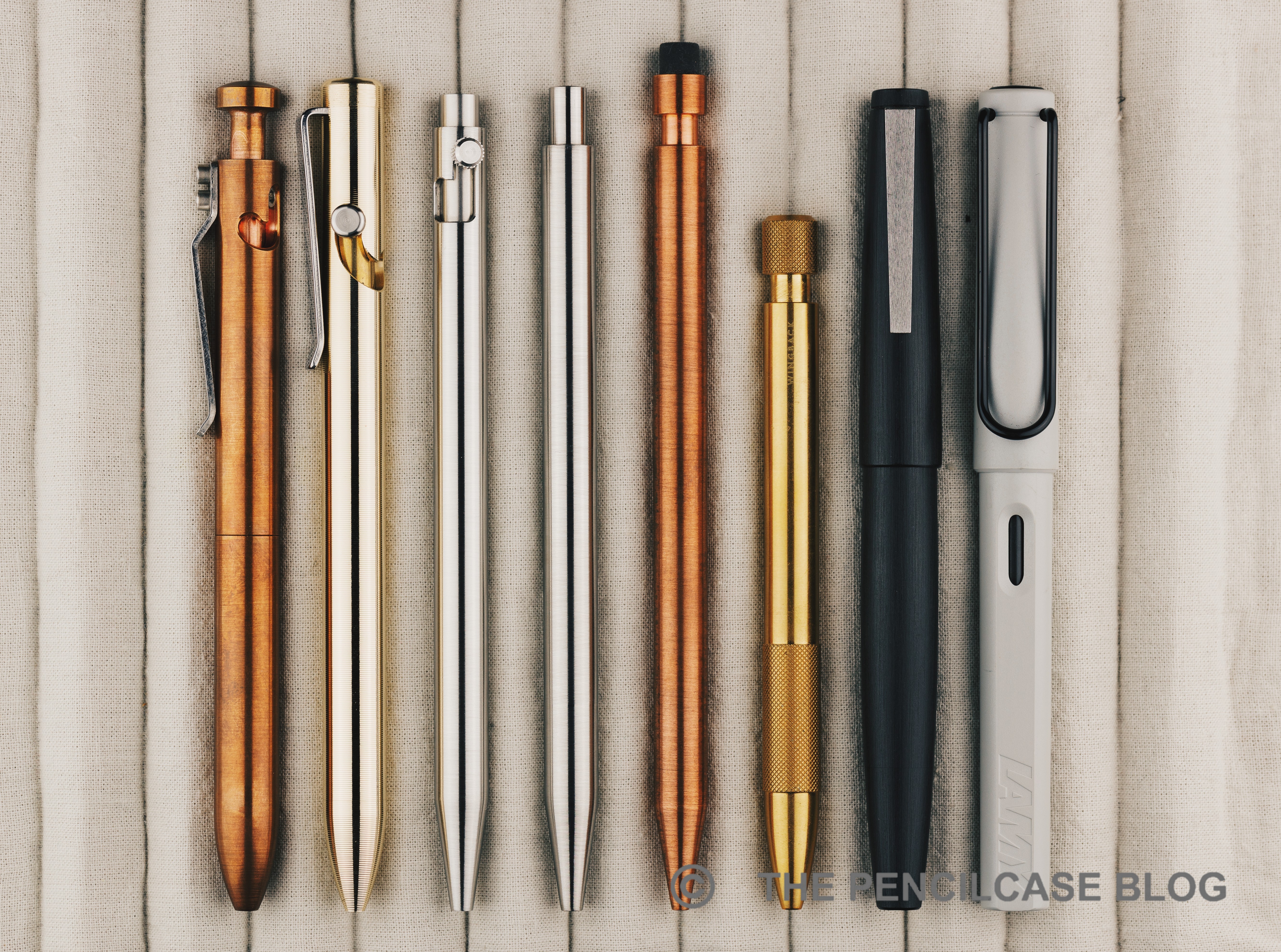
L to R: Karas Bolt Action, Tactile Turn Bolt Action, Modern Fuel Bolt Action, Modern Fuel Pen, Modern Fuel Pencil, Wingback Mechanical Pen, Lamy 2000, Lamy Safari
REVIEW: MODERN FUEL BOLT ACTION PEN
The Bolt Action looks nimble, mostly thanks to the fairly slender design (9.3mm/ 0.37"). It measures 13.8 cm/ 5.43", down to 13.6 cm/ 5.73" when the bolt mechanism is engaged, so it's definitely a full-sized pen, just noticeably narrower than some of the competition (by comparison, the Tactile Turn Bolt is 11mm). All Modern Fuel products are available in either stainless steel, titanium, bronze, or copper. I was sent the steel version of the Bolt Action, which weighs 36 grams. It strikes a good balance between feeling solid yet nimble in hand. Interestingly, no weight measurements are given on Modern Fuel's website, but according to my guesstimate calculations, the titanium version should come in around 20 grams, with the bronze and copper versions both around 40 grams.
REVIEW: MODERN FUEL BOLT ACTION PEN
Machining is top-notch on this pen. Nothing rattles around when you write, and the tolerance on the tip is so small that there's almost no wiggle room for the refill. Same can be said for the bolt-action mechanism, which fits precisely in the barrel, yet moves smoothly up and down and engages with a satisfying 'snick'. The bolt is fun to play with, but the knurled edges are quite sharp so you do feel that on your finger after a while (maybe to prevent you from getting distracted for too long!)
REVIEW: MODERN FUEL BOLT ACTION PEN
Modern Fuel's Bolt Action pen is much sleeker and low-profile than comparable Tactile Turn (top) or Karas Pen Co (bottom) offerings
Modern Fuel ships this pen with a Pilot G2 refill as standard. I like the G2 refill a lot, but the Modern Fuel Bolt Action is also a very nice housing for it. It's a massive departure from the chunky and heavy copper Tactile Turn Bolt Action (the older-style Glider) that I daily. And it looks super sleek on the desk. While I'm personally not particularly bothered by it, the biggest complaint could be the all-smooth metal barrel. While the brushed finish adds a little to the grip (it's better than a polished metal finish), it can still become a bit slippery after a while.
REVIEW: MODERN FUEL BOLT ACTION PEN
When I say this pen is over-engineered, I mean it! The Bolt Action pen arrives with an 11-page manual, and you'll probably want to hang on to it. Like with the pencil, part of the beauty of Modern Fuel's products is that there's no obvious way to disassemble the Modern Fuel Bolt Action. The body and tip are all a single piece of metal, so the only way to get to the refill is through the mechanism. But how? Well, included in the box are a few small parts (all metal, by the way!), including a little wrench with what looks like a geared hole on one end. That hole fits precisely on the cog-shaped bolt to help unscrew it, and out pops the entire mechanism. 

The biggest engineering feat is that, despite it being such a slender and seemingly simple pen, the Bolt Action can accommodate anything from a Fisher Space or standard Parker G2, up to refill types that are even longer than a Pilot G2 (think: certain rollerball refills, etc.). Adjusting the pen to fit those different size refills is done with the other end of the little wrench-tool, which doubles as a screwdriver to tighten or loosen a long threaded set screw on the inside of the bolt mechanism to control how far it protrudes (This can also serve as a fine-tune mechanism to have the refill tip extend more or less from the tip of the pen, according to your personal preference!). 
REVIEW: MODERN FUEL BOLT ACTION PEN
You'll want to hang onto the instruction booklet for this one!
For very short refills like the Fisher-Space, a black metal adapter is included in the box, while an included shorter set screw allows accommodating very long refills. They even added a longer spring to better suit different refills. 

Perhaps the only thing missing in the box is a clip, contrary to the slide-on clip included with the regular pen and pencil. However, there's a simple reason for that: the slide-on clip can't work because it would interfere with the bolt mechanism on the side of the barrel. That means you'll have to go clipless with this one, perhaps a bit unfortunate for a pen that's otherwise quite pocketable!
REVIEW: MODERN FUEL BOLT ACTION PEN
MSRP on the Modern Fuel Bolt Action starts at 150$ for the bronze pen, up to 200$ for the all-titanium version. As said, Modern Fuel products don't come cheap, but I continue to be amazed at their design ingenuity and machining perfection. The looks of the Bolt Action are sleek and unobtrusive, making it even more impressive when you see all the practical engineering going on inside!

Note: This product was provided by Modern Fuel, free of charge, so I could write this review. I was in no way influenced in the making of this review. The opinions shared in this review are completely my own! This post does not contain affiliate links.
REVIEW: MODERN FUEL BOLT ACTION PEN

Wednesday, September 30, 2020

REVIEW: SCHON DSGN POCKET SIX FOUNTAIN PEN

REVIEW: SCHON DSGN POCKET SIX FOUNTAIN PEN
Let me start off by saying the Schon Dsgn Pocket six has been perhaps the most fun I've had with a pen in recent history! Knowing that I tend to not use pocket pens very often  (simply not enough practical use for them in my daily carry), the fact that I've carried this pen with me more than anything else since I've received it, says quite a lot!

For those of you that don't know Ian Schon, man behind the brand, he's one of the most sympathetic minds in our industry. As an engineer and obsessed with the tiniest details, he's constantly showing new techniques and tricks he found to improve his products, on social media. I've always found this kind of "how it's made" content incredibly fascinating to follow, and especially lately when he started doing unique hammered finishes on the Pocket Six (P6), I was hooked!
REVIEW: SCHON DSGN POCKET SIX FOUNTAIN PEN
But, I'm getting ahead of myself! Let's take a look at the P6, shall we? Btw, thanks to Ian for sending a 'normal' brass version of the P6 along with the faceted copper pen I bought. Since the faceted Pocket Six is only available in limited quantities due to production capacity, it wouldn't make sense to review the faceted version standalone, because it might not be available continuously.
REVIEW: SCHON DSGN POCKET SIX FOUNTAIN PEN
The P6 carries over the sort of industrial minimal design language of the original Schon Dsgn ballpoint Pen (that I reviewed HERE), but I feel like it adds some welcome refinement, and slightly gentler lines to the design. The cap finial is subtly rounded for a softer look, and symmetry is still key with the machined line on the cap offsetting the break between barrel and cap - giving the illusion of a 'center band' - so that cap and barrel look like they're equally long (even though they're not). Underneath the cap, you get a nice concave section shape, which is more pleasant to hold than the straight and featureless section on 'the Pen'. 

Refined or not, you're still getting a machined metal pen, with a machined finish. Function before form, with exposed block threads at the back of the barrel, onto which the cap posts.
REVIEW: SCHON DSGN POCKET SIX FOUNTAIN PEN
We haven't talked about the elephant in the room yet! Exotic finishes are sort of Ian's trademark, with crazy anodized options available for the aluminium version of the P6, but also this jaw-droppingly beautiful faceted version of the P6, available for the brass or copper versions! As I said earlier, I've been following Ian's journey in hand-finished hammered finishes (which I tried myself as well!), And then he completely caught me off-guard with this semi-irregular machined faceted finish! The way the light hits the geometric pattern... It's amazing in person, and the detail of the machined and hand-polished finish is ridiculous. I guess the photos will speak for itself! 
REVIEW: SCHON DSGN POCKET SIX FOUNTAIN PEN
The p6 is clipless, which was an omission on the original Schon Pen too, but that pen eventually received an update with a clipped version ('the clip', simple naming convention certainly is Ian's thing!). I'm not saying the P6 might not receive a similar upgrade later on, but technically I find it doesn't need a clip to function as a pocket pen. True pocket pens like this are small enough to carry IN your pants pocket comfortably, instead of being clipped to them, so I haven't found it a particularly big issue.
REVIEW: SCHON DSGN POCKET SIX FOUNTAIN PEN
L to R: Milim Pro Pocket fp, Inventery Pocket fp, Ensso XS, Schon Dsgn Pen, Schon Dsgn P6, Kaweco Lilliput, Kaweco Supra, Kaweco Sport, Lamy Safari, Lamy 2000
REVIEW: SCHON DSGN POCKET SIX FOUNTAIN PEN
The P6 still comes out as one of the biggest pocket pens, despite its tiny form factor!
The P6 is tiny. Really tiny. Imagine tiny, and then make it a bit smaller still, that's how small this pen is! I had read up enough to think that I had a good idea of the size, but even I was thoroughly surprised when I saw it in real life for the first time. 

In hard numbers, the P6 translates into a pen that's 9 cm/ 3.55"  capped, and a convincing full-sized 13.2cm/ 5.2" when the cap is posted. The p6 is - in proportion to the length - a bit skinnier than I imagined, although it has to be said that 12.7 mm/ 0.5" is a very decent diameter for a small pen like this. Most notable of all: it's shorter than a Kaweco Lilliput... let's take a second to let that sink in! It's the absolute shortest pen I own, and yet when open and posted, it's comfortably sized in any possible way.
REVIEW: SCHON DSGN POCKET SIX FOUNTAIN PEN
'regular' concave section left, 'new' ridged section right
The P6 is now available with two section options to choose from, after some suggestions that a slightly girthier section would add to the comfort. The new, straight section is a complete redesign from the simple, concave shape of the regular version. The new section has a straight constant diameter of 9.9 mm/ .390", compared to the concave section which is just a millimeter narrower at the thinnest point, at 8.9 mm/ .350". It's noticeably longer and has a grooved texture along its' entire length, which is smooth and pleasant to hold. 

Aesthetically, I most definitely prefer how the concave section matches the rest of the pen's clutter-free design... But the larger section does make a fair point in terms of comfort, and even the slight difference in diameter is appreciated. The nib is seated noticeably deeper inside the section to account for the added length of the section itself. The slightly wider diameter of the new section also mates a bit better to the threaded section of the barrel, which makes for a more pleasing and smooth transition. The block threads are noticeable and there is a bit of a step towards the barrel, but given how much section real estate you get on such a small pen (especially with the new larger section!), comfort isn't bad at all for a pocket pen!
REVIEW: SCHON DSGN POCKET SIX FOUNTAIN PEN
A small detail that I particularly like on the P6 is the incorporation of a rubber o-ring on the inside of the cap. It seals against the small straight section in front of the threads (very similar to Karas' Sta-Fast system on the new Ink fountain pen!) and effectively keeps the nib from drying out, or keeps possible ink leaks contained (not that I had any issues with that so far). Just like with the Karas Ink, the o-ring also adds a smooth, reassuring resistance to the capping action.

The flipside of a super-duper-small pocket pen is that a converter obviously won't fit - except maybe one of those Kaweco converters, but those are more hassle than function - so you're limited to cartridges. Syringe-filling is the way I deal with that, but of course, it's a little less hassle-free than a piston or converter. 
REVIEW: SCHON DSGN POCKET SIX FOUNTAIN PEN
The P6 gets its name from the #6 sized nib it contains under the hood. It's impressive for a pen to be this compact, it's even more impressive that it also has a large nib! The nibs are stock JoWo, not engraved with any logo except for the standard flourishes that JoWo nibs have - which don't play well with the minimal character of the pen itself, but oh well...

So, one reason why I'm excited about JoWo nibs on a metal pen like this: it's always Bock. It's slim pickings in stock nib world anyway, and metal pens always seem to go for Bock. This is a little different. I feel like JoWo nibs are typically a bit less temperamental, a bit smoother, and maybe a bit stiffer. Stock nibs seem to be a bit of a 'meh' thing these days, and I get the tiredness of always seeing the same nibs (it's a bit boring to review, too!), But there's no denying you're getting a pretty spot-on writing experience. I did open up the tines if the broad steel nib ever so slightly though. It was on the dryer side before, not terrible, but I prefer it slightly wetter. 
REVIEW: SCHON DSGN POCKET SIX FOUNTAIN PEN
Now the really exciting stuff happens when you go swapping nibs. I knew way in advance what to put in the exotic faceted copper p6: an equally exotic nib from Franklin-Christoph's stable, their double-slit Music nib. Can I just say what an absolutely nuts combo this is? Good lord... I grinned all the way from here to Tokyo when I first put this pen to paper. It should probably be illegal to pack so much pen into such a small form factor!
REVIEW: SCHON DSGN POCKET SIX FOUNTAIN PEN
Lots of fun - and EDC practicality, let's not forget! - in a small package, I guess that should be the Schon Dsgn P6's bottom line, so I'll end with that. 

This small pen comes with a - comparatively - not so small price, ranging from 118$ for aluminium, 142$ for brass, and up to 162$ for copper (the ridged long section adds about 10-12$). In return, you are getting a pen that's made with care in Ian's own workshop and locally produced do warrant a premium in my opinion. With that in consideration, only the faceted pens really stand out to me as properly expensive (250$ to 270$). The reasoning behind the price jump is a considerably longer machining time and more hand-finishing involved in getting the finish as spectacular as it is. 270$ is certainly the most expensive metal pen I've ever purchased... But so far I have not had a single regret! 

NOTE: Some of the products featured in this review were provided by Schon Dsgn, so I could write this article. I was in no way influenced in the making of this review, the opinions shared in this review are completely my own! This post does not contain affiliate links.
REVIEW: SCHON DSGN POCKET SIX FOUNTAIN PEN

Wednesday, September 5, 2018

REVIEW: SCHON DSGN CLIP PEN

Pen review: The Schon DSGN Clip pen
I was sceptical about the Schon DSGN pen. More than sceptical really. Judging from pictures, it looked clunky and crude. Especically the section seemed like it would never in a million years be comfortable in the hand. Yet, I kept reading positive things about it online, what was it about this pen that I didn't see? 

After getting one in hand for this review, I found out what's so special about this little pen, and I had to thoroughly re-evaluate my opinion (this seems to be a recurring trend with many products I review...). 
Pen review: The Schon DSGN Clip pen
The Schon DSGN Classic pen (or Clip, depending on your choice of clipped/clipless) in a neat box that folds open to reveal the pen with its 'buyer's card' accompanying it. I had a little WOW moment when I first opened it, because the pen itself is sooo much tinier than I expected! It's often quite difficult to judge a pen based on measurements you find online, but in this case I completely missed the ball. 

Anyway, we'll come back to the size later. Let's focus first on the design, because the moment I held the Schon Clip pen in my hands, I started to appreciate the design choices that Ian (founder of Schon DSGN) made. It doesn't look crude or clunky in person. Very industrial, yes, but you can clearly see the thought that went into this -seemingly- simple pen. 
Pen review: The Schon DSGN Clip pen
Symmetry is key!
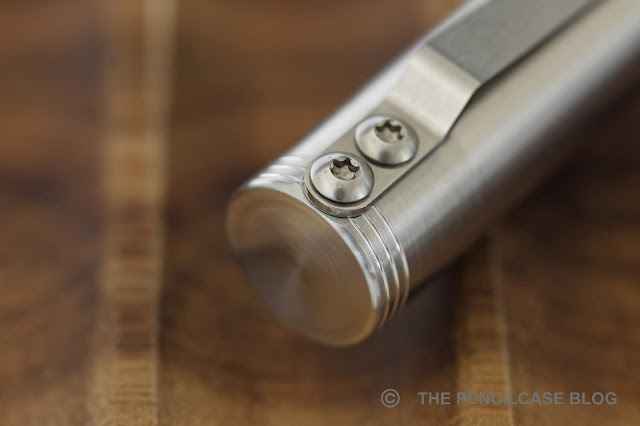
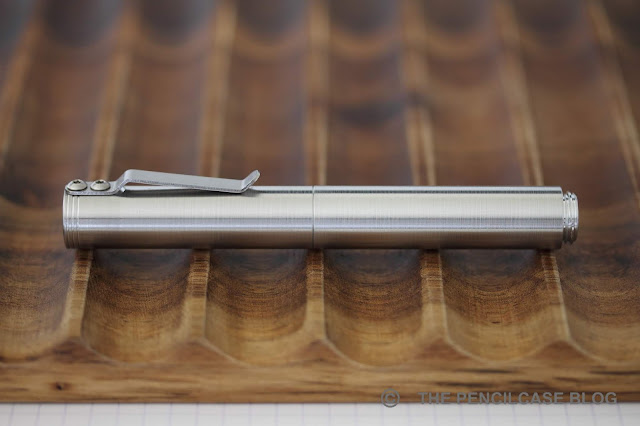
It's a straight, flattop, cylindrical pen from the outside, so nothing too spectacular per se. But as is the case so very often: the devil is in the details! The body of the pen is equal in length to the the cap, and to enhance the symmetry between both parts, the three grooves near the cap finial mimic the the threads at the back of the barrel. Nifty!
Pen review: The Schon DSGN Clip pen
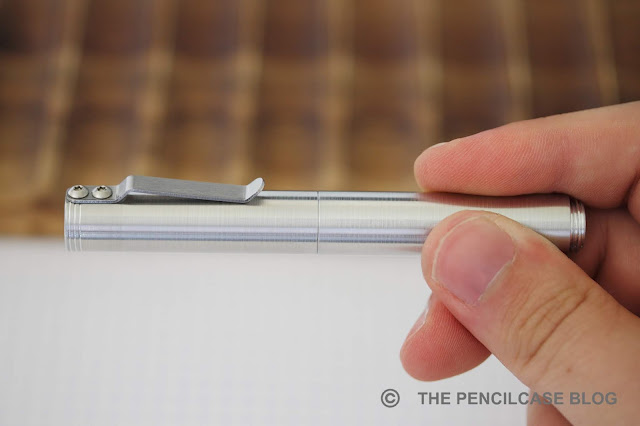
The folded steel clip is very similar to those used by Karas Pen Co., which is a sound choice for EDC-focused pens, and continues the industrial look. Different to the one found on Karas pens, the Schon pen features a narrower clip, which looks elegant but is also a bit easier to use because it's less stiff. The clip is bolted to the top of the pen, almost flush with the cap finial, so the pen doesn't stick out too far if you wish to pocket carry. 
Pen review: The Schon DSGN Clip pen
Underneath the cap, you'll find a slender but very long section, which ends in a short and stubby nose cone. The block threads are really short and placed towards the back of the section, closely followed by a rather large step. All these aspects together make for a rather interesting section that looks a bit out of proportion, but it really isn't. My only gripe would be that the nose cone is a bit too stubby, making it hard sometimes to see what you are writing.

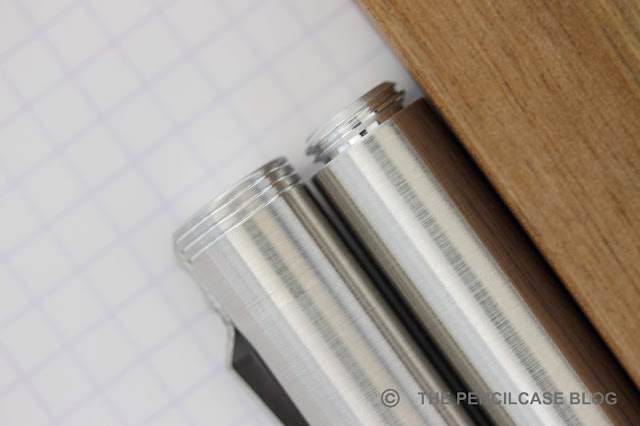
The back of the barrel has the same short block threads which allow the cap to post. It looks like a cross-threading nightmare, but to my surprise that only happened occasionally. Most of the time, the cap and barrel align itself quite well and thread together smoothly. 
Pen review: The Schon DSGN Clip pen
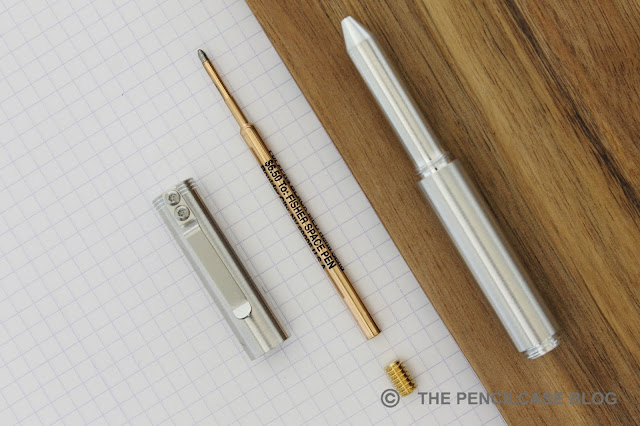
The Schon DSGN pens don't dissasemble near the section, like most pens do. Instead, you'll find a brass set screw at the back finial, which you have to unscrew to change the refill. I like this quirky design element, and I particularly like that all pens (various different materials, from stainless steel, brass or copper to annodized aluminium) come with the same brass screw, almost like a maker's signature.
Pen review: The Schon DSGN Clip pen
The set screw has one downside however: changing the refill means you have to have a flathead screwdriver handy. The Clip pen takes care of that, as the the tip of the clip is pointed upwards just enough to use it as a screwdriver! I wouldn't suggest using the clip for DYI jobs, but just for this task, it works perfectly. 
Pen review: The Schon DSGN Clip pen
L to R: Kaweco Al Sport, Lamy Pico, Baron Fig Squire Click, Inventery Pocket fountain pen, Schon DSGN Clip pen, Lamy Safari, Lamy 2000
At 10.2 cm (4") closed, 14.6 cm (5-3/4") posted and with a diameter of 1.3 cm (1/2"), these are definitely pocket pens. They have a surprisingly good heft to them, at 34g (1.2 oz) for the aluminium Clip version (up to 93g/3.3 oz for the solid copper versions!). 

It's obviously not meant to be used unposted, because it will literally dissapear in your hand. But with the cap posted, it transforms into a surprisingly comfortable full-sized writer. The section may be slender, but because it's long, it does a good job keeping my grip away from the threads and step. So while it may not seem comfortable at first, it's actually quite enjoyable to use for such a compact pen.
Pen review: The Schon DSGN Clip pen
The refill closes the deal for me, as Ian chose to make his pens compatible with the popular Fisher Space gas pressurized refill. These are excellent ballpoint refills. They are well-behaved and put down a smooth and relatively dark line that is as consistent as ballpoint pens go. Apart from that, it obviously has the advantage of being perfectly usable in wet, cold or hot environments, on difficult surfaces or even upside down. The choice of refill makes this pen all the more appropriate for EDC use. The only downside is that the refills are smalL, and quite expensive.
Pen review: The Schon DSGN Clip pen
To round up, the Schon DSGN Clip is a pen that does things right; It's clear aim at EDC use reflects in every aspect, from the durable build, practical size, strong clip,...all the way to the quality Fisher Space refills. I've followed Ian and his brand for many years (despite never pulling the trigger on one of his pens) and I know how anal retentive he is about quality and even the smallest of details (Talking about details: check out his drop-dead gorgeous handmade watches at Schon Horology! Expensive, but holy cow they are cool!). 

Ian persuaded me about his product, I have to admit I'm now one of the bloggers that will tell you this is an amazing pen. Yes, the price is a bit higher compared to the rest of the market, but that seems to be a recurring theme with made in the USA, EDC goods, and there is clearly a market for these high-quality products. If you want an excellent EDC pocket pen, and are willing to invest, watch the Schon DSGN pen!

This product was sent to me by Schon DSGN so I could write this review. I was in no way influenced in the making of this review, the opinions shared in this review are completely my own! This post does not contain affilate links.
Pen review: The Schon DSGN Clip pen

Monday, August 6, 2018

REVIEW: KARAS PEN CO. REAKTOR GALAXIE (XL) & STARLINER (XL)

Karas Pen Co. Reaktor Galaxie ballpoint, Galaxie XL rollerball & Starliner (XL) fountain pen review and comparison post
As you've most likely seen more and more reviews of the brand spanking new line of Karas Pen Co. products -The Reaktor (Stage 1) pens- pop up, I figured it was about high time to drop in my own 2 cents about them. I was lucky enough to get their entire product line sent over, and I think by now I've spent enough time with them to give you my final verdict. The Reaktor product line can be broken up into four products (for now, as there will likely be more products added later on): the Galaxie, Starliner, Galaxie XL and Starliner XL. 

I'll be doing things a bit differently than most other reviewers who discussed each pen separately. Instead, this post will be both a review and comparison of all four models, to show the differences and similarities between the various types. This might become a rather lengthy review... so let's get right to it!
Karas Pen Co. Reaktor Galaxie ballpoint, Galaxie XL rollerball & Starliner (XL) fountain pen review and comparison post
Karas Pen Co. (aka. Karas Kustoms) has had quite an impressive track record so far, with some hugely popular pens like the Render K, Retrakt (reviewed HERE) or Ink. But looking at their latest releases, they are clearly taking a new direction to diversify their offerings. They used to focus primarily on the EDC community, with big, heavy and tough machined metal pens. Since last year they threw in the new Signature line of pens, with the fantastic Decograph (that I reviewed HERE) and now the Vertex (which premiered at the DC pen show last weekend). A third line was launched last week with the Reaktor and its first two products: the Galaxie XL and Starliner XL (the regular Galaxie and Starliner pens will be released later this month).

With stage 1 of the Reaktor pens, they are filling a gap in the lower-end product lineup, providing a cheaper alternative that retains the 'made in the USA' quality. Sort of a gateway drug into the hobby. As I mentioned earlier, the first stage of the Reaktor product line includes four different pens available in four colorways, making for a total of 16 different configurations. 
Karas Pen Co. Reaktor Galaxie ballpoint, Galaxie XL rollerball & Starliner (XL) fountain pen review and comparison post
Interestingly, the fountain pens (Starliner) and rollerball/ballpoint pens (Galaxie) each have their own design style, although they follow the same general form factor for the most part. Karas relies heavily on vintage 'Americana' influences for the Reaktor series. Both the Galaxie and Starliner found their inspiration in the space race and automotive industry (both pens being named after Ford cars), which reflects in certain prominent design features, as well as more subtle details.
Karas Pen Co. Reaktor Galaxie ballpoint, Galaxie XL rollerball & Starliner (XL) fountain pen review and comparison post
Cap and barrel details of the Galaxie
The Galaxie and Galaxie XL are immediately recogniseable by its intricately CNC'd cap finial, which represents hose fixtures found on space suits (take a look at this space suit from Buzz Aldrin, and you'll also see where they got the inspiration for the anodizing colors, not coincidentally also the colors of the US flag!). 
Karas Pen Co. Reaktor Galaxie ballpoint, Galaxie XL rollerball & Starliner (XL) fountain pen review and comparison post
3...2...1 LIFTOFF!
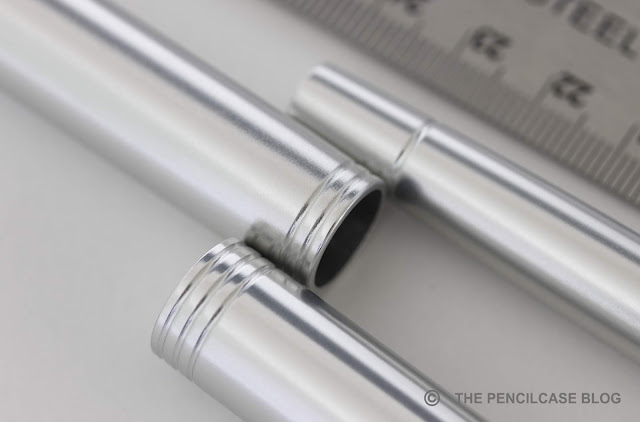
The Starliner and Starliner XL have a more subtle, but stately flat-top design. The cap and barrel finials have a subtle point machined in them, which bounces off the light to mimic the glint of a star (I think it kind of looks like the gravitational field of a star... I'm a geek, lol). The Starliner also includes a cool reference within the rings engraved all over the pen: 3 on the cap finial, 2 at the base of the cap and 1 at the back of the barrel. 3...2...2 LIFTOFF!

The overall shape of the pens is the same for both models: flattop with an oversized cap and narrower, strongly tapered barrel. The proportions are admittedly a bit quirky and unusual, which makes these pens immediately recognizable. 
Karas Pen Co. Reaktor Galaxie ballpoint, Galaxie XL rollerball & Starliner (XL) fountain pen review and comparison post
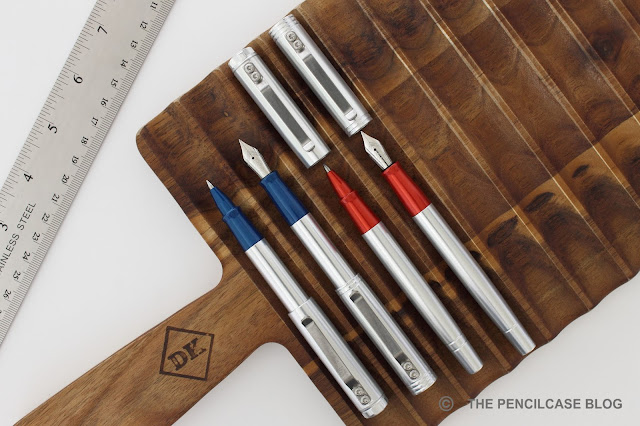
Then there's the two sizes that you can choose from: regular or XL. Apart from the obvious difference in size, the XL also differs because of the sprung steel clip. The smaller size is made to carry inside your pocket, while the XL can be attached to your pocket. Both pens are actually fairly compact. But the smaller model is a 'true' pocket pen that is extremely comfortable to just throw in your pocket and always have with you, whereas the XL is a more full-sized pen.

The Galaxie and Starliner are the first Karas pens that feature a snap cap. The mechanism is simple: a rubber o-ring inside the cap provides a 'bump' on which the flared edge of the section catches. Even though it's a somewhat unconventional mechanism, it works surprisingly well. The cap opens and closes with a reassuring 'snap' and I never worried that the cap may pop off inside my pants pocket. Worth pointing out is that the closure mechanism does allow for some side-to-side wiggle. The cap rattles a tiny bit, although I expected much worse.
Karas Pen Co. Reaktor Galaxie ballpoint, Galaxie XL rollerball & Starliner (XL) fountain pen review and comparison post
Silver - Black - Tumbled Raw
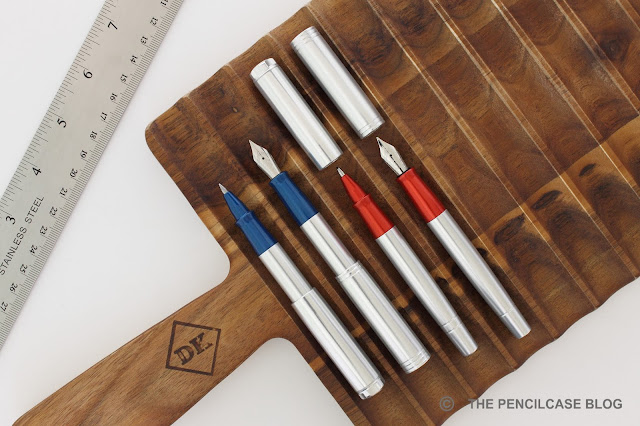
Because these pens sit at an entry-level price point, the material and finish options are restricted to aluminium in either silver or black anodized finish, or a tumbled finish. The silver annodised version is available with a blue or red anodized grip section to give a total of four colorways to choose from. I'm personally a big fan of the tumbled and black anodized finishes. The reasoning behind this narrowed down offering is simply to cut on production costs.
Karas Pen Co. Reaktor Galaxie ballpoint, Galaxie XL rollerball & Starliner (XL) fountain pen review and comparison post
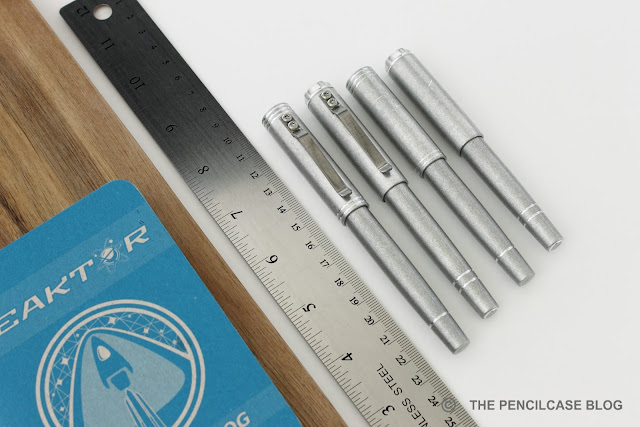
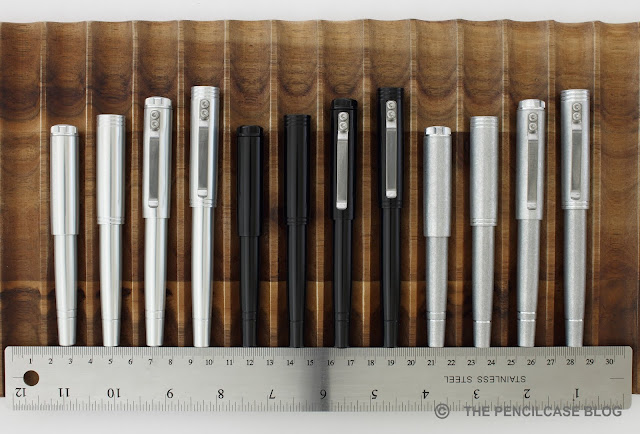
L to R: Schon DSGN The Clip, Karas Pen Co. Fountain K, Karas Pen Co. Retrakt, Karas Pen Co. Galaxie XL/Starliner XL/ Galaxie/Starliner, Lamy Safari, Lamy 2000
Karas Pen Co. Reaktor Galaxie ballpoint, Galaxie XL rollerball & Starliner (XL) fountain pen review and comparison post
Galaxy and Starliner, posted and unposted
Karas Pen Co. Reaktor Galaxie ballpoint, Galaxie XL rollerball & Starliner (XL) fountain pen review and comparison post
L to R: Galaxie, Starliner
The Galaxie ballpoint pen and Starliner fountain pen are pocket-sized pens, and measure 11cm (4.3") and 11.5cm (4.5") respectively when closed. Uncapped, both pens drop below 11cm, which is too short for anything but a quick jot. The cap posts securely with a firm push, and the o-ring inside the cap holds it in place. The cap posts deeply onto the barrel, making for a total length of 11.5cm (4.5") for the Galaxie and 12.5cm (4.9") for the Starliner. Both pens weigh in at 24g total, which is not particularly heavy, but enough to give a solid feel in the hand.
Karas Pen Co. Reaktor Galaxie ballpoint, Galaxie XL rollerball & Starliner (XL) fountain pen review and comparison post
Galaxie XL and Starliner XL
The larger Galaxie XL rollerball and Starliner XL fountain pen receive a modest bump in length: 12.3cm and 12.8cm respectively. Uncapped, the Galaxie XL rollerball is a bit short for me, measuring 11.6cm (4.56"), but the Starliner XL fountain pen has a slightly longer section which brings up to a more comfortable length of 12.5cm (4.9"). Posted, both pens have a comfortable length (12.9cm/5.1" for the Galaxie XL and 13.7cm/5.4" for the Starliner XL), and the oversized cap gives it a more central-weighted feel in the hand. The clip and slightly larger dimensions increase the total weight to 29g, which is still relatively lightweight.
Karas Pen Co. Reaktor Galaxie ballpoint, Galaxie XL rollerball & Starliner (XL) fountain pen review and comparison post
L to R: Galaxie XL, Galaxie XL posted, Starliner XL, Starliner XL posted
All four pens have a similar section shape, but the Starliner fountain pens have the advantage of a slightly longer section. The widest part of the section measures 1.1cm (0.43"), and tapers down strongly towards the nib, where it flares out again to provide a secure grip. The section design, combined with the lack of threads and a smooth transition from barrel to section, makes the Galaxie and Starliner pens all extremely comfortable and balanced writers. Granted, the regular Galaxie and Starliner HAVE to be posted to comfortably fit my hand, whereas the XL's are comfortable either way.
Karas Pen Co. Reaktor Galaxie ballpoint, Galaxie XL rollerball & Starliner (XL) fountain pen review and comparison post
The Starliner pens use 076 nib units from Bock. L to R: Bock #5, Bock 076, Bock #6
New for Karas pens are the Bock 076 nibs used on the Starliner fountain pens. Up until a month or two ago, I had only seen this nib size on the TWSBI 580. And now in a relatively short time, both the Stilform Kosmos Ink (reviewed HERE) and these Starliners make use of them. In size, the 076 sits in between the #5 and #6, but shares the housing with the #5 nibs so these are interchangeable.
Karas Pen Co. Reaktor Galaxie ballpoint, Galaxie XL rollerball & Starliner (XL) fountain pen review and comparison post
In terms of performance, I'd also rate them in between the #5 and #6. I'm not a huge fan of the small #5 because I find the ink flow can sometimes be a bit unpredictable. The nibs on the Starliner are smooth and responsive, all the way from EF to B. The ink flow seems better and more consistent than on the #5's. I really enjoyed using these pens for EDC, and never had issues with any of them (the rubber o-ring also does a pretty good job keeping the nib from drying out). Bock nibs are often criticized for being lackluster, but they get the job done just fine. 
Karas Pen Co. Reaktor Galaxie ballpoint, Galaxie XL rollerball & Starliner (XL) fountain pen review and comparison post
The Galaxie and Galaxie XL use different refills. Where the Galaxie is meant as a ballpoint, and utilizes the Parker-style G2 refills, the XL can accomodate the larger Pilot G2 rollerball refills. The Galaxie comes loaded with a Schmidt Megaline P950 medium refill in black. This pressurized refill works well and lays down a line that is relatively dark and consistent. I personally prefer the Schmidt Easyflow 9000 which are smoother and darker (although more prone to smearing). But of course you can swap the refill out for whatever suits you best. 
Karas Pen Co. Reaktor Galaxie ballpoint, Galaxie XL rollerball & Starliner (XL) fountain pen review and comparison post
The Galaxie XL comes with a 0.5mm Pilot G2 refill in black, which is an excellent refill for my taste. It works consistently in my hands , and lays down a crisp line that suits my needs just fine (some prefer the finer 0.38mm tip size). 
Karas Pen Co. Reaktor Galaxie ballpoint, Galaxie XL rollerball & Starliner (XL) fountain pen review and comparison post
Karas wanted to fill a gap in the low end of their catalog. And if you ask me, they did a great job filling the vacancy with this new Reaktor line. The Reaktor pens start at 40$ for the Galaxie, and go up from there (45$ for the Galaxie XL, 50$ for the Starliner and 55$ for the Starliner XL), which even includes domestic shipping! These pens offer incredible value for money at a price point previously unseen on the market of USA-made metal pens. 

Does that mean they had to chimp on quality? I don't think so. They managed to cut costs by implementing some clever tricks: a smaller nib, only one material and four finishes (specifically those finishes that are easiest to manufacture consistently, to minimize losses through faulty parts). You also won't find the regular packaging here, but instead the pens will come in color-coded pen tubes, which are cheaper and easier to ship because they are smaller.

Along with the recent Signature line, the new Reaktor pens prove that the people at Karas Pen Co. are working hard to bring products to the market that diversify their offerings, which will appeal to a wider audience. In this case, the Galaxie and Starliner are fantastic options for people that are just starting out in the hobby, or if you are looking for a cheap but durable EDC option.

This product was sent to me by Karas Pen Co. so I could write this review. I was in no way influenced in the making of this review, the opinions shared in this review are completely my own! This post does not contain affilate links.
Karas Pen Co. Reaktor Galaxie ballpoint, Galaxie XL rollerball & Starliner (XL) fountain pen review and comparison post