Showing posts with label rollerball pen. Show all posts

Sunday, August 23, 2020

REVIEW: BEN WALSH DESIGN GRAVITAS FOUNTAIN PEN & GRAVITAS TWIST PEN

PEN REVIEW: BEN WALSH DESIGN GRAVITAS FOUNTAIN PEN & GRAVITAS TWIST PEN
I started chatting with Irish designer Ben Walsh about a year ago when all this was still a concept idea and a bunch of renders. Ben - who got into the pen making industry with unique, handmade concrete pens - wanted to create a metal pen from scratch, and he was actively engaging with the community to gather feedback. One year, and a lot of exchanged thoughts and ideas later, Ben has released his pen - I should say 'pens - out in the wild via a Kickstarter campaign that took off last week: Gravitas pens!

Now, if you know me and my reviews, you'll know that I have a sliiiiight tendency to get overly excited about cool metal pens, but believe me when I say this is a Kickstarter you HAVE to check out if you're even the slightest bit interested in this type of pens! If you still don't believe me after this review - no offense taken - check out Anthony's review over at UK Fountain Pens. Anthony likes it too, and he's a tough guy to convince!
PEN REVIEW: BEN WALSH DESIGN GRAVITAS FOUNTAIN PEN & GRAVITAS TWIST PEN
From afar, you might be forgiven for thinking of the Gravitas fountain pen and Gravitas 'Twist' capless rollerball as a 'been there, done that' design. True, nobody's reinventing the wheel here (not that anyone has done that in the pen industry for a very long time, I'd dare to say), but if anything the Gravitas pens are very good looking wheels! The Gravitas and Gravitas Twist pair up nicely side by side, but they are two relatively different pens in terms of design. 
PEN REVIEW: BEN WALSH DESIGN GRAVITAS FOUNTAIN PEN & GRAVITAS TWIST PEN
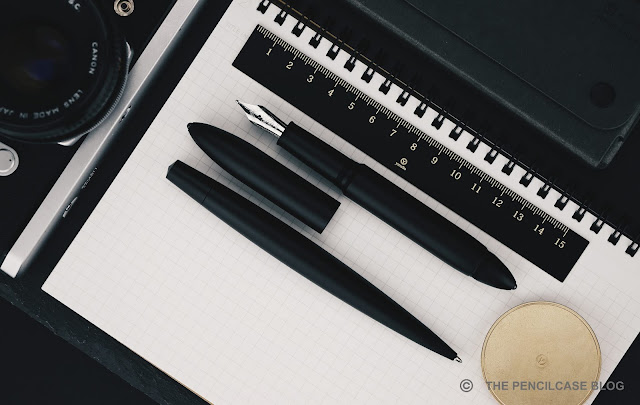
Let's start with the Gravitas fountain pen (and capped rollerball), which has a very pronounced torpedo shape with a girthy, straight cylindrical body. It tapers down sharply towards the cap and barrel finials into pointed ends... but instead of a point, you'll find a small silicon nitride ball on either end! 

Despite a somewhat tactical pen vibe, the finials' main intent is to provide a more durable design that could survive a drop better than a bare aluminium finial would. Compared to the more rounded cigar-shaped Ensso Piuma or Namisu Horizon - two comparable pens - the Gravitas has a much more robust and bulky appearance (probably because it IS robust and bulky), which I quite enjoy. 
PEN REVIEW: BEN WALSH DESIGN GRAVITAS FOUNTAIN PEN & GRAVITAS TWIST PEN
Yeah... too much is too much!
The clean, minimal design is interrupted by a threaded section on the back of the barrel. While I don't find the threads as visually distracting as I thought I would, I'm still happy to know that they will be dropped in the final production version. The Gravitas is more than long enough to be used without posting (in fact, it looks a bit silly with the cap on the back!) so you won't miss those threads at all. 
PEN REVIEW: BEN WALSH DESIGN GRAVITAS FOUNTAIN PEN & GRAVITAS TWIST PEN
Streamlined!
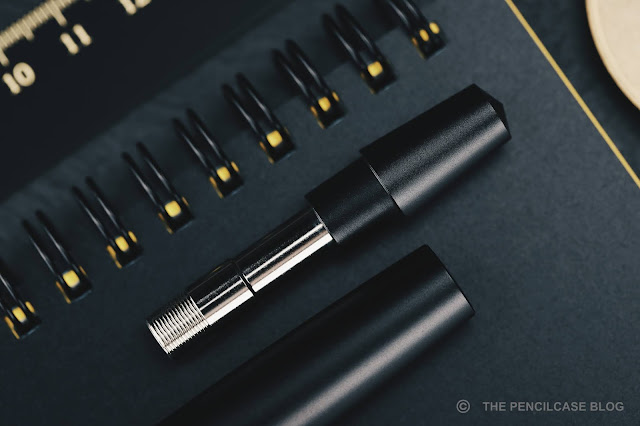
The Twist pen is a different beast altogether. It's sleeker, skinnier, and has a long and rounded taper towards the narrow tip of the pen. What sets the Twist apart is its flat spot that prevents it from rolling around. With respect to the center of the pen, the flat is angled towards the front of the pen (my photo's don't do this justice at all). This gives the pen a mean-looking 'stance' when it sits on a flat surface, with the tip angled downward - it's quite cool. 
PEN REVIEW: BEN WALSH DESIGN GRAVITAS FOUNTAIN PEN & GRAVITAS TWIST PEN
The twist mechanism of the Twist (the name certainly isn't far-fetched!) is of Schmidt make, the same as those found in Baron Fig's Squire. It has a pleasant action and feels quite solid (there's a slight rattle, but nothing too distracting). I do wish that the twist knob was a bit longer compared to the rest of the pen, to make it easier to reach and operate. Ben took note of this as well, when I and a couple other reviewers were asked to give input on these production prototypes, and so these changes will most likely end up in the final design. 
PEN REVIEW: BEN WALSH DESIGN GRAVITAS FOUNTAIN PEN & GRAVITAS TWIST PEN
While the idea is to expand the Gravitas collection with various materials and finishes (including really neat laser-etched graphics that cover the entire pen!), the Kickstarter starts off with three clean-looking anodized aluminium finishes: black, silver and gold. Even on these 'prototypes' (quite advanced proto's, but still...), the finish is immaculate. The aluminium base pen is bead-blasted to remove machining marks, and then anodized to give a smooth matte finish that is very pleasant to the touch.
PEN REVIEW: BEN WALSH DESIGN GRAVITAS FOUNTAIN PEN & GRAVITAS TWIST PEN
The Gravitas fountain pen...
PEN REVIEW: BEN WALSH DESIGN GRAVITAS FOUNTAIN PEN & GRAVITAS TWIST PEN
And the Gravitas Twist pen
PEN REVIEW: BEN WALSH DESIGN GRAVITAS FOUNTAIN PEN & GRAVITAS TWIST PEN
L to R: Baron Fig Squire, Karas Retrakt, Namisu Nova, Ensso Piuma, Gravitas fountain pen, Gravitas Twist pen, Lamy Safari, Lamy 2000
The Gravitas fountain pen is a fairly large pen, noticeably larger than most other metal pens from the likes of Ensso, Namisu, Karas... It measures 14.8 cm/ 5.81" capped, and 13.4 cm/ 5.28"  uncapped. The maximum diameter of 1.5 cm/ .59" runs along almost the entire length of the pen, which makes it look bulky and robust. Underneath the cap, you'll find a long, gently tapered section with a comfortable diameter (1.1 cm/ .43" even at the thinnest point) that flares out slightly towards the nib.
PEN REVIEW: BEN WALSH DESIGN GRAVITAS FOUNTAIN PEN & GRAVITAS TWIST PEN
Shallow threads and an angled transition towards the barrel create a comfortable writing experience 
The threads are shallow and fine, rendering them barely noticeable in the hand. The threads are single start on this prototype, and take a hefty three full turns to cap and uncap. The final production pen will get more common triple start threads that need fewer turns. One of my favorite practical design elements on the Gravitas is how the step towards the barrel is angled to make the transition much more gentle in the hand. It's an elegant and simple design decision that makes all the difference in terms of comfort, and yet you barely ever see it on other pens. It's a larger pen, so even the all-aluminium construction still comes in at 39 grams. I guess you could say the Gravitas has a reassuring... gravitas to it (terrible pun, I know), it sits nicely balanced in the hand.
PEN REVIEW: BEN WALSH DESIGN GRAVITAS FOUNTAIN PEN & GRAVITAS TWIST PEN
The Twist pen is a bit smaller than its capped companion, although in absolute terms it's still far from compact. At 14.1 cm/ 5.55" in length, and with a maximum diameter of 1.4 cm/ .55" it's a bit shorter than the fountain pen. Due to the more tapered shape of the Twist, it definitely appears smaller than it actually is. With a weight of 34 grams, it feels positively hefty in the hand, too.

In terms of comfort, both pens score high marks with me. The Gravitas fountain pen has a comfortable design, a lot of the small details, like the shape and size of the section, the subtle threads and angled transition towards the barrel, are the result of careful consideration on Ben's end, taking into account a lot of input he got from the community. The Twist actually has a unique angle (hah! got it?) in terms of comfort, with the flat spot providing a natural area to rest your thumb, index or middle finger (either way you rotate it, it sits comfortably in your hand). The stretched out, tapered design means you can hold it closer to the tip or further up, to get the grip diameter you prefer. 
PEN REVIEW: BEN WALSH DESIGN GRAVITAS FOUNTAIN PEN & GRAVITAS TWIST PEN
The Gravitas Twist comes loaded with Schmidt's P8127 rollerball refill. While that's not a bad refill, I've recently switched towards gel-based refills for my non-fountain pen writing. Luckily, the P8127 is similarly sized to standard Parker G2 refills (not to be confused with Pilot's G2!), which gives plenty of choices to swap refills to a ballpoint or gel refill (I've been using the Monteverde Ceramic gel refill, which fits perfectly and works quite well, even though it's not quite as fine as I'd like)
PEN REVIEW: BEN WALSH DESIGN GRAVITAS FOUNTAIN PEN & GRAVITAS TWIST PEN
The Gravitas fountain pen, on the other hand, warrants some explaining: While the prototype I have in my hand has a Bock nib - common for most metal pens you'll find on the market today - Ben made the switch to JoWo when he noticed the quality wasn't as consistent as he'd like with Bock. It's good to know that a strict QC is in place to ensure each nib functions as it should. As a lot of brands adopt stock JoWo and Bock nibs these days, individual QC is the way to provide that little extra that sets your brand apart. Ironically, the Broad Bock nib on this particular pen has been one of the smoothest, and wettest Bock nibs I've come across. But regardless, I think JoWo is the safer choice, and it's something different from what most other brands are doing!
PEN REVIEW: BEN WALSH DESIGN GRAVITAS FOUNTAIN PEN & GRAVITAS TWIST PEN
The Ben Walsh Design Gravitas pens are the result of a million small little details and considerate design choices. It has taken quite a few years, but the culmination of Ben Walsh's effort has led to two great-looking AND functioning pens (technically three, also counting the capped rollerball) that I can wholeheartedly stand behind. Maybe because I've had a teeny tiny say in how they turned out, but probably because they are just fantastic pens - simple as that! If I sound enthusiastic about them, that's because I am. 
PEN REVIEW: BEN WALSH DESIGN GRAVITAS FOUNTAIN PEN & GRAVITAS TWIST PEN
If you feel like supporting the Gravitas pens, you can check out the Kickstarter page until September 17th. The Gravitas Twist pen starts at 45€, and the capped Gravitas rollerball and fountain pen each start at 50€, which is very affordable. Even at future respective retail prices of 65 and 70 euros, I still think these are a killer deal. Enough blabbing already! I've already gone and put my money where my mouth is, and I think you should, too.

This product was sent to me by Ben Walsh Design so I could write this review. I was in no way influenced in the making of this review, the opinions shared in this review are completely my own! This post does not contain affilate links.
PEN REVIEW: BEN WALSH DESIGN GRAVITAS FOUNTAIN PEN & GRAVITAS TWIST PEN

Saturday, May 23, 2020

RE-REVIEW: BARON FIG SQUIRE ROLLERBALL

RE-REVIEW: BARON FIG SQUIRE ROLLERBALL
Since I am: A) terribly late with this review of the special edition - yet currently still available - Baron Fig Squire 'Clear Habits' rollerball, so at this point I don't know how useful an in-depth review of this particular edition would still be. And B) have already reviewed the Squire, in its many iterations, almost half a dozen times by now (Links to all reviews can be found HERE). I've probably said about everything there is to say about the Squire in my previous reviews, and rambled on enough to cause at least a little migraine.

So this post will be a Re-review of the Baron Fig Squire in general, instead. And I will focus on my experiences with the Squire rollerball thus far, and how my perception of this pen has maybe changed over the years.
RE-REVIEW: BARON FIG SQUIRE ROLLERBALL
The Squire was a pen that immediately won me over. How could it not? Baron Fig, if anything, really has their brand delivery figured out to absolute perfection. The minimalist in me (or rather the minimal design enthusiast, I don't think a hoarder like me could possibly classify as a minimalist!) smiles every time I see the simple packaging, clean lines, bold colors and minimal graphics that look like they came straight from Apple HQ. If you identify with a minimal aesthetic like this, it's easy to get sucked into their biosphere of minimal productivity products... dare I say addictive, even?

But packaging and branding is one thing (You could even argue if it's a valid reason for buying a product?). Luckily, the Squire inside is every bit as brilliant as its packaging. Design is certainly one area where my opinion about the Squire hasn't changed a bit, which is a good thing in this case. In many ways the Squire is about as good as minimal design gets: Just two parts. A very clean and simple, almost fluid-like design that's completely uninterrupted by hard corners, edges, or seams... except where the two parts of the pen meet.
RE-REVIEW: BARON FIG SQUIRE ROLLERBALL
Talking about that tiny seam: the slight gap between the two parts has been my only pet peeve from the beginning of the Squire's career. Albeit a bit of a stupid one, I suppose. But I can't really fault the design in any other way, so a stupid pet peeve is what you'll get. I feel like they improved the fit between the two parts a bit over the years, but you can still see and feel a slight gap. Is it a problem? No. Do I secretly wish that they'd figure out a way to make it (almost) as seamless as a Lamy 2000? Yeah, obviously!

...Oh, and while we're at it, a roll-stopper could be useful as well!
RE-REVIEW: BARON FIG SQUIRE ROLLERBALL
Baron Fig's style and impeccable ability to create an attractive story, reflects in the fantastic special edition releases they've done with the Squire over the years. Even though I'm not mad about them slowing down their pacing of special releases these days (All those seasonal subscriptions started to feel like a chore, trying to keep up with one special edition after the other), they've consistently outdone themselves on every single one of them over the years. Not just the minimal color schemes and themed engravings, but also the entire atmosphere created around each theme (The 'Lock & Key' being my absolute favorite, closely followed by the highly sought-after chemistry-themed 'Experiment' that I - as a chemist - thoroughly regret missing out on) - every piece of the puzzle just always fits together.
RE-REVIEW: BARON FIG SQUIRE ROLLERBALL
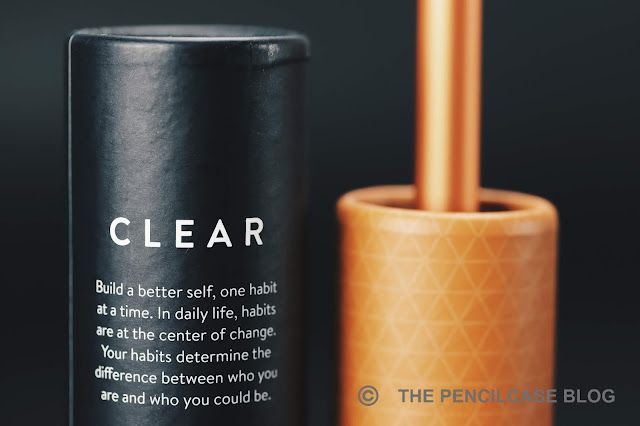
The 'Clear Habit' special edition that you're seeing here, is based on the color scheme of the 'Atomic Habits' book by James Clear (A self-improvement book about creating and breaking Habits), and Baron Fig's own Habit-tracker special edition Clear Habit Confidant notebook. Even though I don't read self-improvement books (I probably should), I still very much like the look of this rusty-orange pen and the triangle-pattern engraving.

Despite frequently having multiple Squires hanging around my desk and in my EDC carry, it still strikes me every time how compact these things are. Especially in the anodized aluminum versions that are also very light, making for an incredibly small and nimble pen. And yet despite the almost pocket-sized dimensions, it never feels like a pocket pen in the hand. It IS quite thin, though, which remains my only comfort-related gripe with the Squire. The combination of the slick, smooth shape, and anodized finish, with a fairly thin grip diameter (even at the widest point) does make it a little prone for my hand to cramp up after a while. Granted, it's not as thin as that other Baron Fig pen, the Squire Click (which is not one I'd recommend for more serious writing tasks), but I'd still like to see them try a design with a slightly wider grip area.
RE-REVIEW: BARON FIG SQUIRE ROLLERBALL
The refill... this is an area where I've changed my mind quite a bit over the past years, and my opinion on the Baron Fig-branded Schmidt P8126 rollerball refill still tends to go back and forth. Since my first experience with the Squire, I've definitely been using more rollerball and gel ink pens. The P8126 was something just shy of revolutionary for me at first encounter, and it's still one of the most satisfying and consistent rollerball refills I've used to date.

But gel pens have taken over the number one spot on my non-fountain pen list. The Pilot G2 (0.5) is just too good of a refill, and it's noticeably less picky about what paper you use it on, since the slightly more viscous gel ink has less tendency to feather and bleed on cheaper paper. That being said, the Squire does also accept Parker G2-style refills, which opens up a wide selection of refills that can be fitted (including the excellent Schmidt EasyFlow 9000M hybrid ballpoint ink refill that's a good compromise between ballpoint and rollerball inks).
RE-REVIEW: BARON FIG SQUIRE ROLLERBALL
Everything from the minimal design, aesthetically pleasing storytelling, compact and nimble size and excellent rollerball refill... Three years later, these are the things that make me reach for the Baron Fig Squire surprisingly often. And even though aesthetically you could call Baron Fig the stationery-world equivalent of Apple, their prices are actually quite reasonable I think. Starting at 55$, the Squire hits a pretty attractive price point, which makes it hard for me not to recommend picking one up. (Interestingly, the Squire's prices haven't gone up at all in the last three years, the same can't be said for a lot of other pens!)

NOTE: This product was provided by Baron Fig, so I could write this review. I was in no way influenced in the making of this review, the opinions shared in this review are completely my own! This post does not contain affiliate links.
RE-REVIEW: BARON FIG SQUIRE ROLLERBALL

Thursday, January 24, 2019

REVIEW: TACTILE TURN GLIDER BOLT-ACTION PEN

Review: Tactile Turn Glider Bolt-Action pen
In my fascination for metal pens I've already come across a bunch of interesting brands, and have tried some truly excellent products in the process. Suprisingly, there was one brand that has always been on my radar, yet for some reason it took me until now to finally check them out: Tactile Turn!

A couple months ago, I bought a titanium Tactile Turn Gist fountain pen from Mike Dudek (of The Clicky Post and Dudek Modern Goods fame!). Shortly after, by coincidence, I got in touch with both Will (owner of Tactile Turn) and Sascha (who owns German-based online store 'Writing Turning Flipping', one of few EU-based retailers that stocks Tactile Turn!). Suffice to say you'll encounter quite a few Tactile Turn products here on the blog in the next few months!

I thought I'd start by taking a look at the Glider -sent to me by Writing Turning Flipping-, which has consistently been part of my daily carry in the past couple months. The Glider is something new for me, as I had never used a bolt-action pen (which are quite popular in the EDC community). As the cherry on top, Sascha sent it over in one of my favorite metals: copper!
Review: Tactile Turn Glider Bolt-Action pen
The Glider in beteen the Mover and mechanical pencil, notice the subtle difference in shape of the Glider.
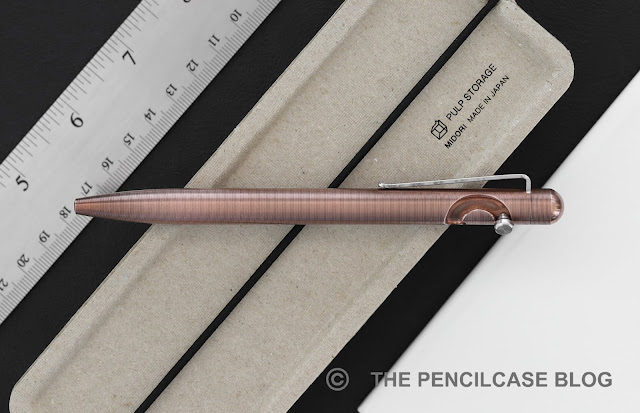
The Glider is one of two bolt-action pens Tactile Turn makes: the Glider and Slider. The Glider is about 0.5" longer and therefore takes another refill, but otherwise they are identical in design. The Glider is a large but sleek and streamlined pen. It strikes a good balance between minimal and industrial design. The barrel tapers gently into the nose cone at the front and at the rear end of the pen is a rounded finial where you'd usually find a knock mechanism.

But this is of course a bolt-action pen, and the mechanism can be found on the right next to the clip. It's a nicely rounded semi-circle shape with a small stainless steel bolt that doesn't protrude too far out from the barrel so it doesn't really sit in the way.
Review: Tactile Turn Glider Bolt-Action pen
The mechanism takes some getting used to, but once you get the hang of the 'swooping' motion (in lack of a better explanation) it almost becomes second nature. It's also EXTREMELY addictive to fiddle with. Seriously, once I pick it up, I have a hard time putting it back down. That said, it's not necessarily the most practical mechanism to quickly deploy and jot something down, but it sure does look cool. If I had to really nitpick on this pen, I would've liked to bolt to travel a mm or two further down so that the tip of the refill extends just a hair further. Of course that's easy to fix, I just taped a small piece of plastic to the back to give it that little extra length.

Basically all Tactile Turn pens share two specific design elements: the machined ridged texture across the entire surface of the pen, and the sturdy folded stainless steel clip. While this type of clip is something you can see on a lot of EDC-minded pens, it's attached internally instead of bolted to the outside of the barrel. The 'tactile' surface finish -what's in a name!- gives the pen a unique satin matte appearance from afar, and also provides excellent grip in the hand.

As I said, I chose the copper finish, which is hefty and creates a wonderful patina with use. If you're not a fan of copper, Tactile Turn provides plenty other metal options to choose from (aluminium, brass, titanium, stainless steel, damascus steel or even zirconium!), each with their own unique character and feel.
Review: Tactile Turn Glider Bolt-Action pen
L to R: Karas Pen Co Retrakt, Tactile Turn Gist 1.0, Tactile Turn  Mover, Tactile Turn pencil, Tactile Turn Glider, Lamy Safari, Lamy 2000
The Glider is a large pen, measuring in at 14.2cm (5.6"), and with a comfortable 11mm (0.43") diameter across the entire body of the pen. In this copper finish, it's a hefty 65g. For comparison, the aluminium is only 26g, and the titanium comes in at 36g, so that's quite a big difference in weight (there are a few other metal options to choose from, which have slightly different weights). Even though this copper version is heavy, it's very nicely balanced and I rarely had issues with fatigue. The combination of the surface texture, good size and nice heft makes this a very comfortable pen. I've used it for long writing sessions without any issues.

One thing that stands out in all Tactile turn products, is that they are made with an excellent eye for detail. The design is considerate and machining is impeccable. Fit and finish is so good on these pens, that you'll have to look very closely to spot the seam where the two halves of the barrel meet. The knurled texture is consistent across the entire pen, and apart from providing grip it also helps to hide small scuffs and scratches from use.
Review: Tactile Turn Glider Bolt-Action pen
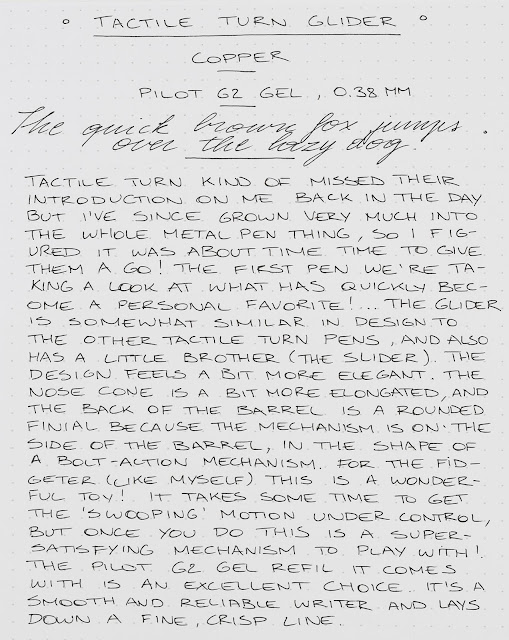
The Pilot G2 gel ink refill? An excellent choice in my book. It has actually surpassed the Schmidt P8126 rollerball refill in my personal rating. Both are fantastic refills, but because the G2 uses gel-based ink, it's less prone to bleeding and feathering on crappy paper. The Tactile Turn pens come stock with a black 0.38mm G2 refill, which lays down a crisp and fine line. On top of that, the G2 refill is available in a ton of colors, and it's a common size that is shared by a bunch of other refills (Tactile Turn provides a list of compatible refills HERE)
Review: Tactile Turn Glider Bolt-Action pen
The Glider is an allround excellent pen with an impeccable level of detail in the machining. There's really just one caveat: the mechanism on this pen is so addicting to play with... it may drive people around you crazy!

Making it even easier to recommend is the price. The Tactile Turn Glider is competitively priced when compared to direct competitors like the Karas Pen Co. Bolt. Prices obviously vary depending on the metal you choose: the aluminium version starts at 60$ (65€), this copper version is 70$ (75€) and the titanium Glider comes in at 80$ (85€). The more exotic finishes, like DLC-coated titanium, damascus steel and zirconium, obviously command a rather hefty premium.

This product was sent to me by Writing Turning Flipping so I could write this review. I was in no way influenced in the making of this review, the opinions shared in this review are completely my own! This post does not contain affiliate links. 
Review: Tactile Turn Glider Bolt-Action pen

Sunday, October 21, 2018

PENS FOR SALE!

If anything, I am a straight up pen hoarder. It's true, I admit it. But the collection gets out of hand sometimes, and now is the time to do something about that. 

I listed roughly 50 fountain pens, multipens, ballpoints and pencils on my for sale page. You can check it out HERE, or under the tab 'FOR SALE'.

Feel free to contact me if you have any questions or want to make an offer, you can get in touch through email (use the email widget at the bottom of this website), or on instagram DM!

Monday, August 6, 2018

REVIEW: KARAS PEN CO. REAKTOR GALAXIE (XL) & STARLINER (XL)

Karas Pen Co. Reaktor Galaxie ballpoint, Galaxie XL rollerball & Starliner (XL) fountain pen review and comparison post
As you've most likely seen more and more reviews of the brand spanking new line of Karas Pen Co. products -The Reaktor (Stage 1) pens- pop up, I figured it was about high time to drop in my own 2 cents about them. I was lucky enough to get their entire product line sent over, and I think by now I've spent enough time with them to give you my final verdict. The Reaktor product line can be broken up into four products (for now, as there will likely be more products added later on): the Galaxie, Starliner, Galaxie XL and Starliner XL. 

I'll be doing things a bit differently than most other reviewers who discussed each pen separately. Instead, this post will be both a review and comparison of all four models, to show the differences and similarities between the various types. This might become a rather lengthy review... so let's get right to it!
Karas Pen Co. Reaktor Galaxie ballpoint, Galaxie XL rollerball & Starliner (XL) fountain pen review and comparison post
Karas Pen Co. (aka. Karas Kustoms) has had quite an impressive track record so far, with some hugely popular pens like the Render K, Retrakt (reviewed HERE) or Ink. But looking at their latest releases, they are clearly taking a new direction to diversify their offerings. They used to focus primarily on the EDC community, with big, heavy and tough machined metal pens. Since last year they threw in the new Signature line of pens, with the fantastic Decograph (that I reviewed HERE) and now the Vertex (which premiered at the DC pen show last weekend). A third line was launched last week with the Reaktor and its first two products: the Galaxie XL and Starliner XL (the regular Galaxie and Starliner pens will be released later this month).

With stage 1 of the Reaktor pens, they are filling a gap in the lower-end product lineup, providing a cheaper alternative that retains the 'made in the USA' quality. Sort of a gateway drug into the hobby. As I mentioned earlier, the first stage of the Reaktor product line includes four different pens available in four colorways, making for a total of 16 different configurations. 
Karas Pen Co. Reaktor Galaxie ballpoint, Galaxie XL rollerball & Starliner (XL) fountain pen review and comparison post
Interestingly, the fountain pens (Starliner) and rollerball/ballpoint pens (Galaxie) each have their own design style, although they follow the same general form factor for the most part. Karas relies heavily on vintage 'Americana' influences for the Reaktor series. Both the Galaxie and Starliner found their inspiration in the space race and automotive industry (both pens being named after Ford cars), which reflects in certain prominent design features, as well as more subtle details.
Karas Pen Co. Reaktor Galaxie ballpoint, Galaxie XL rollerball & Starliner (XL) fountain pen review and comparison post
Cap and barrel details of the Galaxie
The Galaxie and Galaxie XL are immediately recogniseable by its intricately CNC'd cap finial, which represents hose fixtures found on space suits (take a look at this space suit from Buzz Aldrin, and you'll also see where they got the inspiration for the anodizing colors, not coincidentally also the colors of the US flag!). 
Karas Pen Co. Reaktor Galaxie ballpoint, Galaxie XL rollerball & Starliner (XL) fountain pen review and comparison post
3...2...1 LIFTOFF!
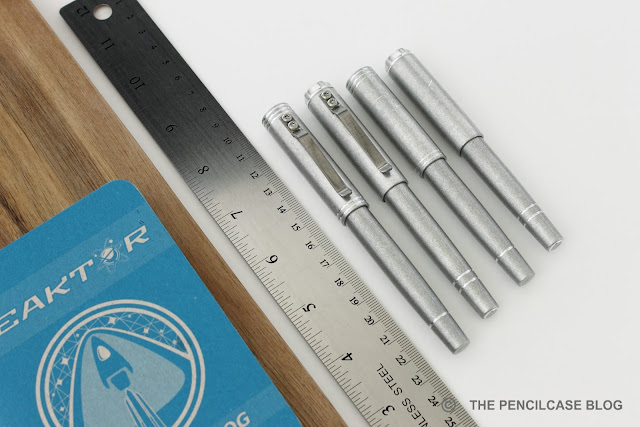
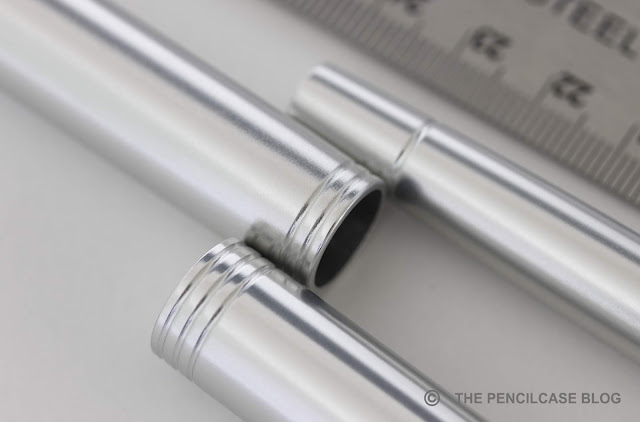
The Starliner and Starliner XL have a more subtle, but stately flat-top design. The cap and barrel finials have a subtle point machined in them, which bounces off the light to mimic the glint of a star (I think it kind of looks like the gravitational field of a star... I'm a geek, lol). The Starliner also includes a cool reference within the rings engraved all over the pen: 3 on the cap finial, 2 at the base of the cap and 1 at the back of the barrel. 3...2...2 LIFTOFF!

The overall shape of the pens is the same for both models: flattop with an oversized cap and narrower, strongly tapered barrel. The proportions are admittedly a bit quirky and unusual, which makes these pens immediately recognizable. 
Karas Pen Co. Reaktor Galaxie ballpoint, Galaxie XL rollerball & Starliner (XL) fountain pen review and comparison post
Then there's the two sizes that you can choose from: regular or XL. Apart from the obvious difference in size, the XL also differs because of the sprung steel clip. The smaller size is made to carry inside your pocket, while the XL can be attached to your pocket. Both pens are actually fairly compact. But the smaller model is a 'true' pocket pen that is extremely comfortable to just throw in your pocket and always have with you, whereas the XL is a more full-sized pen.

The Galaxie and Starliner are the first Karas pens that feature a snap cap. The mechanism is simple: a rubber o-ring inside the cap provides a 'bump' on which the flared edge of the section catches. Even though it's a somewhat unconventional mechanism, it works surprisingly well. The cap opens and closes with a reassuring 'snap' and I never worried that the cap may pop off inside my pants pocket. Worth pointing out is that the closure mechanism does allow for some side-to-side wiggle. The cap rattles a tiny bit, although I expected much worse.
Karas Pen Co. Reaktor Galaxie ballpoint, Galaxie XL rollerball & Starliner (XL) fountain pen review and comparison post
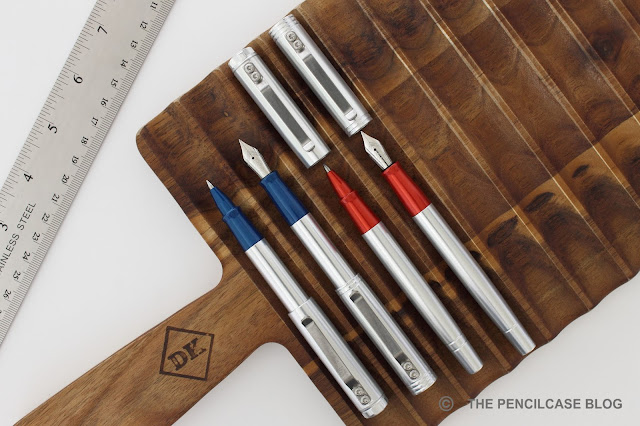
Silver - Black - Tumbled Raw
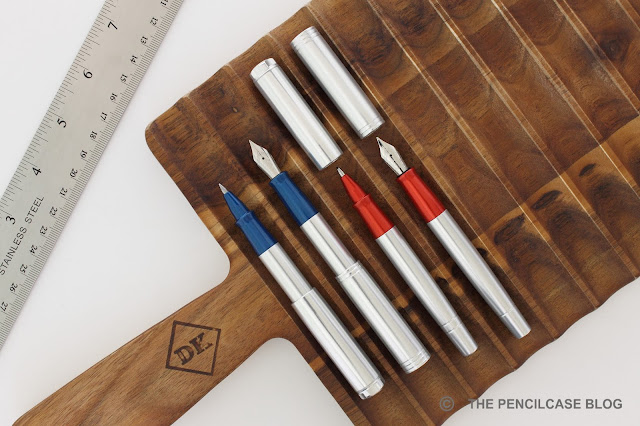
Because these pens sit at an entry-level price point, the material and finish options are restricted to aluminium in either silver or black anodized finish, or a tumbled finish. The silver annodised version is available with a blue or red anodized grip section to give a total of four colorways to choose from. I'm personally a big fan of the tumbled and black anodized finishes. The reasoning behind this narrowed down offering is simply to cut on production costs.
Karas Pen Co. Reaktor Galaxie ballpoint, Galaxie XL rollerball & Starliner (XL) fountain pen review and comparison post
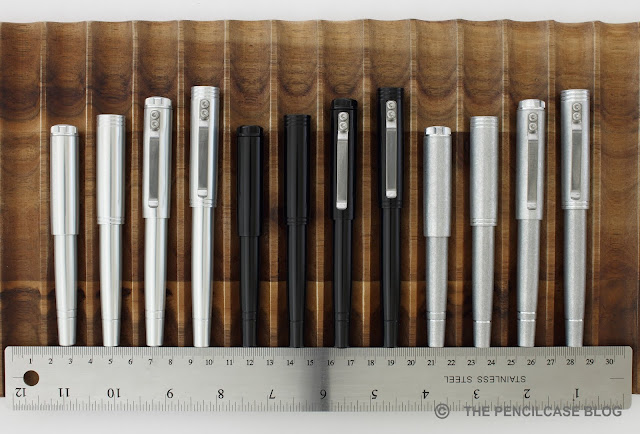
L to R: Schon DSGN The Clip, Karas Pen Co. Fountain K, Karas Pen Co. Retrakt, Karas Pen Co. Galaxie XL/Starliner XL/ Galaxie/Starliner, Lamy Safari, Lamy 2000
Karas Pen Co. Reaktor Galaxie ballpoint, Galaxie XL rollerball & Starliner (XL) fountain pen review and comparison post
Galaxy and Starliner, posted and unposted
Karas Pen Co. Reaktor Galaxie ballpoint, Galaxie XL rollerball & Starliner (XL) fountain pen review and comparison post
L to R: Galaxie, Starliner
The Galaxie ballpoint pen and Starliner fountain pen are pocket-sized pens, and measure 11cm (4.3") and 11.5cm (4.5") respectively when closed. Uncapped, both pens drop below 11cm, which is too short for anything but a quick jot. The cap posts securely with a firm push, and the o-ring inside the cap holds it in place. The cap posts deeply onto the barrel, making for a total length of 11.5cm (4.5") for the Galaxie and 12.5cm (4.9") for the Starliner. Both pens weigh in at 24g total, which is not particularly heavy, but enough to give a solid feel in the hand.
Karas Pen Co. Reaktor Galaxie ballpoint, Galaxie XL rollerball & Starliner (XL) fountain pen review and comparison post
Galaxie XL and Starliner XL
The larger Galaxie XL rollerball and Starliner XL fountain pen receive a modest bump in length: 12.3cm and 12.8cm respectively. Uncapped, the Galaxie XL rollerball is a bit short for me, measuring 11.6cm (4.56"), but the Starliner XL fountain pen has a slightly longer section which brings up to a more comfortable length of 12.5cm (4.9"). Posted, both pens have a comfortable length (12.9cm/5.1" for the Galaxie XL and 13.7cm/5.4" for the Starliner XL), and the oversized cap gives it a more central-weighted feel in the hand. The clip and slightly larger dimensions increase the total weight to 29g, which is still relatively lightweight.
Karas Pen Co. Reaktor Galaxie ballpoint, Galaxie XL rollerball & Starliner (XL) fountain pen review and comparison post
L to R: Galaxie XL, Galaxie XL posted, Starliner XL, Starliner XL posted
All four pens have a similar section shape, but the Starliner fountain pens have the advantage of a slightly longer section. The widest part of the section measures 1.1cm (0.43"), and tapers down strongly towards the nib, where it flares out again to provide a secure grip. The section design, combined with the lack of threads and a smooth transition from barrel to section, makes the Galaxie and Starliner pens all extremely comfortable and balanced writers. Granted, the regular Galaxie and Starliner HAVE to be posted to comfortably fit my hand, whereas the XL's are comfortable either way.
Karas Pen Co. Reaktor Galaxie ballpoint, Galaxie XL rollerball & Starliner (XL) fountain pen review and comparison post
The Starliner pens use 076 nib units from Bock. L to R: Bock #5, Bock 076, Bock #6
New for Karas pens are the Bock 076 nibs used on the Starliner fountain pens. Up until a month or two ago, I had only seen this nib size on the TWSBI 580. And now in a relatively short time, both the Stilform Kosmos Ink (reviewed HERE) and these Starliners make use of them. In size, the 076 sits in between the #5 and #6, but shares the housing with the #5 nibs so these are interchangeable.
Karas Pen Co. Reaktor Galaxie ballpoint, Galaxie XL rollerball & Starliner (XL) fountain pen review and comparison post
In terms of performance, I'd also rate them in between the #5 and #6. I'm not a huge fan of the small #5 because I find the ink flow can sometimes be a bit unpredictable. The nibs on the Starliner are smooth and responsive, all the way from EF to B. The ink flow seems better and more consistent than on the #5's. I really enjoyed using these pens for EDC, and never had issues with any of them (the rubber o-ring also does a pretty good job keeping the nib from drying out). Bock nibs are often criticized for being lackluster, but they get the job done just fine. 
Karas Pen Co. Reaktor Galaxie ballpoint, Galaxie XL rollerball & Starliner (XL) fountain pen review and comparison post
The Galaxie and Galaxie XL use different refills. Where the Galaxie is meant as a ballpoint, and utilizes the Parker-style G2 refills, the XL can accomodate the larger Pilot G2 rollerball refills. The Galaxie comes loaded with a Schmidt Megaline P950 medium refill in black. This pressurized refill works well and lays down a line that is relatively dark and consistent. I personally prefer the Schmidt Easyflow 9000 which are smoother and darker (although more prone to smearing). But of course you can swap the refill out for whatever suits you best. 
Karas Pen Co. Reaktor Galaxie ballpoint, Galaxie XL rollerball & Starliner (XL) fountain pen review and comparison post
The Galaxie XL comes with a 0.5mm Pilot G2 refill in black, which is an excellent refill for my taste. It works consistently in my hands , and lays down a crisp line that suits my needs just fine (some prefer the finer 0.38mm tip size). 
Karas Pen Co. Reaktor Galaxie ballpoint, Galaxie XL rollerball & Starliner (XL) fountain pen review and comparison post
Karas wanted to fill a gap in the low end of their catalog. And if you ask me, they did a great job filling the vacancy with this new Reaktor line. The Reaktor pens start at 40$ for the Galaxie, and go up from there (45$ for the Galaxie XL, 50$ for the Starliner and 55$ for the Starliner XL), which even includes domestic shipping! These pens offer incredible value for money at a price point previously unseen on the market of USA-made metal pens. 

Does that mean they had to chimp on quality? I don't think so. They managed to cut costs by implementing some clever tricks: a smaller nib, only one material and four finishes (specifically those finishes that are easiest to manufacture consistently, to minimize losses through faulty parts). You also won't find the regular packaging here, but instead the pens will come in color-coded pen tubes, which are cheaper and easier to ship because they are smaller.

Along with the recent Signature line, the new Reaktor pens prove that the people at Karas Pen Co. are working hard to bring products to the market that diversify their offerings, which will appeal to a wider audience. In this case, the Galaxie and Starliner are fantastic options for people that are just starting out in the hobby, or if you are looking for a cheap but durable EDC option.

This product was sent to me by Karas Pen Co. so I could write this review. I was in no way influenced in the making of this review, the opinions shared in this review are completely my own! This post does not contain affilate links.
Karas Pen Co. Reaktor Galaxie ballpoint, Galaxie XL rollerball & Starliner (XL) fountain pen review and comparison post