Showing posts with label The Pencilcase Blog. Show all posts

Monday, September 4, 2023

PAPER REVIEW: AJOTO POCKET PAPER NOTEBOOK

PAPER REVIEW: AJOTO POCKET PAPER NOTEBOOK
Ajoto - the British design brand known for THE pen - has expanded their product catalog with a selection of premium notebooks. Their new "Pocket Paper" notebooks landed on my doorstep a few weeks ago. With the crowdfunding live on Kickstarter as we speak, it's about time to have a quick look at what you can expect from these new products...
PAPER REVIEW: AJOTO POCKET PAPER NOTEBOOK
The Pocket Paper collection comprises three different notebook types, or rather paper types, accompanied by a custom leather cover and pen holder. All three notebooks share the same external design: softcover (heavy black cardboard stock) with an exposed bound spine that creates an interesting look, but more importantly, a flexible notebook that opens flat without needing too much convincing.
PAPER REVIEW: AJOTO POCKET PAPER NOTEBOOK
The notebook's lay-flat properties come from the unique Swiss-style binding, a design I've only ever seen on the rather obscure Fantasticpaper Color notebooks (reviewed HERE)
PAPER REVIEW: AJOTO POCKET PAPER NOTEBOOK
The Swiss binding does have one downside: Because the paper is only attached to the right side of the cover, the left sides of the pages are unsupported and hover in the air a bit. So keep in mind that writing on the reverse side of the pages is a bit awkward. That is, at least until you're past halfway through the notebook.
PAPER REVIEW: AJOTO POCKET PAPER NOTEBOOK
The Pocket Paper project has apparently been in the works for several years, and I think it shows in the attention to detail of the final product. The packaging is minimalistic and clean, and the notebooks itself reflect the same design style. Minimal branding is visible on the front, just the Ajoto hallmarks stamped in the bottom corner of the cover. The first page has embossed lines (not actually printed) to jot down content details or "return-if-found" information. It's all very tastefully done.

Interestingly, Ajoto chose a very non-standard size for their notebooks. At 17.2 cm tall, and 10.5 cm wide, it's distinctly taller than your average notebook. In fact, it's as wide as an A6, while being as tall as the larger B6 format. For comparison, Midori's large travelers notebook measures 12 by 22 cm.

As they found out in their journey of creating 'the perfect notebook', there's no such thing as one perfect notebook! That's why they're offering three different paper types, to cater to different needs:
PAPER REVIEW: AJOTO POCKET PAPER NOTEBOOK#1 Notebooks come with 116 pages of a rather thick 120 gsm paper. This notebook is pencil/ballpoint/gel pen-oriented, which is clearly noticeable from the coarser paper texture. It can take some fountain pens with finer nibs, but it's not focused on fountain pen use. It's also not the paper to render inks in a particularly nice way, as they mostly fall flat. 

To me, the #1 notebook compares closest to a Leuchtturm or Baron Fig notebook; fountain pens CAN be used, but it's not their main focus. #1 Makes a lot of sense in Ajoto's product lineup since they're focused on making rollerball pens, which pair well with this paper.
PAPER REVIEW: AJOTO POCKET PAPER NOTEBOOK
#2 Is a smooth fountain pen-friendly paper. The notebook has 126 pages (slightly more than the #1) of a slightly thinner 100 gsm paper (which is still distinctly heavy for general writing paper). This paper is also noticeably more white than the other two paper stocks (which are a light cream color). #2 can handle a variety of fountain pen nibs and ink swabs like a champ.

PAPER REVIEW: AJOTO POCKET PAPER NOTEBOOK
Dry times are longer on the #2 paper, but in return you get excellent shading and sheen characteristics!
Inks dry nicely with strong, crisp shading and a good amount of sheen. That does come at the drawback of extended drying times, but that's to be expected. There's some showthrough on the back of the page, but no bleedthrough (except with heavy ink swatches).
PAPER REVIEW: AJOTO POCKET PAPER NOTEBOOKPaper #3 is made for sketching and drawing. The notebook contains far fewer pages (only 62) of a much heavier 190g stock. It's quite unconventional paper for a notebook but I can imagine it being a very popular option for (urban) sketching, as it can easily withstand heavy ink and aquarel applications. Fountain pen actually works very well on this paper, too!
PAPER REVIEW: AJOTO POCKET PAPER NOTEBOOK
Ink swatches look great on it, and there's absolutely no bleedthrough whatsoever. Also, the pages don't warp much when using water because the paper is so thick. If you don't mind the lesser page count and want something to experiment with fountain pen inks (maybe a swatch book?), This one could be a very interesting option!

PAPER REVIEW: AJOTO POCKET PAPER NOTEBOOK
An overview of the bleedthrough/ghosting you can expect from the different notebooks, from left to right: #1, #2 and #3
All in all, I'm very impressed with the overall quality of Ajoto's first steps into the paper world, and I really like their concept with different paper types for different use cases!

I do have two remarks though: For one, I think the heavy card stock covers aren't quite up to the standards I'd expect from a 23€ notebook (MSRP, the pre-order price on Kickstarter is 18€). Something a bit more durable would be nice, especially since these notebooks are designed for pocket carry. Extra durability can be obtained in the form of Ajoto custom leather covers for the Pocket Paper, though at an MSRP of 95.95€, they add a hefty chunk of change to the overall cost. 

Secondly, all three paper types are currently only offered in an unruled blank version. Ruled/grid/dot paper options for #1 and #2 will only be made available if certain stretch goals are met during the Kickstarter - I wish they just made those options available straight away. While blank paper absolutely makes sense for the creative-focused #3 paper, #1 and #2 could definitely use a subtle ruling to help structure your writing. 

Note: This product was provided by Ajoto, free of charge, so I could write this review. I was in no way influenced in the making of this review. The opinions shared in this review are completely my own! This post does not contain affiliate links.

Sunday, December 18, 2022

REVIEW: PLATINUM CURIDAS FOUNTAIN PEN

THE PENCILCASE BLOG REVIEW: PLATINUM CURIDAS FOUNTAIN PEN
To say that the Platinum Curidas had a bit of a false start would be the understatement of the century. Platinum's "Capless-killer" was extremely hyped when it was first announced in early 2020. But Covid hit hard, and the launch of the Curidas suffered -like almost every other product back then-  from supply issues. 

The initial hype had already slightly dissipated by the time the Curidas actually hit the market.. But then came reports of feeds cracking randomly, and despite Platinum fixing the issue rather swiftly, that totally killed the momentum for the Curidas. Admittedly, even I didn't really give the Curidas much thought... that is, until today! In an effort of Platinum's EU marketing team to finally give this pen the attention it deserves, a Curidas found its way onto my desk for review. Call it a second 'launch', if you will. 
THE PENCILCASE BLOG REVIEW: PLATINUM CURIDAS FOUNTAIN PEN
In all fairness, the Curidas absolutely deserves more attention. It may not be a perfect pen, but IMHO neither are similar pens like the Pilot Capless or Lamy Dialog 3, and at least Platinum has both competitors firmly beat in terms of pricing. 
THE PENCILCASE BLOG REVIEW: PLATINUM CURIDAS FOUNTAIN PEN
The design of the Curidas is an interesting one. There's something positively futuristic about it, a bit space-age almost, executed in a very Japanese way. Unfortunately, Japanese pen brands don't shy away from using injection-molded plastics (sometimes on pens many times the price of the Curidas!), so that's also the material of choice we see here. The transparent plastic doesn't give a very premium feeling to the Curidas. Though what it can do is provide a unique insight into the mechanism. I went for the clear finish to get the most out of the demonstrator look, but the other color finishes offer a similar translucency to gaze at the pen's innards.
THE PENCILCASE BLOG REVIEW: PLATINUM CURIDAS FOUNTAIN PEN
L to R: Gravitas Sentry, Pilot Capless LS, Pilot Capless, Platinum Curidas, Platinum #3776, Lamy 2000, Lamy Safari
THE PENCILCASE BLOG REVIEW: PLATINUM CURIDAS FOUNTAIN PEN
Uncommon for most Japanese pens in this price range, the Curidas is a very large pen. Measuring 15.3cm (6.01") when closed, it towers out above pens I'd gladly call oversized (such as the Gravitas Sentry). With the nib extended, the story changes a bit; the Curidas is now 14.1cm (5.53") long, the same length as a Pilot Capless. 

With a diameter of 13.6mm (0.54") for most of its length, the Curidas is an incredibly bulky and massive pen. Especially for the Japanese market, it's quite off-brand to make such a large pen. The Curidas has a similar bulkiness to the Lamy Dialog 3 (which I forgot to include in the above size comparisons!), but differs strongly from the all-metal Lamy in terms of weight. The mostly plastic construction has the merit of keeping this bulky pen fairly lightweight, at just 24 grams. 
THE PENCILCASE BLOG REVIEW: PLATINUM CURIDAS FOUNTAIN PEN
If you're used to wider pens, the Curidas can be a comfortable fit for you. For once, clip placement - a classic problem with retractable fountain pens - isn't an issue with the Curidas. The wide diameter of the barrel keeps your grip mostly out of the way of the clip. My fingers still rest against it, but it's not too noticeable. Just in case you do find it bothersome, Platinum did make the clip removable (they even include a tool to disassemble it). 
THE PENCILCASE BLOG REVIEW: PLATINUM CURIDAS FOUNTAIN PEN
In terms of comfort, the biggest gripe for me is this weird protrusion on the underside of the pen (which is necessary to make room for the internal mechanism to actuate). You might be able to avoid it if your grip sits quite far back, but there's a very real chance that your middle finger will bump into it from time to time. Personally, I find it incredibly distracting for my grip. At the very least, I'm convinced they could've made it a bit more rounded off and comfortable. 

All in all, the Curidas is a comfortable enough pen for short to mid-length writing sessions, and it's a pen that's easy to reach for in those scenarios. Writing a full-length essay with it, though (like the draft for this review)... my hand did get cramped a bit.
THE PENCILCASE BLOG REVIEW: PLATINUM CURIDAS FOUNTAIN PEN
Quite a few parts! You can also disassemble the front section as well!
The Curidas is built around a rather complicated and large mechanism, so it's not very hard to see why Platinum had to make this pen so big to accommodate its innards. The mechanism is mostly metal, but some parts are made of plastic. I'd feel more reassured about longevity if it was entirely metal, though so far I've seen no signs of wear that would give reason for concern. Pretty much the entire thing can be disassembled quite easily (the same cannot be said for the Capless nor Dialog 3), which is very practical for cleaning.

The knock is very long, and has to be pressed all the way down to deploy the nib. That long travel is needed to slide the entire nib unit and its housing (let's call it the 'cocoon') forward. It has a rather satisfying click in which you feel both internal springs engage, and a pleasing and loud 'snap' at the end. The knock does rattle a bit when the nib is extended, though.
THE PENCILCASE BLOG REVIEW: PLATINUM CURIDAS FOUNTAIN PEN
The sealing mechanism for the nib (a plastic and rubber tube with a small trap door) seems to do its job perfectly, even after quite a few weeks of deliberately letting it sit untouched. No signs of drying out yet. I can see a potential issue where, over time, lint and debris could work their way in between the trap door and the soft rubber seal around the cocoon, which could prevent the door from sealing properly. But since the entire mechanism can be disassembled for cleaning, this would be an easy fix.
THE PENCILCASE BLOG REVIEW: PLATINUM CURIDAS FOUNTAIN PEN
Onto the writing end then: The steel F nib (similar in design to other steel Platinum nibs, only smaller of course) required a slight nudge to fix a minor misalignment that was causing some scratchiness. But after that, it has been smooth sailing, really. The nib still has a bit of pleasant feedback, but that's not uncommon for a platinum nib. It feels nice using a true Japanese fine nib again - it just has that certain quality and balance to it that only Japanese nib manufacturers get right. It lays down a very fine line in a balanced ink flow.  The nib has an ever-so-slight amount of bounce to it, which cushions the writing experience quite nicely. 
THE PENCILCASE BLOG REVIEW: PLATINUM CURIDAS FOUNTAIN PEN
At 85€ (Currently on sale for 75€ at Penworld!), the Platinum Curidas doesn't cannibalize on Pilot Capless or Lamy Dialog 3 territory. Instead, it sits comfortably in that sub-100€ price range where it becomes increasingly harder and harder to find exciting pens. So it certainly has its value and uniqueness going for it as selling points. 

The Curidas has the potential to become an excellent mid-range clicky fountain pen. But this is a first iteration of a very complex and ambitious pen, and there are some things that can still be optimized. Especially simplifying the mechanism and getting rid of that 'bump' on the underside of the pen would be a welcome change. Trying to make the entire pen a touch smaller also probably wouldn't hurt. Let's hope that Platinum treats it properly and continues to further improve and hone the Curidas in a future version 2.0!

Note: This product was provided by Penworld, free of charge, so I could write this review. I was in no way influenced in the making of this review. The opinions shared in this review are completely my own! This post does not contain affiliate links.
THE PENCILCASE BLOG REVIEW: PLATINUM CURIDAS FOUNTAIN PEN

Saturday, October 1, 2022

REVIEW: GRAVITAS SENTRY BIG DROPPER & DELRIN FOUNTAIN PEN

REVIEW: GRAVITAS SENTRY BIG DROPPER & DELRIN FOUNTAIN PEN
Yes, it's no surprise that Gravitas has quickly become a sort of personal catnip for me - every new release looks more impressive than the last, and for the life of me I can't keep my wallet shut whenever I see a new Instagram post from Ben... When would this be considered an addiction?

Perhaps you're thinking: "Another Gravitas review? Didn't he publish a review of the Gravitas Sentry just a month ago?" And you'd be absolutely right! But at the dizzying pace that Gravitas produces fantastic new releases, with new products around the corner seemingly every week, I can barely keep up buying them... let alone getting them reviewed! 
REVIEW: GRAVITAS SENTRY BIG DROPPER & DELRIN FOUNTAIN PEN
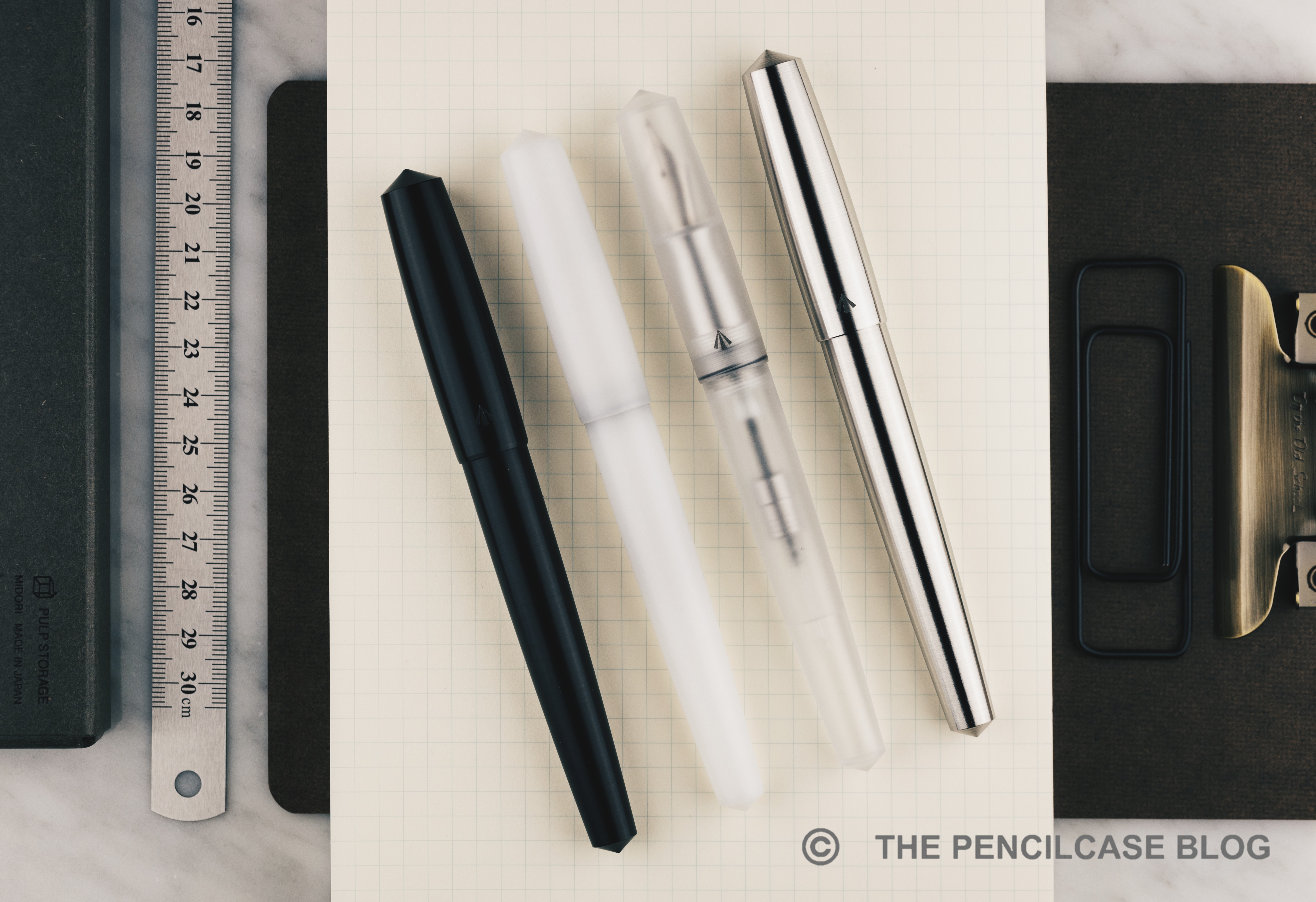
L to R: Black Delrin, white Delrin, Polycarbonate 'Big Dropper', Stainless steel Sentry
In an effort to keep up, I figured I'd bundle two of the more recent Gravitas products together since they share most stats anyway, differing only in the material they're made of. So in this review, we're taking a look at two additions to the Sentry lineup: the Gravitas Delrin and Big Dropper fountain pens. 

For those of you that liked the design of the Gravitas Sentry, but were put off by the sheer weight of these solid metal pens, these two might be right up your alley. The Big Dropper and Delrin fountain pens follow very closely on the design of the Sentry, carrying over the flattop design with pointed finials, curvy cap, and elegant long tapered body.

The real difference obviously comes from the use of clear translucent polycarbonate for the Big Dropper, and Delrin for the... well, Delrin version. 
REVIEW: GRAVITAS SENTRY BIG DROPPER & DELRIN FOUNTAIN PEN
The Big Dropper is made from clear translucent polycarbonate with a matte frosted finish. The machining and frosting is very uniform and provides a pleasant texture to the pen. As the name suggests, the Big Dropper lends itself perfectly to eye-droppering. I typically stay away from eye droppers (I don't care for the potential discoloration on clear pens, and I rarely ever need or want the ridiculous large ink capacity they provide), but this pen comes fully prepared, should you wish to eyedropper yours. 
REVIEW: GRAVITAS SENTRY BIG DROPPER & DELRIN FOUNTAIN PEN
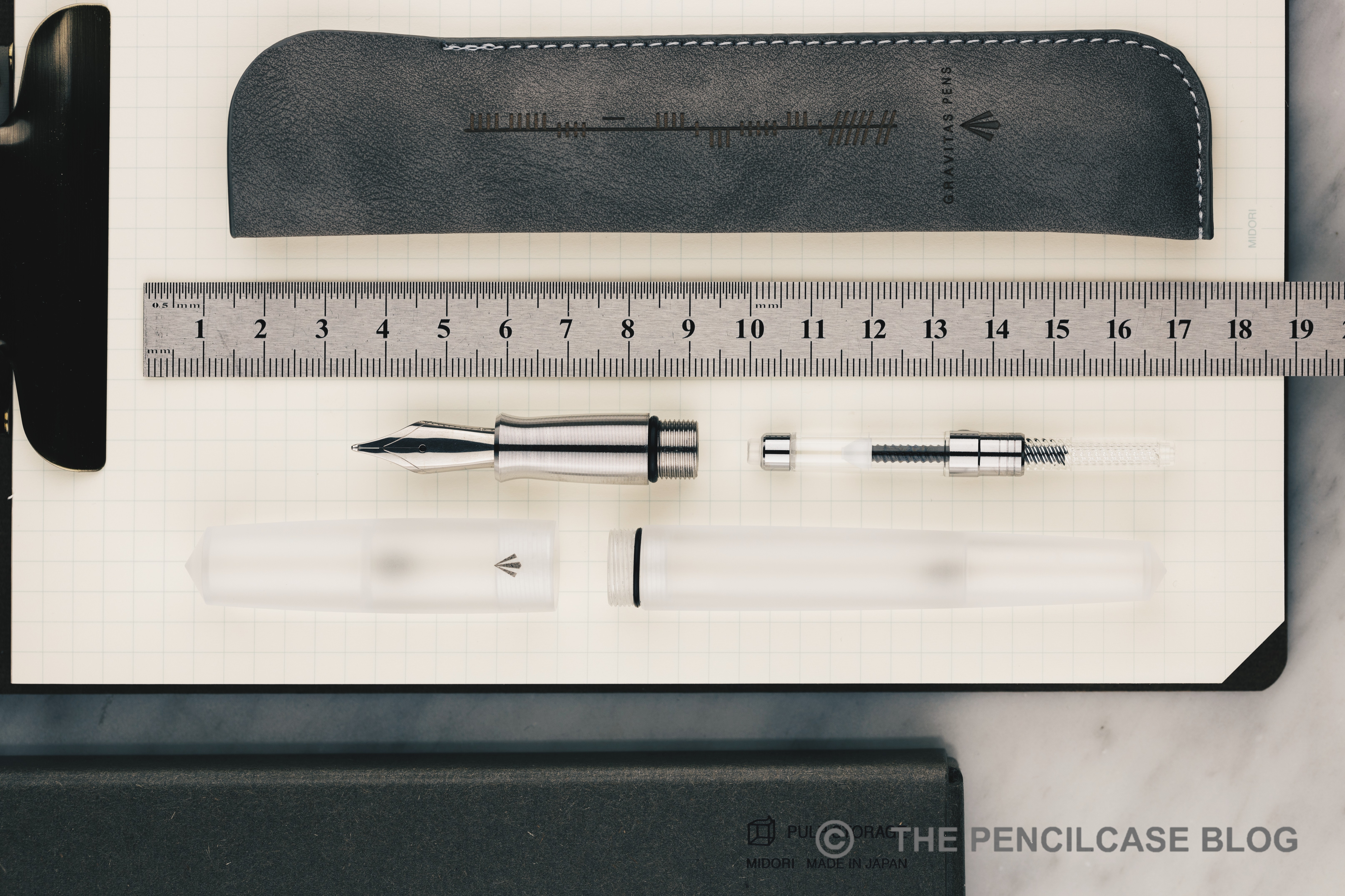
O-rings ready for eye-droppering!
They even added o-rings to the threads on both the section and cap to ensure an airtight seal (though you might want to add a dab of silicon grease on the section threads, just to be safe). It's difficult to say how the stainless steel section will react to prolonged contact with ink, but I'd assume it'll be fine as long as you don't go for very acidic iron gall inks or the like.
REVIEW: GRAVITAS SENTRY BIG DROPPER & DELRIN FOUNTAIN PEN
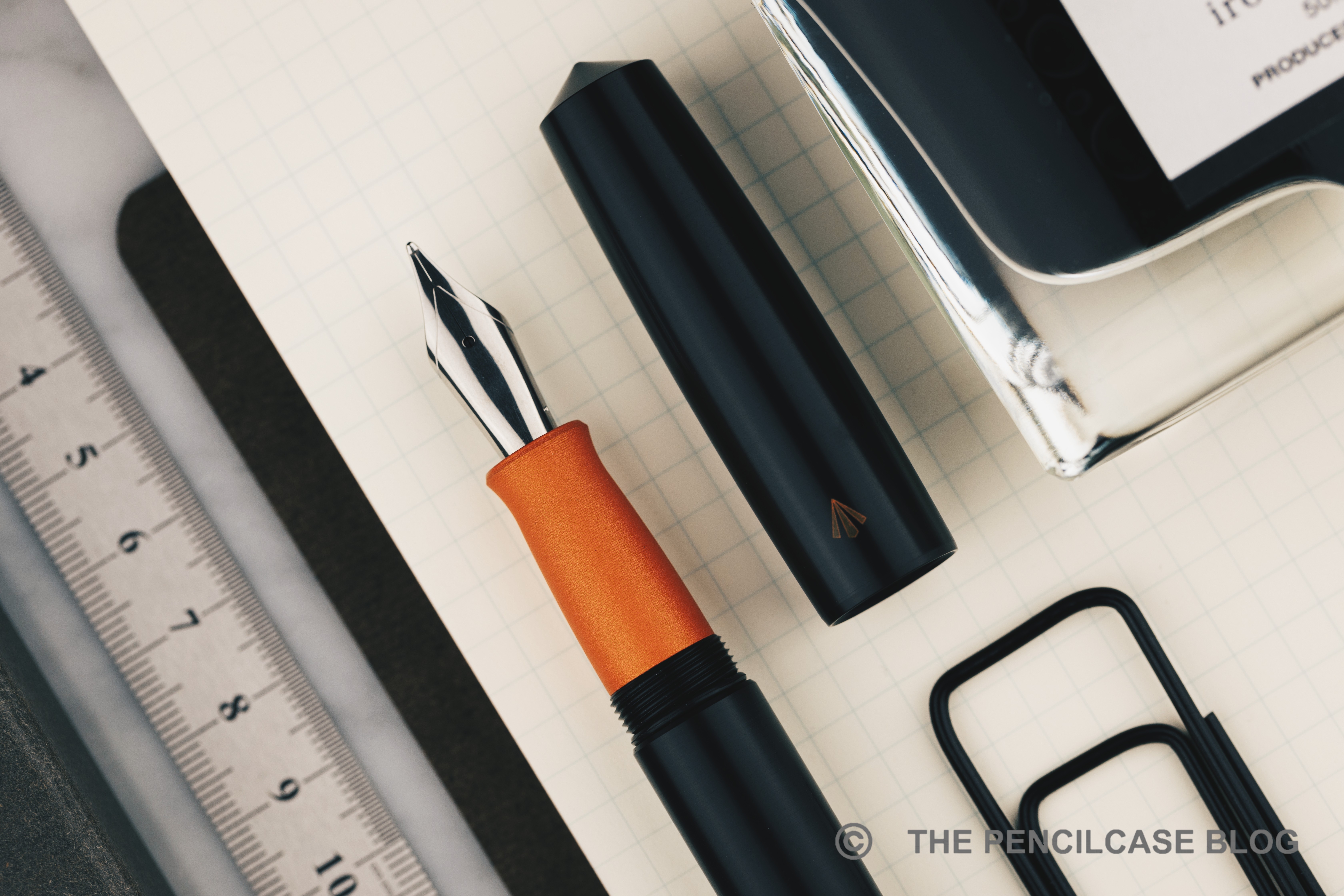
A subtle detail separates the regular black Delrin on the left, from the Delrin orange Cerakote on the right.
The Delrin option is perhaps my favorite (at least until I get my hands on the new Ultem version!). Delrin is a rather unique 'engineering plastic', meaning it has special characteristics and high durability that make it useful in industrial applications. It is slightly more dense, and has a super-slick and smooth (Delrin is often used as a liner in moving parts, because it's low-friction) feel in the hand. Just like the Big Dropper, the Delrin version comes outfitted with o-rings, ready to be eyedroppered!
REVIEW: GRAVITAS SENTRY BIG DROPPER & DELRIN FOUNTAIN PEN
The two standard colors of Delrin are opaque black and opaque white (interestingly, the white Delrin is the only pen without an etched Gravitas logo on the cap, because the material doesn't work well with laser-etching!). For a hint of color, there's also a black delrin version with an orange logo on the cap (though the color is quite faint) and an orange cerakote section. If you want even more color, Ben has also found a way to dye the Delrin into whatever color you like. If you've already bought a Gravitas pen before, you're automatically a Gravitas member and have access to a members-only area on their website where you can find some of those more experimental and flashy finishes! 

The one downside of Delrin is that it is highly susceptible to scuffs and scratches, so you might want to look elsewhere if you want to keep your pens looking pristine! This is especially noticeable on the black delrin, scuffs are harder to see on the white version.
REVIEW: GRAVITAS SENTRY BIG DROPPER & DELRIN FOUNTAIN PEN
L to R: Namisu Nova, Ensso Piuma, Gravitas Pocket, Gravitas Delrin, Gravitas Sentry, Gravitas Entry, Gravitas Flagship, Lamy 2000, Lamy Safari
Dimensions - at least on the outside - are identical to other variants of the Sentry, with a capped length of 14.6 cm/ 5.75", and 13.9/ 5.47" cm uncapped. At the widest point of the cap, the Sentry measures 15.5 cm/ 0.61" in diameter, and the barrel is 14 cm/ 0.55" at its widest. 

Of course, polycarbonate and Delrin - while both durable plastics - can't be machined as thin as their metal counterparts. This is apparent in the changes to the thickness of the cap, which meant that a slight redesign of the internals was necessary to make it fit together properly 
REVIEW: GRAVITAS SENTRY BIG DROPPER & DELRIN FOUNTAIN PEN
Sentry Delrin on the left, Sentry aluminum black anodized on the right
So while the section remains equally long to the one found on the Sentry, you'll notice that it is in fact a bit narrower (12mm at its widest point versus 13 on the metal version of the Sentry). This puts the Big Dropper and Delrin Sentries in between the Entry and (metal) Sentry in terms of section size, striking a good balance in my opinion. 
REVIEW: GRAVITAS SENTRY BIG DROPPER & DELRIN FOUNTAIN PEN - www.pencilcaseblog.com
Those millimeter differences might not sound like much, but they do make the plastic versions to the Sentry feel noticeably less bulky in the hand. Also due to the increased thickness of the cap, there's a more visible transition from the barrel to the section, though in the hand it's still barely noticeable as it steps down very gradually from the tapered edge of the barrel to the rubber o-ring, then the threads, and finally the section. 
REVIEW: GRAVITAS SENTRY BIG DROPPER & DELRIN FOUNTAIN PEN - www.pencilcaseblog.com
The plastic cap and barrel of course make for a substantially lighter pen. The polycarbonate big dropper weighs in at 29 grams (uncapped 26g), while the slightly more dense Delrin version weighs 32g (uncapped 26g). Since the metal section provides most of that weight, both plastic Sentries have a very clear balance towards the section, and feel much more nimble in the hand. I know a lot of people have strong feelings against metal sections, but Gravitas consistently implements them very well on all their pens, with a strongly pronounced taper and ridged machined texture to provide a comfortable grip.
REVIEW: GRAVITAS SENTRY BIG DROPPER & DELRIN FOUNTAIN PEN - www.pencilcaseblog.com
I got these back when Gravitas still equipped their pens with JoWo nibs. There's no point in telling you how a JoWo nib writes (you probably know this already, anyway). BUT, the new nib units are still backward-compatible with JoWo housings, so you can swap them out with spare nibs you may have lying around. In my limited experience with the new Gravitas steel nibs, I was quite pleased with how they perform, they can certainly hold up against JoWo.
REVIEW: GRAVITAS SENTRY BIG DROPPER & DELRIN FOUNTAIN PEN - www.pencilcaseblog.com
The Gravitas Sentry Big Dropper and Sentry Delrin are enticing new additions to the ever-expanding Gravitas catalog. They offer the same streamlined-yet-robust design of the Sentry, which I enjoy a lot. Will you mistake the Big Dropper or Delrin Sentry for a small pen? Probably not. But the combination of lighter weight and balance, and more average section width, definitely strikes a better balance if you're not that into oversized pens. 

They're priced fairly reasonably as well, at just 95€ regardless of which plastic version (polycarbonate, Delrin, or Ultem) you choose. As always, Ben Walsh has even more material options to choose from on the horizon (most noticeably, a Micarta version is currently in production), so there's no lack of options!

Some of the products featured in this review were sent to me by Gravitas. I was in no way influenced in the making of this review, the opinions shared in this review are completely my own! This post does not contain affilate links.
REVIEW: GRAVITAS SENTRY BIG DROPPER & DELRIN FOUNTAIN PEN - www.pencilcaseblog.com

Sunday, November 21, 2021

ACCESSORIES FOR THE DESK: MAKERS CABINET HØVEL & IRIS REVIEW


ACCESSORIES FOR THE DESK: MAKERS CABINET HØVEL PENCIL SHARPENER & IRIS COMPASS REVIEW

As with so many hobbies, most things within the writing community aren't about making sensible financial decisions. Let's be honest, it's quite easy to be tempted into buying (ahem, hoarding) all kinds of pens, pencils, desk accessories, and gadgets that nobody really needs... but everybody wants! The two desk accessories by Makers Cabinet we'll be looking at, certainly categorize as such. I can't help but be quite enamored by these nifty tools. 

UK-based Makers Cabinet hit the market somewhere in 2017 (then as 'Brahman Design') and was started by three product design graduates. Aesthetics is the name of the game with Makers Cabinet. You'd think 'form follows function' is out of the door then, but after using the Makers Cabinet Høvel pencil sharpener and Iris compass, the meticulous attention to detail quickly becomes clear.

As aesthetics are a big part of the appeal of the Høvel and Iris, so let's start there...

ACCESSORIES FOR THE DESK: MAKERS CABINET HØVEL PENCIL SHARPENER & IRIS COMPASS REVIEW

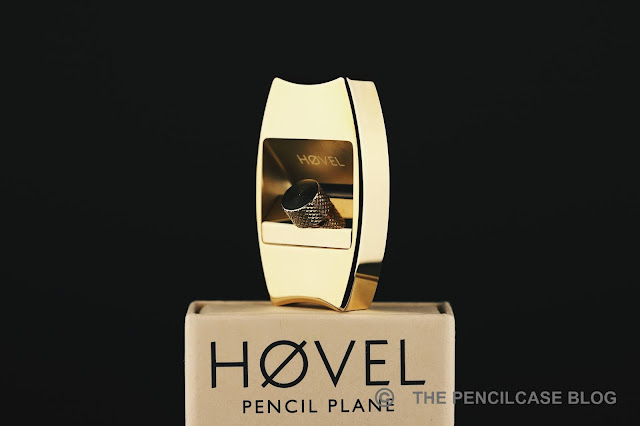
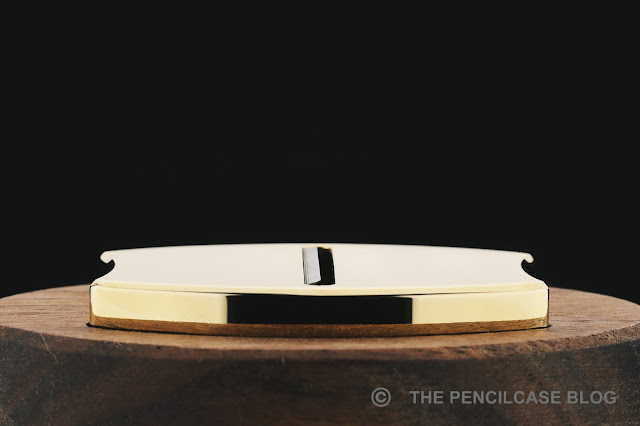
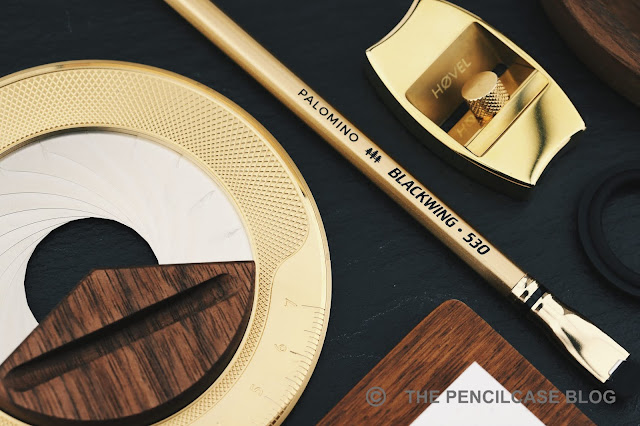
One key element returns throughout the entire product catalog of Makers Cabinet: all of their products are made out of brass! But as much as that ties together their different products, each item still very much brings its own unique look and feel. 

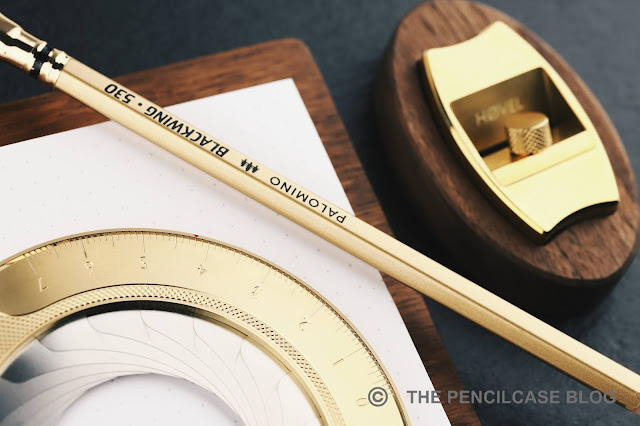
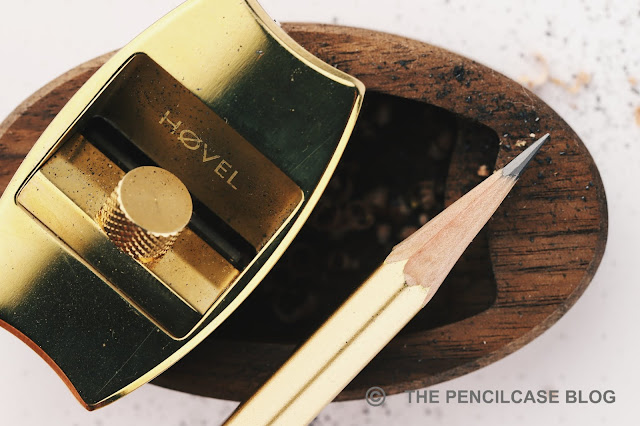
The Hovel - a very minimal, miniature interpretation of a wood planer - is a slick and sleek chunk of brass, with rounded edges and a highly polished finish. The rectangular cutout that houses the blade setup received a lightly sandblasted finish for a subtle contrast, it also has the 'Høvel' logo laser-engraved there.

ACCESSORIES FOR THE DESK: MAKERS CABINET HØVEL PENCIL SHARPENER & IRIS COMPASS REVIEW

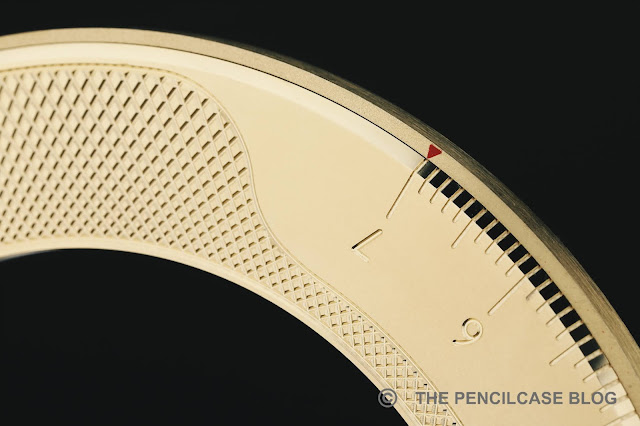
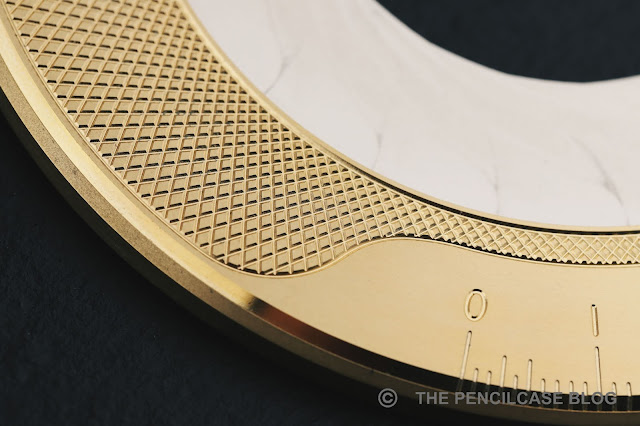
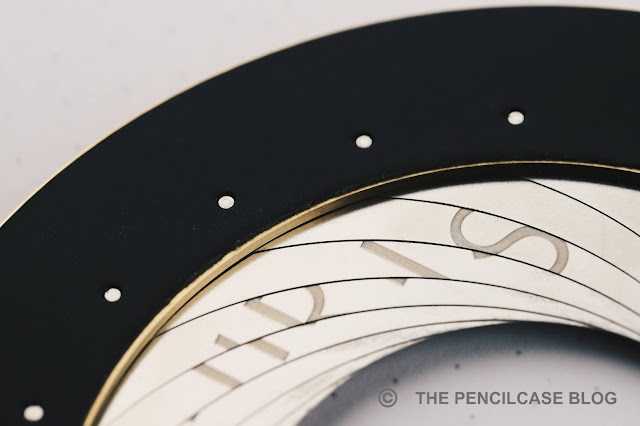
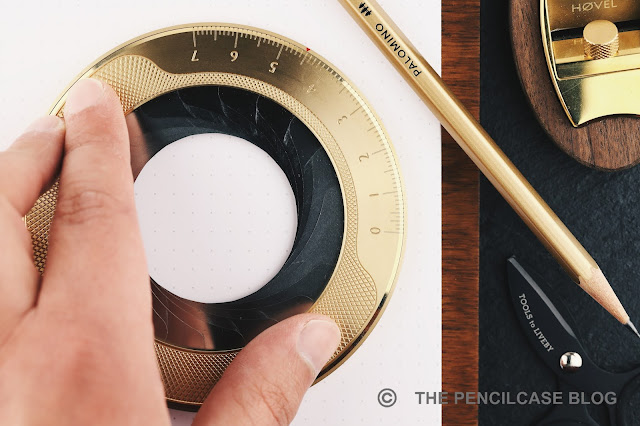
The Iris - a brilliantly overengineered take on the classic circle drawing compass - is quite the opposite in terms of design. Its crisp beveled edges, knurling, and mixture of finishes (machined finish, brushed, and sandblasted) interweave to create a distinctly industrial look and feel. One thing I noticed while using both products, is that the type of brass they use isn't very prone to tarnishing (even though it's not coated), I'm still waiting for the Høvel and Iris to take on a nice vintage appearance. 

ACCESSORIES FOR THE DESK: MAKERS CABINET HØVEL PENCIL SHARPENER & IRIS COMPASS REVIEW
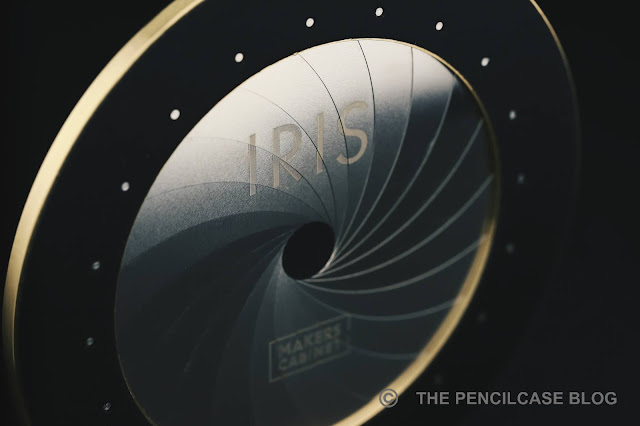
The 'Makers Cabinet' and 'Iris' branding only appears when you close the blades of the Iris!

The solid brass construction creates a wonderfully hefty tactile appearance. So much so, that I'm constantly tempted to play with the Høvel as a worry stone... if it wasn't for the blade sticking out of the bottom (not quite so practical as a fidget toy!).

ACCESSORIES FOR THE DESK: MAKERS CABINET HØVEL PENCIL SHARPENER & IRIS COMPASS REVIEW

No, neither Iris nor Høvel are cheap products by any stretch of the imagination, but it has to be said that the production quality on both is really, really impressive. Machining is precise, assembly and fit and finish is flawless, finishing is cleanly done. I have no remarks, it's as simple as that. 

Especially on the Iris - a rather complex mechanical construction with a lot of moving metal parts - it's extra impressive how everything fits together perfectly and the diaphragm slides open and closed buttery smooth. The only remark I could make is that stainless steel diaphragm blades of the Iris do pick up scuffs from sliding over each other, but that's to be expected with these moving parts.

Let's move on to functionality, because yes, you really are getting more than just a good-looking paperweight for your money!

ACCESSORIES FOR THE DESK: MAKERS CABINET HØVEL PENCIL SHARPENER & IRIS COMPASS REVIEW
It doesn't take much practice to get nice and clean sharpening results.

Starting with the Høvel; it has been mocked in the past for its very concept: a plane for a pencil sharpener, why even?!? I must say, I was skeptical as well, and my view aligned with some reviews that stated it's awkward and unnecessarily difficult to use.

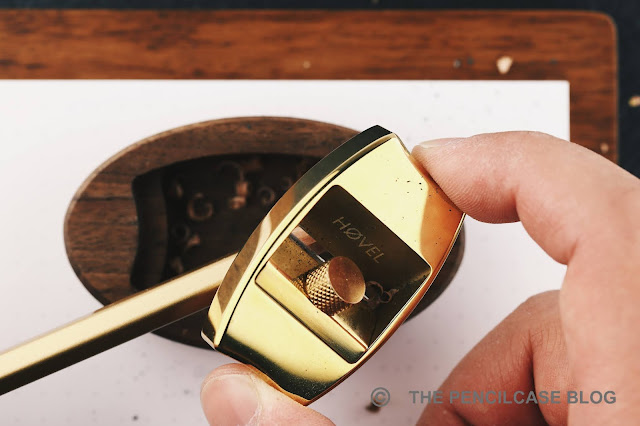
Though as soon as I started testing the Høvel myself, I found it surprisingly easy and intuitive to use. That does come with a slight sidenote that I often sharpen pencils with a pocket knife (I'm weird like that), so I do have some practice with unconventional sharpening techniques (that's undoubtedly my weirdest flex ever!). The alignment of the blade - just a millimeter below the plane surface - allows thin curls of wood to be shaved off using minimal pressure. With some practice, you can get straight and clean cuts and even make a nicely symmetrical point onto your pencil. 

The Høvel, just like a knife, gives you more freedom in varying the angle and shape of the pencil tip entirely to your liking, and it can also be used for oddly sized and shaped pencils that don't fit a traditional sharpener. The Høvel comes with a cute tiny package of 10 blades, which is more than enough to keep you sharpening for a while. 

ACCESSORIES FOR THE DESK: MAKERS CABINET HØVEL PENCIL SHARPENER & IRIS COMPASS REVIEW

One remark I have with the Høvel is that you have to hold it sort of precariously at the very edge to keep your fingers out of the way of your pencil, and the mirror-polished finish is quite slippery. Perhaps it would be useful if they'd add some knurling or texture to the sides of the Høvel. Maybe an idea for a future iteration? 

ACCESSORIES FOR THE DESK: MAKERS CABINET HØVEL PENCIL SHARPENER & IRIS COMPASS REVIEW

The Iris is probably my favorite of the two tools, and that's mostly due to the incredibly smooth and precise action of the 20-blade diaphragm opening and closing by turning the outer ring. It's very satisfying to play with! 

ACCESSORIES FOR THE DESK: MAKERS CABINET HØVEL PENCIL SHARPENER & IRIS COMPASS REVIEW

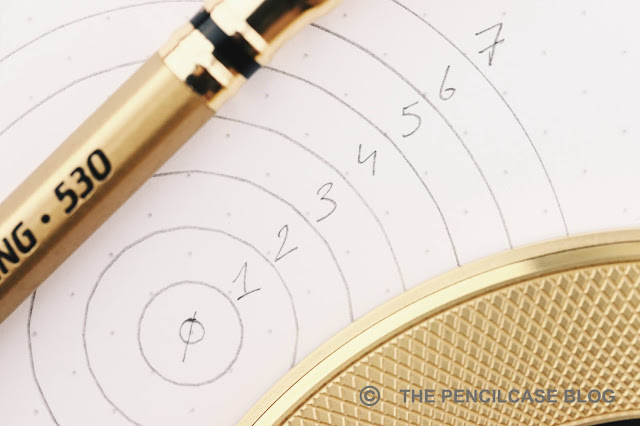
The centimeter scale on the outer edge enables you to precisely draw circles with a defined diameter, or measure them. Talking about that scale: I of course tested the accuracy, and it's accurate down to a millimeter or so. One slight caveat is that, even though the diaphragm has a lot of rounded blades, you always get a subtly 20-sided circle, not a perfectly round one. At some circle diameters it's more noticeable than others, though (circles above 5 cm appear perfectly round). With that said, I'd say the Iris is still perfectly suitable for drawing, sketching, or doodling. Anything but precise technical drawing. 

ACCESSORIES FOR THE DESK: MAKERS CABINET HØVEL PENCIL SHARPENER & IRIS COMPASS REVIEW

The rubber padding on the underside of the Iris keeps it firmly in place on the paper, which is necessary as the twist mechanism does require a fair bit of force to operate. 

ACCESSORIES FOR THE DESK: MAKERS CABINET HØVEL PENCIL SHARPENER & IRIS COMPASS REVIEW
The Høvel can also be placed upside-down in the wooden base and used as such

One more thing... Both the Iris and Høvel have a purpose-built walnut wooden base. With the Iris, it's included in the box (and doubles as a center-point finder when you place it within the Iris). The base for the Høvel, unfortunately, isn't included and adds an additional 14$ to the cost of the pencil plane. Frankly, I think the base for the Høvel should also be included in the price, as you miss out on a lot of functionality without it. For one, it protects the blade (and also your desk!) when not in use, but it also doubles as a pencil shavings tray, and a holder to place the Høvel upside down to sharpen your pencil with the Høvel on the table  (although I personally find it easier to use handheld). 

ACCESSORIES FOR THE DESK: MAKERS CABINET HØVEL PENCIL SHARPENER & IRIS COMPASS REVIEW

If price is no object, and you want something unique on your desk - certainly a conversation piece -, the Makers Cabinet Høvel (69€/ 80$) and Iris (120€/ 138$) are two tools (because despite the beautiful and unique design, that's still what they are) that are definitely worth checking out. Build quality is second to none, and I'm sure the Stria ruler and upcoming pencil extender 'Ferrule' will hold to the same high-quality benchmark Makers Cabinet has set for themselves. 

Better yet - with the upcoming Holiday season in mind - both the Iris and Høvel could make for ideal gifts for the design-minded writing or drawing enthusiasts that already have all the other essentials covered on their desk!

NOTE: These products were provided by Makers Cabinet, so I could write this review. I was in no way influenced in the making of this review, the opinions shared in this review are completely my own. This post does not contain affiliate links.

ACCESSORIES FOR THE DESK: MAKERS CABINET HØVEL PENCIL SHARPENER & IRIS COMPASS REVIEW