Showing posts with label Kunisawa. Show all posts

Saturday, March 13, 2021

PAPER REVIEW: PONT NEUF NOTEBOOKS

PAPER REVIEW: PONT NEUF NOTEBOOKS
I was really happy to see Japanese stationery brand Kunisawa recently re-introducing themselves with a completely revised product lineup (read the re-review HERE!). Their confidence in the updated paper quality turned out to be absolutely justified, finally combining the stunning business-chic notebook designs with fantastic - consistent - quality Japanese paper on the inside. 

But alongside the updated Kunisawa products, they also sent a few other products that certainly didn't fit in. That's because, as I mentioned earlier, mother company Kawachiya Print also houses a second stationery brand: Pont Neuf!  
The contrast between Kunisawa and Pont Neuf doesn't need an explanation...
Pont Neuf is best described as the absolute polar opposite of Kunisawa's functional, subtle, business-appropriate designs. Instead, they go for bright, colorful, playful products. The most eye-catching being a selection of wild, fluffy, fabric-covered notebooks - extravagant (and quite high-end)! But also the notebooks I'll be showing today, which are a collaboration with Tokyo-based art Gallery Brain Trust, for a collection with William Morris design notebook covers.
PAPER REVIEW: PONT NEUF NOTEBOOKS
William Morris was a renowned 19th-century artist and craftsman and is perhaps best known for his hugely popular - to this day - botanical patterns. His designs were originally created for wallpaper decoration, but I think it works equally well on these notebooks, and it fits right in with the style Pont Neuf tries to convey. 
PAPER REVIEW: PONT NEUF NOTEBOOKS
Both the A5-sized slim staple-bound softcovers (64 pages) and thicker A5 hardcover notebooks (192 pages) in the William Morris collection each come with unique cover prints, four in total. The printing is high quality and detailed, and the colors - while certainly vibrant - aren't overdone. One minor detail: I say A5, but both notebooks are actually 195 x 138 mm, which is ever-so-slightly smaller than the traditional A5 size!
PAPER REVIEW: PONT NEUF NOTEBOOKS
While the softcovers come with simple, uncoated paper stock for the cover (which has a nice subtle debossed texture from the printing!), the hardcover notebooks are distinctly more upscale. The cover is made of textured, heavily coated (plastic?) paper with gold foil debossed details, gilded edges, and rounded corners. One downside about the stiff, plastic-like material used on the hardcover is that it cracks and frays a bit around the edges of the notebook, which deters from the otherwise pristine cover design, and gives the edges a slightly rough feel.
PAPER REVIEW: PONT NEUF NOTEBOOKS
Both notebook types are able to lay open quite flat
Inside, the Pont Neuf notebooks do match the minimalist approach of Kunisawa with un-numbered, dot-grid pages and pretty much nothing else. The hardcover does have one practical element that the thin softcover booklets don't have: a thin bookmark ribbon.
PAPER REVIEW: PONT NEUF NOTEBOOKS
The paper inside the Pont Neuf notebooks seems to be identical to the excellent paper we've already seen in the updated Kunisawa Find stationery, which is of course a good thing. 
PAPER REVIEW: PONT NEUF NOTEBOOKS
For those of you that didn't read my previous review, here's a short rundown of my findings on this new paper: it's a very smooth stock, more or less the same thickness as Rhodia (so around 80-85 gsm), and with a distinct yellowy-ivory tint to it. The paper shows excellent shading and sheen and doesn't budge to wet nibs or even ink swabs, with no bleedthrough and minimal showthrough (or ghosting) to speak of.
PAPER REVIEW: PONT NEUF NOTEBOOKS
"Create your own style" an appropriate catchphrase for the eccentric Pont Neuf brand!
While I personally lean towards the minimal and clean aesthetics of the Kunisawa products, there is certainly something to be said for the more extravagant side of Pont Neuf's colorful collection of notebooks. The two brands work nicely side-by-side, offering unique products on two very distinct ends of the scale. Pricing is also comparable between the two brands, and - while certainly on the more premium side - is quite fair given the excellent paper quality and great design. The softcover notebooks retail for 5€/ 6$, and 25€/ 30$ for the hardcover.

Note: The products shown here were provided by Kunisawa, so I could write this review. I was in no way influenced in the making of this review, the opinions shared in this review are completely my own! This post does not contain affiliate links.
PAPER REVIEW: PONT NEUF NOTEBOOKS

Monday, January 25, 2021

RE-REVIEW: KUNISAWA FIND NOTEBOOKS

RE-REVIEW: KUNISAWA FIND NOTEBOOKS
As a reviewer, I wholeheartedly believe in second chances. I may or may not have already talked about this in the past, but I really appreciate when brands put in the effort to improve their product. Frankly, I may even find it more promising and reassuring than having a brand create an inoffensive - though middle-of-the-road - product, and then calling it a day. If you fail once, but stand back up and show dedication to improving - that's a win in my book! 

And that's exactly how we end up at Kunisawa today. If you remember my first encounter (review HERE) with this young Japanese stationery brand, their immaculate, business-chic design language created very high expectations... only to ultimately be let down by the terribly inconsistent paper quality. So sad.

RE-REVIEW: KUNISAWA FIND NOTEBOOKS
BUT! Kunisawa took the communities' criticism by heart and promised something better! A few months later, the first indication of their 'something better' arrived on my doorstep, in the form of a new paper prototype: a simple, thin 'cahier'-style notebook with a design that had nothing to do with the Kunisawa products I tested earlier, but the most important part was, of course, the new paper inside. I tested the prototype (didn't review it, as it was not a product intended for retail), and relayed my findings back to Kunisawa. 

Onto present day, and I'm looking at a stack of the updated 'Find' notebooks Kunisawa recently sent me. 'Find', of course being the unifying Moniker of every product sold under the Kunisawa brand. How I understand it, Kunisawa is part of a larger company Kawachiya Printing & Stationery, and represents the more business-styled side of the product catalog.

RE-REVIEW: KUNISAWA FIND NOTEBOOKS
The contrast between Kunisawa and Pont Neuf couldn't possibly be any bigger!
I fell in love with Kunisawa's distinct, clean and sober styling back in early 2019, and I'm glad it hasn't changed yet. You'll still find an overall quite muted and darker color palette among the offerings, with tasteful copper accents. In a way that only Japanese stationery can pull off, Kunisawa products are very simple in design and functionality, yet they always exude pure quality. In contrast to the Kunisawa products, the Kawachiya brand also houses a second brand: Pont Neuf. And if I say contrast, these two brands literally couldn't be any further apart. I'll be discussing Pont Neuf separately in a future post, as the products definitely cater to an entirely different audience, to say the very least!
RE-REVIEW: KUNISAWA FIND NOTEBOOKS
All-black everything
Back to the Kunisawa products at hand. As I said, design changes on the outside are very subtle, but there are a few small details here and there: There's now an all-black colorway with black gilded edges and accents - very cool and extra sleek! A larger, ring-bound 'Find Executive' notebook (more or less B5-sized, 80 sheets) was added to the lineup, the sticky notes (also 80 sheets) are now square-shaped and feature a very interesting recycled paper (more on that later). Oh, and the A5 Find 'Hard' note (a traditional A5 with a semi-hard cover, 96 sheets) now comes packaged in a box for some odd reason.
RE-REVIEW: KUNISAWA FIND NOTEBOOKS
But enough about the outside, because I was of course dying to find out if they managed to change the inside of their notebooks: the paper! I conducted some randomized tests throughout the different notebooks, and these are my findings...
RE-REVIEW: KUNISAWA FIND NOTEBOOKS
The paper is exceptionally smooth. It's MUCH smoother than the old watermarked 'Foolscap' paper, much smoother than Rhodia's vellum stock, much smoother than even most Life paper, yet the latter certainly comes closest. The smoothness makes it feels like a strongly coated paper, yet for some strange reason, it doesn't feel too coated or slick when you write on it, retaining just the right amount of texture - it's very strange and difficult to explain. In any case, I like writing on it, and it doesn't even seem to be too bothered by oils from your hand (Even though that's something smoother paper types often struggle with!).
RE-REVIEW: KUNISAWA FIND NOTEBOOKS
Shading and sheen are strong, even when compared to the reigning champion, Tomoe River. It's very difficult to get the paper to show any bleedthrough, despite throwing ink swatches and very wet and wide nibs at it. Even show through (or ghosting) is very well-contained.

RE-REVIEW: KUNISAWA FIND NOTEBOOKS
Yes, that's perfect sheen and shading, on a sticky note!

So, what about those sticky notes then? I obviously went 'oh no!' when I saw the recycled paper inside. However, to my biggest surprise, even this paper performed excellently in my writing test! No bleedthrough, no feathering, even the shading, and sheen can perfectly live up to the performance of the rest of the Kunisawa lineup! I don't know what sorcery they used for this, but clearly, it works very well!

The paper is downright excellent, and most of all, it's excellent all across the board. Every product, from the new Executive ring notebook, down to even the recycled paper sticky notes, showcased excellent paper, the kind of paper I'd expect when I crack open a notebook from Japanese manufacture.

RE-REVIEW: KUNISAWA FIND NOTEBOOKS
I'm very happy to see Kunisawa make a strong return. I was already hooked on their design style, and the paper quality on the inside can now match the luxurious looks on the outside! Whereas the mixed results with the old paper made it hard to draw a general conclusion last time, it's now much easier to come up with a bottom line: these notebooks are very, very good. 

Considering the more 'premium' style of the Kunisiwa brand, I'd say their pricing isn't that excessive (the Find sticky memo, Find Executive Ring note, and Find Note Hard notebook are priced at 6€/ 7$, 12€/ 14.5$, and 24€/ 29$, respectively), though they certainly land on the pricier side once you account for the costs of importing from Japan. With the quality I'm seeing today, that easily earns Kunisawa a recommendation from my end!

Note: The products shown here were provided by Kunisawa, so I could write this review. I was in no way influenced in the making of this review, the opinions shared in this review are completely my own! This post does not contain affiliate links.

RE-REVIEW: KUNISAWA FIND NOTEBOOKS

Monday, February 4, 2019

PAPER REVIEW: KUNISAWA FIND NOTEBOOKS

Paper review: Kunisawa Find notebooks
Some products start off so strong that you're convinced you'll never find any flaws to them... but then things take a turn for the worse. The Kunisawa Find notebook collection is one of those products. A pity really, because I was really quite was blown away by this extensive selection of Japanese stationery at first!
Paper review: Kunisawa Find notebooks
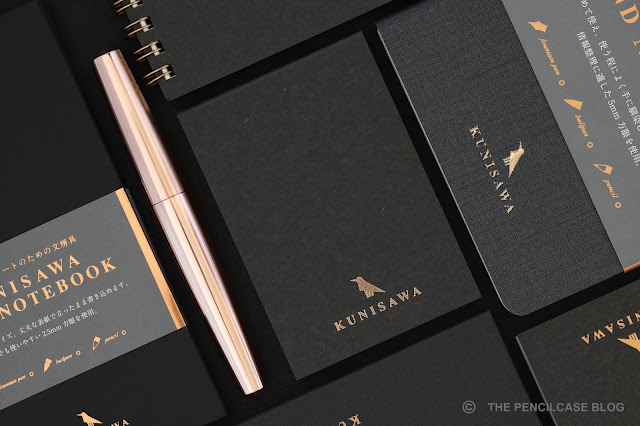
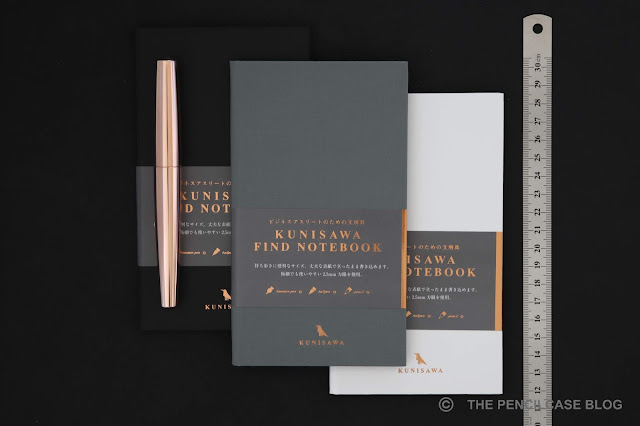
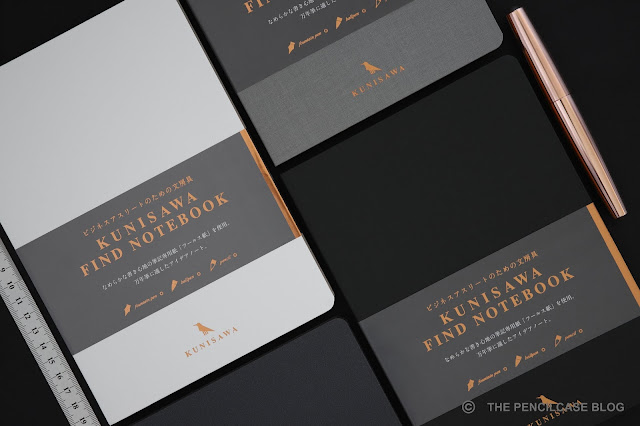
It all started out as a love on first sight-situation. Everything from the design to the precise packaging of the Kunisawa Find products is what I've come to expect from Japanese stationery: minimal design, subtle colors, neat and precise manufacturing,... These have it all. The aesthetic is focused around a business-y monochrome black-grey-white color scheme (with a few exceptions of brown and blue here and there) that are offset by copper accents such as the hot-foiled logo and gilded edges. The result is a stylish and varied set of notebooks, reporter pads, sticky notes,... 'plain' enough to be used in a professional environment, but with a distinct touch that sets them apart from the rest. 
Paper review: Kunisawa Find notebooks
One small detail about the design that I particularly enjoy, is that they use different cover materials for their different products. The hardcover notebooks have plastic covers with different textured finishes, while the ring-bound books are made with cardboard and the 'Soft' notebook has a textured PU foam cover -all of them in matching colorways of course. The variety in materials gives each product its own look and feel.
Paper review: Kunisawa Find notebooks
The logo represents the three-legged crow 'Yatagarasu', a Japanese mythical creature representing the god of guidance.
Then there's the wide range of products to choose from:
Paper review: Kunisawa Find notebooks
Find Sticky Memo. A7 size with 80 adhesive sheets, blank.
Paper review: Kunisawa Find notebooks
Find Block Memo. A7 size with 80 sheets, 2.5mm grid ruled.
Paper review: Kunisawa Find notebooks
Find Pocket Note. Spiral-bound hardcover notepad, 9x15cm. 50 sheets (100 pages), 5mm grid ruled.
Paper review: Kunisawa Find notebooks
Find Smart Note. A compact and slim hardcover notebook. 9x17 cm with 40 sheets (80pages) and gilt edges, 2.5mm grid ruled. Lays open completely flat.
Paper review: Kunisawa Find notebooks
Find Soft Note. A 12x21 cm softcover with flexible PU cover (very flexible!). 96 sheets (192 pages), 5mm grid ruled. Doesn't lay open flat because of the more flexible spine.
Paper review: Kunisawa Find notebooks
Find Slim Note. A thin A5 softcover notebook. 40 Sheets (80 pages) with gilt edges, 5mm grid ruled. Lays open almost completely flat.
Paper review: Kunisawa Find notebooks
Find Ring Note. A5 spiral-bound softcover. 80 Sheets (160 pages), 5mm grid ruled. 
Paper review: Kunisawa Find notebooks
Find Hard Note. Semi-hardcover A5 bound notebook. 96 Sheets (192 pages) with gilt edges, 5mm grid ruled. Lays open almost completely flat.

Functionally, all Kunisawa products follow a very minimalist approach, similar to other Japanese notebooks. All Find notebooks are as barebones as it gets: no numbered pages, no page marker, no elastic closure or back pocket. The only exceptions are the Find Note Soft and Find Note Hard, which come with a thin grey page marker ribbon. If you like your notebooks quite feature-packed, Kunisawa is likely not the brand for you.

Up until this point, I have absolutely zero complaints. I can live without numbered pages or a bookmark, but I expect to find decent paper on the inside. Unfortunately, that's an area where Kunisawa couldn't always live up to my (high) expectations.

All Find stationery utilizes the exact same 'Foolscap' paper (The term Foolscap most likely got lost in translation at some point as it's not a brand name, but rather a type and size of letter paper). The cream-colored paper seems to be around 80 gsm in weight (I couldn't find any actual specs to back this up). It's relatively smooth but not glassy smooth, so it's also suitable for use with pencil. All Find notebooks come with 5mm grid paper, except the Find Block Memo and Smart Note, which have a tiny 2.5mm grid. I wasn't so sure if a grid this small would be usable, but in practice it's really quite enjoyable to write on and I found that my writing would naturally fit inside the ruling. The light grey grid is noticeable, but not too obtrusive in my opinion.
Paper review: Kunisawa Find notebooks
Good vs Bad. Nice crisp lines on the left, feathering and a flat, bland line on the right.
Paper review: Kunisawa Find notebooks
Good vs Bad. Little to no bleedthrough on the left, quite severe bleedthrough on the right.
Paper review: Kunisawa Find notebooks
Excellent shading and sheen on the left. On the right is one of the 'mediochre' samples which shows little to no sheen but still shows decent shading.
Paper review: Kunisawa Find notebooks
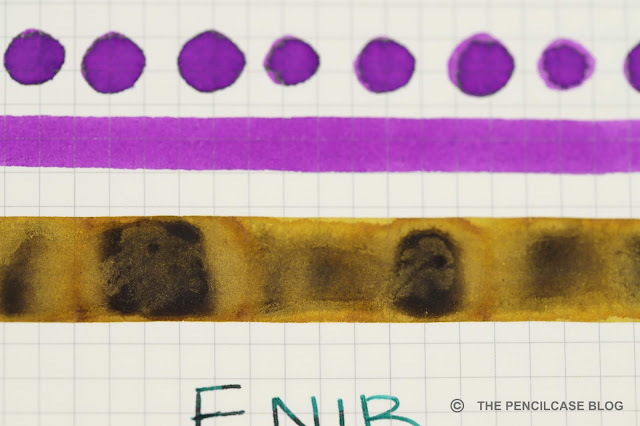
Very interesting shading/oxidation effect of Platinum Classic Citrus Black ink swab. This is one of the good paper samples.
As you can probably tell from the photos above, the problem is that -despite all using the same paper- they don't all perform equally well. I tested each different product with various fountain pens, cotton swabs, dip nibs,... and some performed absolutely perfect (zero feathering, almost no bleedthrough and ink dried crisply with nice shading and sheen), where others couldn't hold up to fountain pen use. 

Kunisawa sent samples to a couple different reviewers, and paper quality results seemed to be completely random throughout their product lineup. I'm fairly convinced that it's not a matter of bad paper choice (some samples I tested were legitimately excellent), but rather poor (or lack of) quality control that allowed a faulty batch of paper to slip through the net and get spread across different products. I emailed back and forth with Kunisawa about the paper issues and they in turn communicated it with their paper manufacturer. They acknowledged the issue and seemed to be working to fix it. 
Paper review: Kunisawa Find notebooks
"I do not seek, I find."
As it stands now, It's difficult to recommend any of the Kunisawa Find products, since there is no way of knowing which ones will perform well and which ones won't. Especially at their rather premium price point (up to 27$ for the A5 Find Note Hard notebook), there's no room for error. Kunisawa is a promising brand that I'll certainly keep an eye on. Their design philosophy and build quality is already on point, but I really hope they can fix the inconsistency in paper quality. Some of the products I tested had downright excellent paper, so I'd be all on board if they could provide that kind of quality across the board.

This product was sent to me by Kunisawa so I could write this review. I was in no way influenced in the making of this review, the opinions shared in this review are completely my own! This post does not contain affiliate links. 
Paper review: Kunisawa Find notebooks
Good paper left, bad paper right.
Paper review: Kunisawa Find notebooks
Good paper left, bad paper right.