Showing posts with label metal. Show all posts

Friday, August 7, 2020

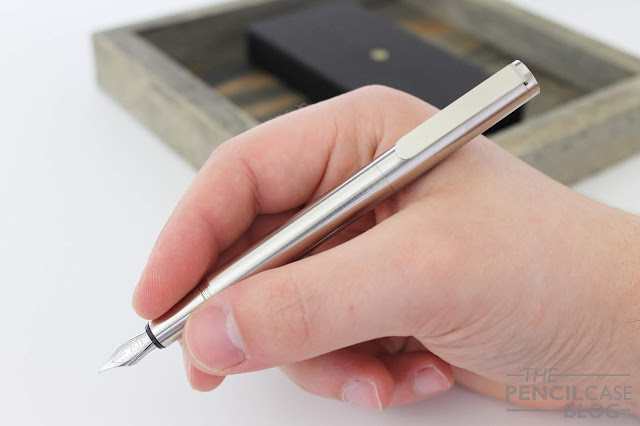
REVIEW: NAMISU NOVA STUDIO FOUNTAIN PEN

REVIEW: NAMISU NOVA STUDIO FOUNTAIN PEN
Back in 2016, Namisu launched the Nova. A pen that caused a short circuit somewhere in my brain I guess, because it was this pen that marked the beginning of my love for minimal design, metal fountain pens. Well, it actually took me about half a year to catch up to this relatively unknown -at that point- trend, because I didn’t buy a Nova straight away. 

The Namisu Nova Studio Ebonite (reviewed HERE) that I bought a while later - while not a metal pen - was my gateway into the brilliantly simple (Nakaya-like) shape of the Nova - to this day one of my favorite pen designs on the market. The Studio Ebonite also turned out to be the foundation for the pen we'll look at today, which is the latest iteration of the nova: The Namisu Nova Studio. 
REVIEW: NAMISU NOVA STUDIO FOUNTAIN PEN
The original Nova featured an ultra-minimal design, an exercise in clean lines, without unnecessary features or parts. Namisu turned to a bit more experimental and complex - but still minimal - designs after that, with combinations of different textures, metals, and shapes. The latest Naos (reviewed HERE) - another excellent pen - is probably the best example of this style. It seems to be the general direction they're trying to go in with their brand, and I think it fits their overall futuristic design language quite well. 
REVIEW: NAMISU NOVA STUDIO FOUNTAIN PEN
With minimal design, it's the small details that matter. And one of the small details that the Naos, Ixion, and Studio Ebonite all have in common is their coin-insert finials (ok, the Naos only has one on the barrel finial, but still). This is also what sets the Nova Studio apart from the regular Nova: it's all about those finials!

While an absolute design purist may find the separate finials on the Studio break up the clean lines, and distract from the ultra-minimalist, clutter-free look of the 'original' Namisu Nova, I think the finial design adds an understated but cool update to an already understated and cool pen. It makes the Nova appear a bit more refined - a bit more modern, even.
REVIEW: NAMISU NOVA STUDIO FOUNTAIN PEN
In essence that's about it, though. You can skip through the rest of this review if you just catch this: the Studio has coin insert finials, on which the Namisu - Studio name is engraved in a very small and subtle font. That’s the gist of it. I mean, of course, it’s still a Nova after all, the rest of the design is pretty much identical. 

Pretty much identical... But you know me, I'm the kind of person to ramble without end about the small stuff, so here are the other things that changed:
REVIEW: NAMISU NOVA STUDIO FOUNTAIN PEN
The bronze Studio (top) has a reddish hue almost like copper, both get a heavy patina over time.
The Nova Studio comes in titanium or bronze, with bronze replacing the usual brass or copper variants. Bronze seems to be all the hype these days in metal pen-land. It has the same heft as brass and copper, but the color is somewhere in between those two (leaning more towards the red hue of copper). The bronze studio has a lightly stonewashed finish on the cap and barrel, which contrasts with the polished cap and barrel finials. Under the cap, the section has a brushed/machined finish, which also has a bit more shine to it.

The titanium version of the Studio, on the other hand, has a more uniform brushed/machined finish on all parts of the pen, including the finials. It makes for a sleeker-looking pen, not in the least because the stonewashed bronze Studio gets a very dark brown patina over time, while the titanium pen retains its shiny, clean look.
REVIEW: NAMISU NOVA STUDIO FOUNTAIN PEN
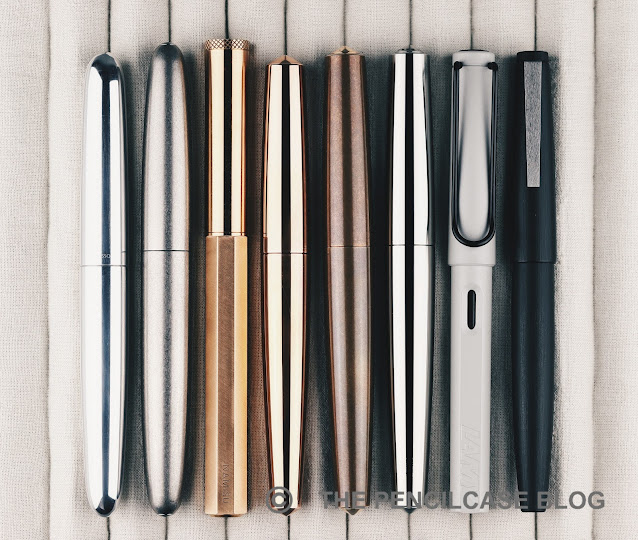
L to R: Ensso Piuma, Namisu Horizon Ti, Namisu Naos, Namisu Nova, Namisu Nova Studio (bronze & Ti), Lamy Safari, Lamy 2000
While the Nova Studio is still very much recognizable in terms of the general design and shape, its size hasn't remained completely unchanged. The Studio version is ever-so-slightly less tapered towards the barrel finial. It's a minute difference - we're talking less than half a mm (1/50th of an inch) thicker! - yet it's enough to give the pen a more robust appearance in my opinion. The Nova Studio also measures 14.1 cm (5.55") capped and 13 cm (5.12") uncapped, which is overall just 2mm (1/16th of an inch!) longer than the regular Nova. The changes are so subtle, you can see the difference when putting both pens side by side, but it's hardly noticeable when writing with them.

The Studio is also heavier. I wanted to write that it's noticeably heavier than the regular Nova, but to be honest I only found out when I actually weighed the pens! I guess I've grown so accustomed to heavier metal pens, I was surprised to see the bronze Studio tip the scales at 106g, and even the titanium version could be considered a true heavyweight at 55g (that makes them both about 10 to 15g heavier than their respective Nova counterparts!). It's not often that even a titanium pen weighs over 50 grams, so take that as a word of caution if you're not a fan of heavy metal...pens!

Since the Nova and Nova Studio aren't quite the same anyway, I'm a bit curious as to why Namisu didn't change up the overall shape and dimensions of the Studio more drastically, to clearly differentiate it. Although why change something that isn't broken, right?
REVIEW: NAMISU NOVA STUDIO FOUNTAIN PEN
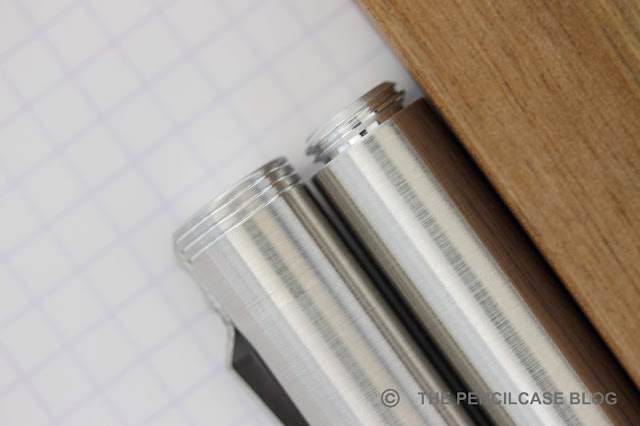
New threads on the left, old on the right.
The section design has always been an area where the Nova still has room for improvement, yet it remained unchanged on this iteration. Ok, not entirely. Just like the rest of the pen, the section is about a millimeter or so longer, but again that's not the kind of change you'll actually notice in use. The straight, tapered section offers enough space to hold the pen, but you'd be hard-pressed to not at least brush up against the threads and the rather large step towards the barrel. In fact, comfort might've actually taken a slight step back as they redesigned the shape of the block threads on the Studio for some reason, which no longer has chamfered edges, making them noticeably sharper to the touch. I was surprised to see that since there isn't a single sharp or unfinished edge to be found on the rest of the pen.

While I aesthetically find the Namisu Nova one of the most pleasing pen designs out there (at least when looking solely at minimal designs), it does make a few compromises for the sake of minimalism. Especially the threads and step are possible downsides to take into consideration when making a purchase decision.
REVIEW: NAMISU NOVA STUDIO FOUNTAIN PEN
The writing end of the Studio is of course still a steel or titanium Bock-made #6 nib. While not perfect, I do feel like I've had a noticeably higher success rate with stock Bock nibs recently (I don't know if that's because the QC improved, or just pure luck on my part). The nibs on these two pens are both very close to perfectly tuned. 

The broad nib on the bronze pen is my favorite. It has a slightly stub-like line variation and is perfectly smooth. The medium-wet ink flow keeps up well. As broad nibs tend to be, it does have a slightly more noticeable sweet spot if rotated. It occasionally hard starts - though briefly, only on the first pen stroke after sitting unused for a while - but otherwise doesn't skip.
REVIEW: NAMISU NOVA STUDIO FOUNTAIN PEN
Some people have had enough of the 'minimal pen' trend of the last few years. Not me though. I can still very much get excited about a good minimal pen, and I'd certainly categorize the new Namisu Nova Studio as good. Aesthetically, I still think the Namisu Nova is one of the best designs in its category. If you agree with me and - just like me - are a bit of a fan of the Nova, the Nova Studio might be a welcome addition to your collection. The design is a nice evolution from the regular model, and I like that that they made a bronze version to change things up a bit. I don't consider it as an upgrade necessarily, it still very much looks and feels like the pen it's based on. 

That being said, no matter how positive my ramble about the design may be, these are very heavy pens, and the section design won't play nice with every grip. Two caveats that prevent me from calling it a great pen. Whether or not they're a dealbreaker for you, is of course highly subjective.  

The Namisu Nova Studio Bronze and titanium have an MSRP of 79£ and 110£ (approx. 105$ and 145$) respectively, but Namisu often runs sales so you can usually find them for less (at the time of writing, both are available at 15% off). That's slightly more expensive than the regular Namisu Nova, but in my mind still a very fair price point.

One of the products shown in this review was sent to me by Namisu so I could write this review. I was in no way influenced in the making of this review, the opinions shared in this review are completely my own! This post does not contain affiliate links.
REVIEW: NAMISU NOVA STUDIO FOUNTAIN PEN

Wednesday, September 5, 2018

REVIEW: SCHON DSGN CLIP PEN

Pen review: The Schon DSGN Clip pen
I was sceptical about the Schon DSGN pen. More than sceptical really. Judging from pictures, it looked clunky and crude. Especically the section seemed like it would never in a million years be comfortable in the hand. Yet, I kept reading positive things about it online, what was it about this pen that I didn't see? 

After getting one in hand for this review, I found out what's so special about this little pen, and I had to thoroughly re-evaluate my opinion (this seems to be a recurring trend with many products I review...). 
Pen review: The Schon DSGN Clip pen
The Schon DSGN Classic pen (or Clip, depending on your choice of clipped/clipless) in a neat box that folds open to reveal the pen with its 'buyer's card' accompanying it. I had a little WOW moment when I first opened it, because the pen itself is sooo much tinier than I expected! It's often quite difficult to judge a pen based on measurements you find online, but in this case I completely missed the ball. 

Anyway, we'll come back to the size later. Let's focus first on the design, because the moment I held the Schon Clip pen in my hands, I started to appreciate the design choices that Ian (founder of Schon DSGN) made. It doesn't look crude or clunky in person. Very industrial, yes, but you can clearly see the thought that went into this -seemingly- simple pen. 
Pen review: The Schon DSGN Clip pen
Symmetry is key!
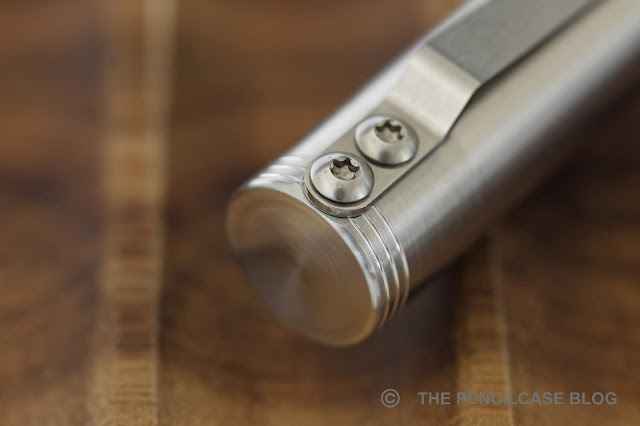
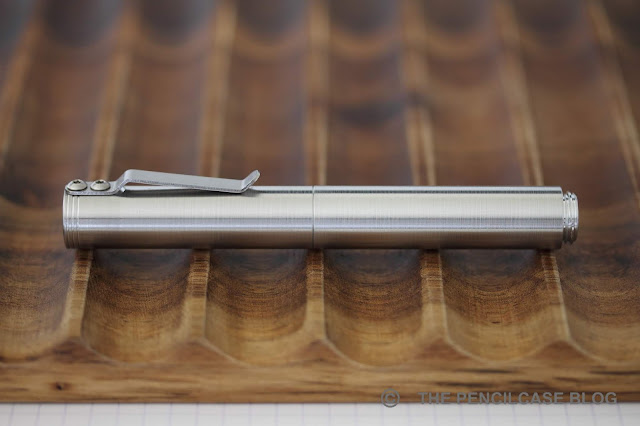
It's a straight, flattop, cylindrical pen from the outside, so nothing too spectacular per se. But as is the case so very often: the devil is in the details! The body of the pen is equal in length to the the cap, and to enhance the symmetry between both parts, the three grooves near the cap finial mimic the the threads at the back of the barrel. Nifty!
Pen review: The Schon DSGN Clip pen
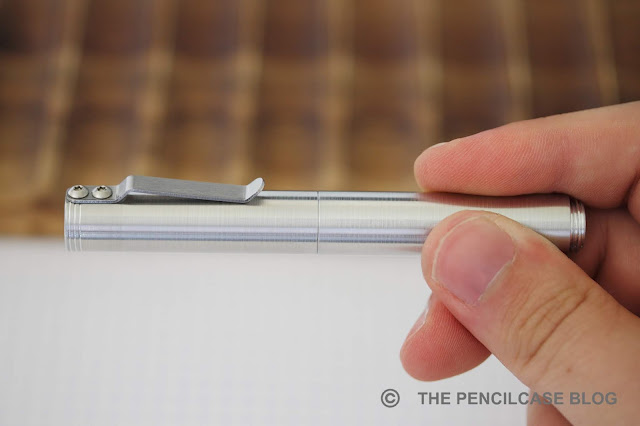
The folded steel clip is very similar to those used by Karas Pen Co., which is a sound choice for EDC-focused pens, and continues the industrial look. Different to the one found on Karas pens, the Schon pen features a narrower clip, which looks elegant but is also a bit easier to use because it's less stiff. The clip is bolted to the top of the pen, almost flush with the cap finial, so the pen doesn't stick out too far if you wish to pocket carry. 
Pen review: The Schon DSGN Clip pen
Underneath the cap, you'll find a slender but very long section, which ends in a short and stubby nose cone. The block threads are really short and placed towards the back of the section, closely followed by a rather large step. All these aspects together make for a rather interesting section that looks a bit out of proportion, but it really isn't. My only gripe would be that the nose cone is a bit too stubby, making it hard sometimes to see what you are writing.

The back of the barrel has the same short block threads which allow the cap to post. It looks like a cross-threading nightmare, but to my surprise that only happened occasionally. Most of the time, the cap and barrel align itself quite well and thread together smoothly. 
Pen review: The Schon DSGN Clip pen
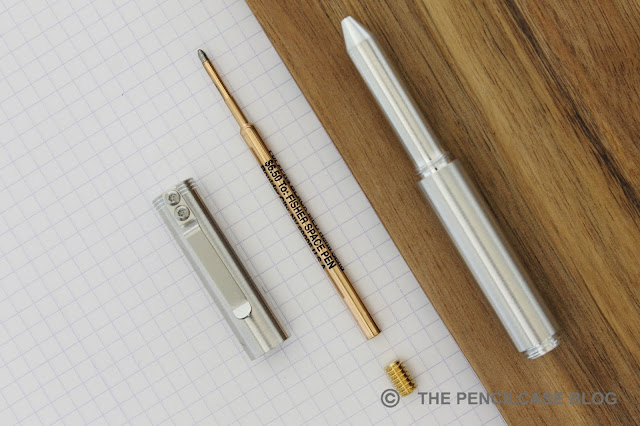
The Schon DSGN pens don't dissasemble near the section, like most pens do. Instead, you'll find a brass set screw at the back finial, which you have to unscrew to change the refill. I like this quirky design element, and I particularly like that all pens (various different materials, from stainless steel, brass or copper to annodized aluminium) come with the same brass screw, almost like a maker's signature.
Pen review: The Schon DSGN Clip pen
The set screw has one downside however: changing the refill means you have to have a flathead screwdriver handy. The Clip pen takes care of that, as the the tip of the clip is pointed upwards just enough to use it as a screwdriver! I wouldn't suggest using the clip for DYI jobs, but just for this task, it works perfectly. 
Pen review: The Schon DSGN Clip pen
L to R: Kaweco Al Sport, Lamy Pico, Baron Fig Squire Click, Inventery Pocket fountain pen, Schon DSGN Clip pen, Lamy Safari, Lamy 2000
At 10.2 cm (4") closed, 14.6 cm (5-3/4") posted and with a diameter of 1.3 cm (1/2"), these are definitely pocket pens. They have a surprisingly good heft to them, at 34g (1.2 oz) for the aluminium Clip version (up to 93g/3.3 oz for the solid copper versions!). 

It's obviously not meant to be used unposted, because it will literally dissapear in your hand. But with the cap posted, it transforms into a surprisingly comfortable full-sized writer. The section may be slender, but because it's long, it does a good job keeping my grip away from the threads and step. So while it may not seem comfortable at first, it's actually quite enjoyable to use for such a compact pen.
Pen review: The Schon DSGN Clip pen
The refill closes the deal for me, as Ian chose to make his pens compatible with the popular Fisher Space gas pressurized refill. These are excellent ballpoint refills. They are well-behaved and put down a smooth and relatively dark line that is as consistent as ballpoint pens go. Apart from that, it obviously has the advantage of being perfectly usable in wet, cold or hot environments, on difficult surfaces or even upside down. The choice of refill makes this pen all the more appropriate for EDC use. The only downside is that the refills are smalL, and quite expensive.
Pen review: The Schon DSGN Clip pen
To round up, the Schon DSGN Clip is a pen that does things right; It's clear aim at EDC use reflects in every aspect, from the durable build, practical size, strong clip,...all the way to the quality Fisher Space refills. I've followed Ian and his brand for many years (despite never pulling the trigger on one of his pens) and I know how anal retentive he is about quality and even the smallest of details (Talking about details: check out his drop-dead gorgeous handmade watches at Schon Horology! Expensive, but holy cow they are cool!). 

Ian persuaded me about his product, I have to admit I'm now one of the bloggers that will tell you this is an amazing pen. Yes, the price is a bit higher compared to the rest of the market, but that seems to be a recurring theme with made in the USA, EDC goods, and there is clearly a market for these high-quality products. If you want an excellent EDC pocket pen, and are willing to invest, watch the Schon DSGN pen!

This product was sent to me by Schon DSGN so I could write this review. I was in no way influenced in the making of this review, the opinions shared in this review are completely my own! This post does not contain affilate links.
Pen review: The Schon DSGN Clip pen

Monday, July 2, 2018

REVIEW: INVENTERY POCKET FOUNTAIN PEN

Review: Inventery Pocket fountain pen
Inventery Co. I've had a first encounter with them last year when I checked out the Inventery Co. Mechanical Pen. If I had to describe the Mechanical Pen in two words, it would be something along the lines of 'thoughtful design'. It has a simple, minimal design, but is put together with attention to detail in the right places (such as the flat side that acts as a roll stopper.

But apparently we haven't seen anything yet. With the new Pocket Fountain Pen, Inventery Co. takes that thoughtfulness one step further. 
Review: Inventery Pocket fountain pen
The Pocket Fountain Pen is not just...a pen, it's a modular writing system that you can fully customize to your personal preferences or depending on the situation. On top of that, Inventery Co. manages to present all that in a delightfully clean and minimal way. 
Review: Inventery Pocket fountain pen
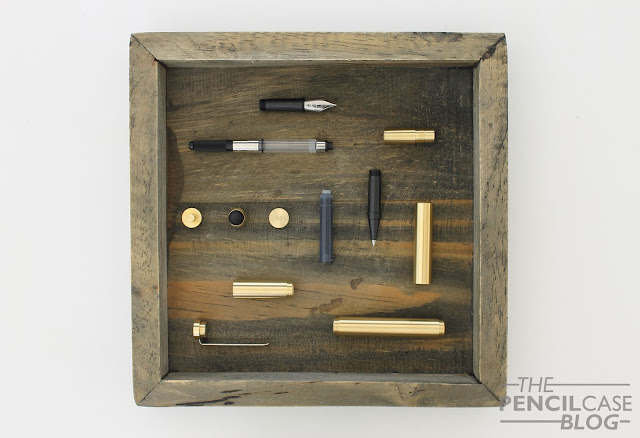
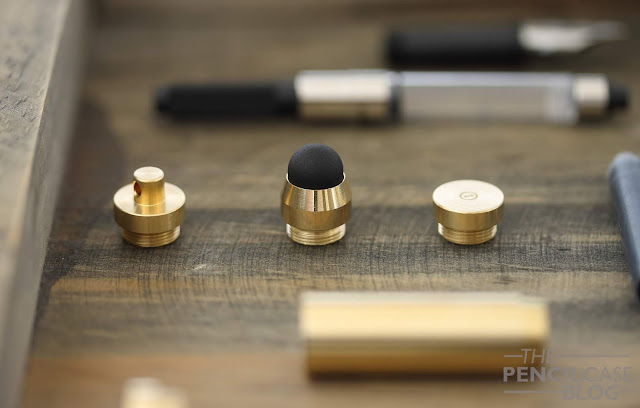
But I realise this may sound more like an advertisement than a review, so what are we really looking at? The Pocket fountain pen is -as the name suggests- a pocket fountain pen in the purest form. It's a very compact, straight cylindrical design that -just like the Mechanical pen- has very little design elements that actually set it apart. It comes standard as a clipped fountain pen, but in the box you'll also find three replacement finials: one clipless, one styles-tipped, and one with a lanyard attachment. 
Review: Inventery Pocket fountain pen
The clip finial is my personal favourite. It completes the design with a sleek touch of functionality. The clip follows the rest of the design aesthetic in that it's a very minimal piece of bent steel. In profile, the clip looks worthless: it doesn't sit tight against the cap, so it won't stay put if you clip it to something thin. But inside a pen case, jeans pocket, or on the cover of a notebook, it does the job quite well.
Review: Inventery Pocket fountain pen
The next item you'll find in the really tiny packaging (REALLY tiny) is a replacement Schmidt cartridge-rollerball tip. You see, this is not just a pocket fountain pen, it's also a pocket ink rollerball -or whatever you would call this-, but more on that later. 
Review: Inventery Pocket fountain pen
The final piece in the box is exclusively available for the more expensive package: an extender tube. This additional piece of connects almost seamlessly between the section and barrel, and allows the pocket pen to transform into an -almost- full sized pen by adding almost an inch in length. 
Review: Inventery Pocket fountain pen
cap posted, no extender
Review: Inventery Pocket fountain pen
extender, without the cap posted
Review: Inventery Pocket fountain pen
L to R: Kaweco Lilliput, Kaweco Supra, Kaweco Al Sport, Inventery Co. Pocket Fountain pen, Inventery Co. Pocket Fountain Pen + Extender, Lamy Safari, Lamy 2000
Depending on whether or not the extender tube is used, the Pocket Fountain Pen measures 10 cm (3.94") or 12.8 cm (5.04") closed, so either way it's a compact pen. Without the cap, the Pocket Fountain Pen + Extender measures just 12 cm (4.7"), but I tend to hold it close towards the nib so it fits my hand quite nicely. 

Posting the cap is kind of a necessity the extender, and brings the total length up to 13.5 cm (5.3"). With both the extender and the cap posted, it gets quite long (16 cm/ 6.3"). It has a constant diameter of just 1cm across the entire length of the pen. That's quite slim, especially because it narrows down to 8-8.5 mm at the section. I'm not normally used to thin and compact pens like this, so it required some getting used to.
Review: Inventery Pocket fountain pen
Since all three pens are brass (just finished differently), they all weigh the same. But of course the total weight changes depending on the way you choose to use the Pocket pen. Without the extender it's a solid 31g total, and the extender adds another 8g to that.

Of course all these measurements are only approximate, since the different finial options will slightly change the weight and length. 
Review: Inventery Pocket fountain pen
Go with what suits you best!
I prefer using it unposted and with the extender in place, even though that kind of defeats the purpose of having a pocket pen. I'm not the kind of person that regularly pocket carries his pen, but that's the beauty of this pen: you can use it however you see fit! Inventery Co. isn't immediately the most affordable brand in town, but you can expect to get quality in return. The Pocket Fountain Pen is no different: everything from the detailed packaging, the crisp and nicely bevelled threads or the overall impeccable fit and finish, show that this design was thoroughly thought out.
Review: Inventery Pocket fountain pen
Slightly ostentatious packaging for some cartridges...
One downside I could find, is the plastic liner inside the cap and extender piece. Given that it's a pocket pen, I would've liked to see the entire thing made out of metal (especially the threads) for extra durability. Another downside -inherent to pocket pens- is that the converter only fits with the extender in place. If you want the freedom to regularly switch between pocket and full-sized, you should stick with short international cartridges (which are easier on the go anyway). 
Review: Inventery Pocket fountain pen
I realise I haven't talked about the leather pen sleeves yet. Inventery also sent their three leather pen sleeves along to take a look at. They come in three sizes to fit the Pocket Fountain Pen, the Mechanical Pen, or the Pocket Fountain Pen + Extender. They match the Inventery pens with a small metal emblem on the back.
Review: Inventery Pocket fountain pen
L to R: Pocket Fountain Pen, Mechanical Pen and Pocket Fountain Pen + Extender
The concept is nice, but they cost between 30$ and 40$ depending on the size... I simply don't think they're worth that kind of money. The leather is thin, the fit and finish is nothing out of the ordinary, and the fit is extremely snug (all three pens will stick out a bit from the top, so not the most ideal protection).
Review: Inventery Pocket fountain pen
As for the nib, Inventery Co. opted for Schmidt for both the fountain pen nibs and cartridge-rollerball parts. For the nib, you can choose between F and EF widths in either black, gold-plated or steel. I received only fine nibs, which are a very balanced option for a pocket fountain pen (they run on the slightly wider side). I have to say, for #5 nibs I prefer Schmidt over Bock. These are solid writers, hard as a nail but ample smooth. The ink flow isn't the most consistent ever, but it never hesitated. It writes from the first letter to the last, no hard starts or skips. Design-wise, Schmidt nibs aren't immediately the most modern or minimal-looking ever, so I would've preferred if they had left the nib face blank or at least less adorned.
Review: Inventery Pocket fountain pen
The cartridge-rollerball is designated as 0.5mm, and lays down a crisp line that is comparable in width to the F nib. The cool thing is that the cartridge-rollerball utilizes the same cartridges/converter as the fountain pen, so you can use your favorite fountain pen ink with it. I found it a tad bit scratchy for my personal preference, but it's nice anyway that you have the option to change.
Review: Inventery Pocket fountain pen
The Inventery Co. Pocket Fountain Pen has a lot to offer, and the multitude of exchangeable parts ensures that you will almost certainly find a setup that suits you best. Inventery is a design brand pur sang, and unfortunately design never comes cheap. Having to machine so so many different parts (8 in total, without the nib and converter!) inevitably adds to the cost as well. The Pocket Fountain Pen comes in at 135$, and the set with extender is 30$ more at a total of 165$. I would be lying if I said that's not a lot of money. But I don't think it's entirely unreasonable, given the great multifunctional concept and excellent execution.


This product was sent to me by Inventery Co., so I could write this review. I was in no way influenced in the making of this review, the opinions shared in this review are completely my own! This post does not contain affiliate links.
Review: Inventery Pocket fountain pen

Monday, June 18, 2018

REVIEW: BN WORKS TWIIST 2-IN-1 PEN

BN Works Twiist pen review
In the last few years the market for machined pens has expanded incredibly fast, making it hard to keep up with every new product that pops up. The BN Works Dot -debut product for the Taiwanese design brand- was one of those products. It kind of flew by me unnoticed. So when Tony from BN Works contacted me, I couldn't immediately connect the dots (terrible pun alert!). It's very difficult to stand out as a new brand, especially with a low-key product like the Dot. Their new product however, seems to be a bit more tricked out and managed to grab my attention when I checked it out.
BN Works Twiist pen review
A Schmidt P900 and P8126 refill are included in the box, as well as two additional replacement stylus tips
The BN Works Twiist (no, that's not a spelling error!) looks like just another rollerball pen, yet it has a neat trick up its sleeve! But more on that later. First, let's look at the design...
BN Works Twiist pen review
At first glance, I find the Twiist has a strong resemblance to the Karas Pen Co. Retrakt (that I reviewed HERE), or a Parker Jotter: a wider top section, and a long grip that tapers towards the front. The clip closely resembles the type of bent steel clip that brands like Karas Pen Co. or Schon use. It is connected to the barrel internally instead of the two external screws, which gives it a less rugged appearance.
BN Works Twiist pen review
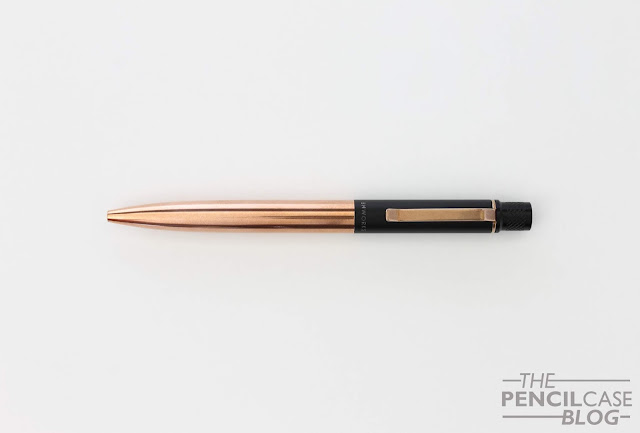
The Twiist is available in four clean-looking anodized aluminium colorways. They all have contrasting upper and lower body parts: black+grey, grey+black or rose+black. The version I chose is a bit different from the rest, in that it features a solid copper lower section, combined with black aluminium on top. The combination of matte black and copper is striking. On top of that I just really enjoy the way copper creates patina so this was an easy choice (yes, it does leave a penny smell, if that bothers you!).
BN Works Twiist pen review
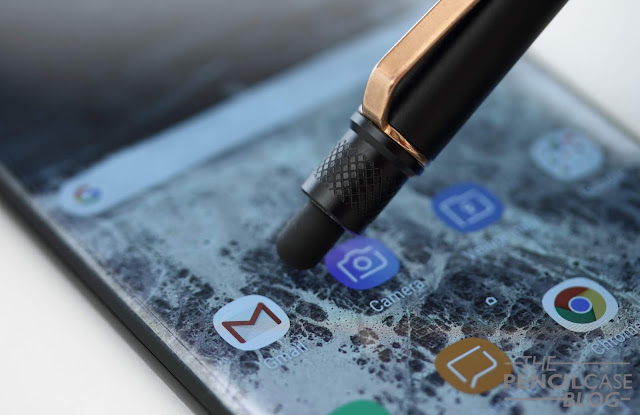
The double 'i' in the name stands for the double twist action: twist the body and the pen engages or retracts. twist the knurled section above the clip, and out pops a capacitive stylus tip. 
BN Works Twiist pen review
First of all, I think the mechanism is absolutely genius. It's simple but effective, and it offers a clean way of protecting the stylus tip. I'm the kind of person that likes uncluttered design, and I find little use for a stylus in my daily life. The only scenario when I will actually use it, would be while I'm writing and quickly need to check something on my phone or tablet. Other than that, I would rather not have it spoil the design, so it's nice that the stylus isn't visible when you don't need it.

Both the pen and stylus mechanism are made out of brass and have a very smooth action. They twist to engage, and reassuringly click into place with a subtle 'snap'. I liked the mechanism so much that I frequently found myself fidgeting with it. There is a tiny bit of play to it, but it doesn't rattle or feel cheap. Overall it feels solid and well put together.
BN Works Twiist pen review
L to R: RIIND The Pen, Karas Pen Co. Retrakt, Baron Fig Squire, BN Works Twiist, Lamy Vista, Lamy 2000
I already mentioned the similarity in design to the Karas Retrakt, but the Twiist is also fairly similar in terms of dimensions. It measures 13.6 cm (5.35"). The diameter is about 10.5 mm at the top section, and 9-10 mm where you grip it. It's quite comfortable in the hand. However, because there is no knurled or textured section, it can become a bit slippery.
BN Works Twiist pen review
The writing experience is quite pleasant. BN Works provides both a Schmidt P900 ballpoint and Schmidt P8126 rollerball refill in the package. I went for the P900, that I had never used before. Ballpoint refills don't have the same dark and consistent line as rollerballs do, but I nevertheless quite like this one. It's a smooth refill, and it doesn't leave blobs or marks that smear. One thing I especially like about the Twiist, is that the tip is machined with a tight tolerance. It doesn't have the tendency to rattle or move around when you write.
BN Works Twiist pen review
I'm not gonna lie, stylus 2-in-1 pens generally seem to be quite a hard sell. Is there really a use for a stylus tip, if your finger does the exact same job? I guess for tablet users and people who draw or sketch on digital devices, the answer would be yes. But for the average consumer it doubt it really offers much added value.

Nevertheless, I like how BN works added a stylus without interrupting a clean design. The stylus retracts when not in use. Out of sight, out of mind, a nice compromise. But of course it still adds to the price tag, so that may be a bit of a hurdle for some.

At 85 USD, the BN Works Twiist sits somewhere in the middle of the market. It costs more than the Karas Pen Co. Retrakt, but less than the RIIND pen (that I reviewed HERE). I think the price is quite fair considering the quality and design of the pen, the complex mechanism with the stylus tip, and the additional replacement stylus tips and refill that you get in the box.

This product was sent to me by BN Works so I could write this review. I was in no way influenced in the making of this review, the opinions shared in this review are completely my own! This post does not contain affilate links.
BN Works Twiist pen review