Showing posts with label journal. Show all posts

Saturday, June 6, 2020

PAPER REVIEW: ELIA NOTE JOURNAL

PAPER REVIEW: ELIA NOTE JOURNAL
At this point, it's almost impossible to imagine that there used to be a time when we didn't have - or at least, didn't know - Tomoe River paper. In less than a decade, it changed the way we look at fountain pen-friendly paper, it even changed how we use inks (and what properties we look for, in said inks!). It's safe to say that it's a pretty big deal for our writing community, and so in the last few years, we've seen numerous brands pop up left and right, dealing almost exclusively in the Japanese miracle paper. Where TR used to be Japan's hidden treasure, nowadays you shouldn't have to look too far to get your hands on some Tomoe, be it in loose sheets, pad, or notebook form.

But for this review, I did look a bit further... All the way to Malaysia even, where a young start-up notebook brand has its roots: Elia Note. Their brand is still only about two years old, but so far they remain based around one, simple product. And thus you'd be right to assume that it just HAS to be a good one. 
PAPER REVIEW: ELIA NOTE JOURNAL
With only a single notebook - The Elia Note Journal - in three variations (blank, lined, or dot grid), as well as an accompanying leather notebook cover, Elia Note keeps things simple and straightforward. You want a notebook, you get a notebook. The notebook itself follows the same minimalist mindset, with a design that's about as simple as it gets: A beefy softcover notebook in A5 size with a thin leatherette cover, unbranded on the outside, and precisely bound (Smyth-sewn, which means the spine is very flexible and the notebook can lay perfectly flat!) and precisely trimmed to give a clean and meticulous first impression.
PAPER REVIEW: ELIA NOTE JOURNAL
The notebook comes packaged in a sturdy cardboard sleeve which protects the notebook and is useful for archiving it once its full. It does lack the blotter sheet that comes included with some other Tomoe River notebooks, so if you're not a fan of watching ink dry, this might not be the notebook for you (although if you hate long dry times, TR is probably off the table altogether!).
PAPER REVIEW: ELIA NOTE JOURNAL
The same, but different: the coated linen cover from the Nanami Seven Seas journal looks and feels quite different from Elia Note's leatherette cover material
There are quite a few brands around the world (Nanami, Musubi, Galen Leather,...) that sell notebooks similar to the one Elia Note offers (I assume that most of them are even made by the same Japanese manufacturer), for good reason: The selling point of a journal like this is that you get an absurd amount of pages in a single notebook, showcasing perfectly what Tomoe River does best: super-thin paper that allows for lightweight and thin print work (TR was originally created for catalogs that needed to be light and thin enough to be sent by postal service!).
PAPER REVIEW: ELIA NOTE JOURNAL
While the Elia Note Journal is certainly a fairly thick boi, it's still relatively compact once you realize there are almost 500 pages inside (496 to be precise, roughly the equivalent of two 'normal' notebooks!). Of all the TR notebooks of this type that I own and could find online, the Elia Note has the absolute highest page count. Although the 16 pages difference with its closest competitor - the Nanami Seven Seas journal - is arguably not that significant, most other brands only come with 400 pages, yet they cost almost the same or more!
PAPER REVIEW: ELIA NOTE JOURNAL
The combination of the soft, leatherette cover and the Smyth-sewn binding and a large number of signatures, makes that this journal stays open and closed when you want it to. The pages lay flat almost completely, and yet it's also quite flexible when you need it to be. This makes for a notebook that's easy to carry around and comfortable to write in - despite being rather thick.
PAPER REVIEW: ELIA NOTE JOURNAL
As I said, there are a few brands that offer high page count Tomoe River notebooks in a similar format as this one, but the Elia Note Journal is the only one I know that offers my preferred ruling as standard: dot grid! Of all the inventive and - sometimes - quirky ruling types that exist nowadays, I still very much prefer dot grid as the most unobtrusive, yet effective method to keep my writing in check.
PAPER REVIEW: ELIA NOTE JOURNAL
With 496 pages of 52gsm Tomoe River paper, you're set for quite a while (although the blank page syndrome may be extra daunting, with that many pages to fill!). I feel like a lot of new notebook brands these days tend to go for the slightly heavier 68gsm version, which - realistically - has the upper hand in terms of bleedthrough and showthrough, and the paper is a bit more practical to handle.
PAPER REVIEW: ELIA NOTE JOURNAL
Is there even really a need for super-lightweight paper in a notebook like this? Probably not. But the 52gsm paper does undoubtedly remains the king in terms of writing fun. It's super smooth (smoother than the 68gsm?), and it's unmatched in terms of how it renders fountain pen ink and brings out all kinds of hues, shading, and sheen that you simply don't get with other paper. The fact that it's frail and crinkly makes it all the more charming. Ah yes, I think I could rave on for hours about Tomoe River!
PAPER REVIEW: ELIA NOTE JOURNAL
The Elia Note Journal is priced at 24€ / 27$. While that's slightly more than your average notebook, keep in mind that you get twice the number of pages, so in terms of absolute cost per page, I can't complain. As I said, there are a couple brands that offer notebooks like this, but the Elia Note journal stands out for its dot grid ruling option and its incredibly high page count.

NOTE: This product was provided by Elia Note, so I could write this review. I was in no way influenced in the making of this review, the opinions shared in this review are completely my own! This post does not contain affiliate links.
PAPER REVIEW: ELIA NOTE JOURNAL

Saturday, January 5, 2019

PAPER REVIEW: STALOGY 365 DAYS NOTEBOOK

Paper Review: Stalogy Editor's note 365 Days notebook
The world of Japanese stationery is vast, and from my -rather limited- experience, filled with a LOT of fantastic products. Stalogy is a new brand to me, but I'm glad I got introduced to their products back in September when I visited 'Buiten De Lijntjes', a stationery/lifestyle shop in the Netherlands! 

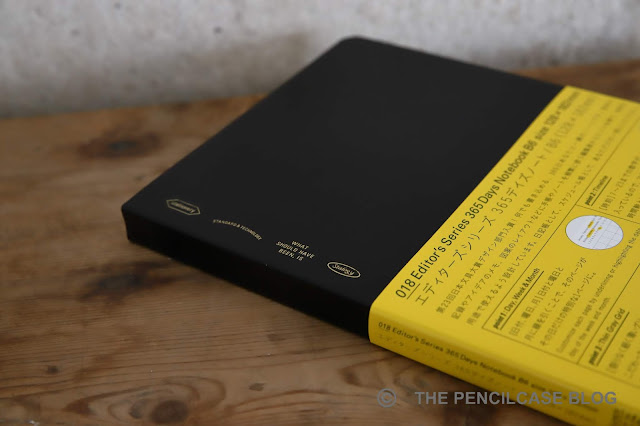
The product that was recommended to me by the shopkeeper was the Stalogy Editor's note 365 Days notebook. A seemingly simple and low-key notebook that didn't stand out much, apart from its bright-yellow packaging. It immediately reminded me of the Hobonichi journals, but it's in no way connected to them (at least as far as I know). 

"...Eliminating unnecessary ornamentation and function, we are taking a new look at what's really necessary, rediscovering essential elements and aiming to finally arrive at what should have existed all along. What should have been, is," -Stalogy

The Stalogy 365 journals are plain-looking, softcover notebooks with a black textured 'plastic' outside cover. A few Stalogy logo's and their slogan "what should have been, is" adorn the top left edge of the front cover, hot-foiled in gold. It's a fairly no-nonsense, industrial-looking product at first sight.
Paper Review: Stalogy Editor's note 365 Days notebook
One reason why I love Japanese stationery is their excellent eye for detail, and Stalogy definitely does not disappoint in that regard. The 365 notebook is flawlessly put together with a tight stitched spine and neatly cut edges. The 365 Days notebook comes in 4 form factors: B6, A6, B5 and B5. All versions come with a massive 368 pages, yet are only about as thick as a regular Leuchtturm notebook (which is only approx. 250 pages!). Reason for that is the extremely thin paper they use. I have the urge to say it's Tomoe River paper (probably the 68 gsm variant), but I couldn't find any information to back this up. 
Paper Review: Stalogy Editor's note 365 Days notebook
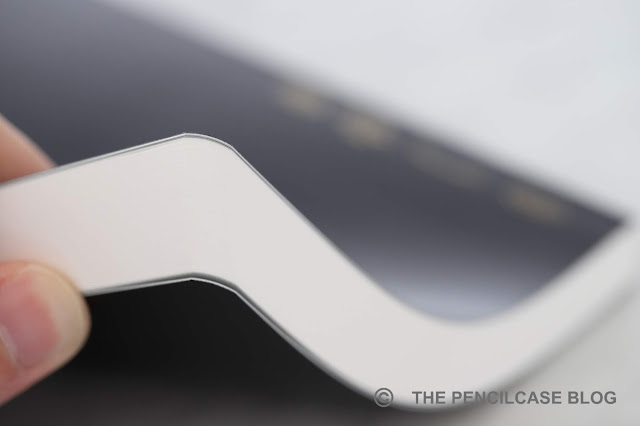
In use, the outside cover is flexible enough to fold almost 360° if you want to. The notebook lays open on itself, but it doesn't stay completely flat. I used the smaller B6 size and it's comfortable to use and take with you on the go, although I usually tend to go for slightly larger notebooks. 
Paper Review: Stalogy Editor's note 365 Days notebook
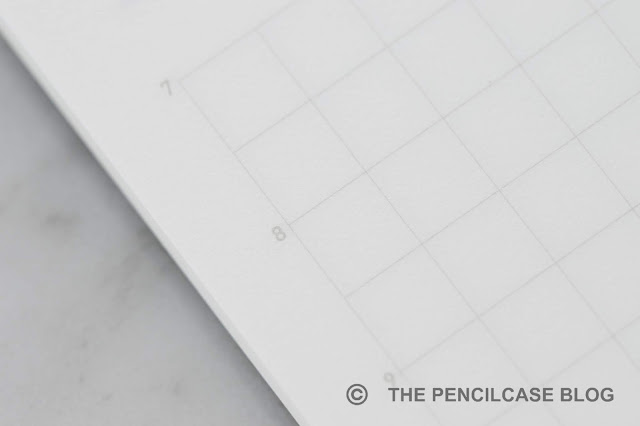
Again in true Japanese style, we're seeing a notebook with very little features. The pages have a faint grey grid printed on them (5x5 mm). The ruling is very pleasant to write on, and doesn't interfere when reading what you wrote down. The 365 Days -as the name suggests- is subtly optimized to be used as a bullet journal or agenda. 
Paper Review: Stalogy Editor's note 365 Days notebook
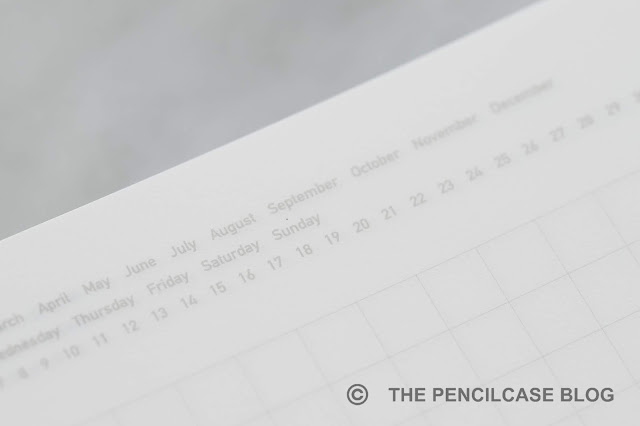
The top right of the page features a date system, and to the left of the grid you can find the hours 7 to 23 printed in a tiny and unobtrusive font. Together, these let you use the notebook as a planner where you can indicate the date and divide the page into the hours of the day (Unless you wake up before 7am, or have appointments after 11pm. In that case I guess you're out of luck...). It's a useful feature when you want to, but it doesn't get in the way when you want to use the notebook as something other than an agenda. Don't bother searching for a page marker, page numbers, index table... you won't find those here.
Paper Review: Stalogy Editor's note 365 Days notebook
One way to add structure to your notebook are the Stalogy stickers and sticky notes. They offer a wide variety of plastic post-it's and tab stickers, among which these small (5x5 cm) square see-through stickers (available in blank, ruled or grid). They are made of some sort of plastic film with an adhesive back, yet their textured surface makes it possible to write on them, even with fountain pen.
Paper Review: Stalogy Editor's note 365 Days notebook
These sticky notes let you add small notes or details throughout your notebook, without making a permanent mark. While I like the idea of these little 'add-ons', they do come at a considerable cost and I admittedly didn't find much use for them. They might be useful for bullet journalling, or important notes, though.
Paper Review: Stalogy Editor's note 365 Days notebook
Some interesting shading going on in some places where the ink meets the grid ruling. And look at that sheen!
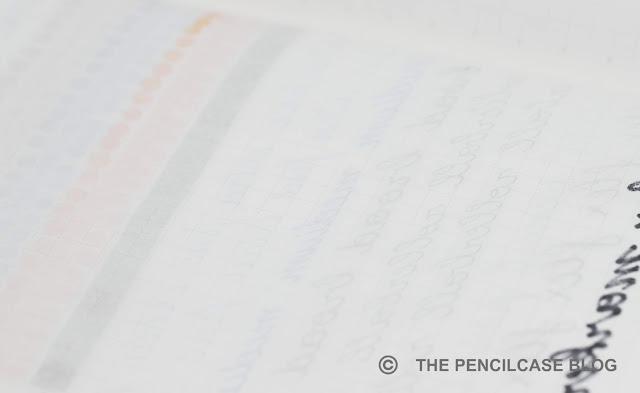
The paper is very smooth to write on, and behaves perfectly with fountain pen (perhaps a bit too slick for pencil use). Ink is handled without feathering and very little bleedthrough (ink swabs, very wet writers and a few flex nibs could give bleedthrough, but all in all it's very well-behaved). Ink dries with a crisp edge and the paper brings out the best of the ink with rich shading and sheen. With the paper being relatively thin, you should expect quite a bit of showthrough, which makes it a bit less legible when you use both sides of the page (it's possible, but not ideal). Overall, if this isn't Tomoe River, at least it's a damn good copy. 
Paper Review: Stalogy Editor's note 365 Days notebook
Quite some showthrough but little to no bleedthrough...except with a sharpie of course
The Stalogy 365 is an all-round excellent notebook. It won't turn heads with its design, but the build quality is bar none, and the paper is great for fountain pen use. Unfortunately quality comes at a price, with these 365 Days notebooks starting at 26€ for the smallest A6, up to 39€ for the B5 size (in the US they can be had for less). Regardless of where you buy, these are a good bit more expensive than, say, a Leuchtturm notebook of the same size (though you do get about a third more pages). The stickers and post-its also come with a pretty price tag, with the see-through post-its coming in at a hefty 9€ (about 6.5$ in the US). While I'm not a huge fan of the accessories at that price, the 365 Days notebook definitely comes highly recommended!

This product was sent to me by Buiten De Lijntjes so I could write this review. I was in no way influenced in the making of this review, the opinions shared in this review are completely my own! This post does not contain affiliate links.
Paper Review: Stalogy Editor's note 365 Days notebook

Saturday, October 6, 2018

PAPER REVIEW: DINGBATS EARTH BULLET JOURNAL

Paper review: Dingbats Earth bullet journal notebook
It's been a while since I reviewed the Dingbats Wildlife journals (read my review here), but the Lebanese brand hasn't been sitting still in the meantime! It seems like they gained a good bit of brand recognition along the way -deservedly so-, and earlier this year they released a new line of notebooks: the Earth collection. 

The Earth notebooks aren't just regular journals. They contain a bunch of features aimed at bullet journalling. To be honest, I know close to nothing about bullet journalling, but I do know that Dingbats created yet another high-quality notebook! 
Paper review: Dingbats Earth bullet journal notebook
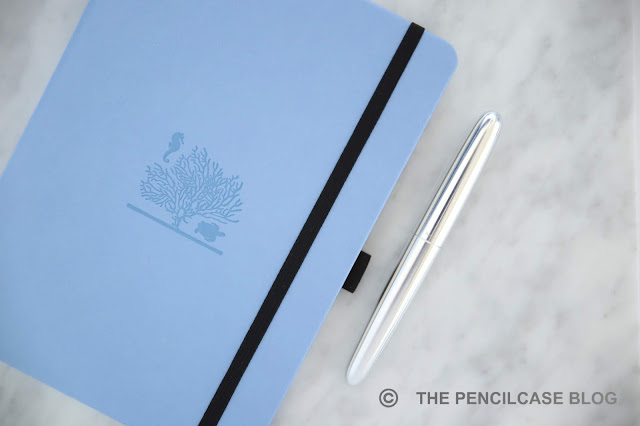
Let's start on the outside, because design is definitely a strong suit. I enjoyed the Dingbats Wildlife, but the Earth is every bit as beautiful and detailed (if not better). The outside is a vegan-friendly PU leather that has a very realistic leather texture. It also FEELS like leather, whereas the Wildlife notebooks felt more rubbery. The cover is debossed with the theme of the notebook (three endangered ecosystems), which also matches the color of the journal. However, they went even further with the theme on the inside of the notebook this time around! 
Paper review: Dingbats Earth bullet journal notebook
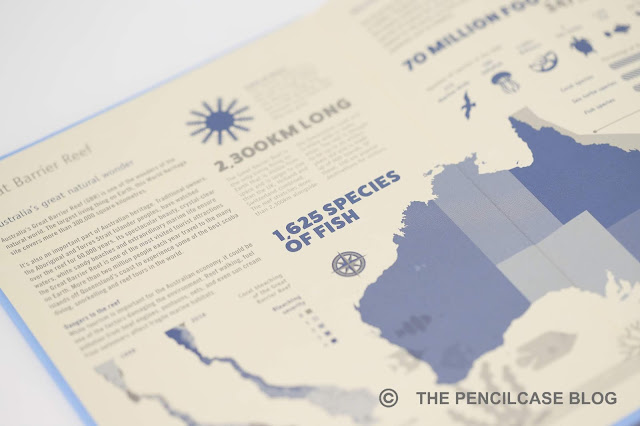
The first two pages feature a layout with information about the region the notebook is based on, and why it's endangered.
Paper review: Dingbats Earth bullet journal notebook
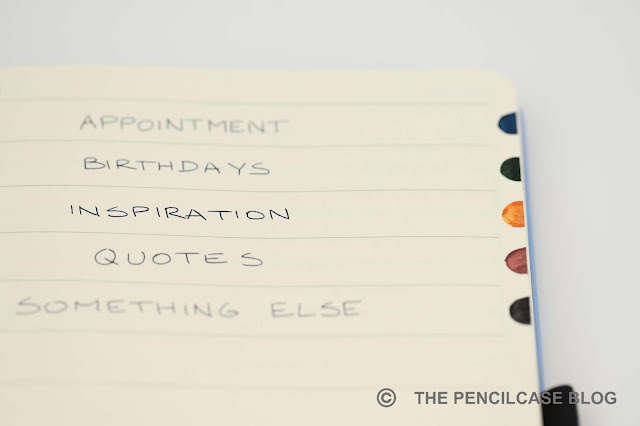
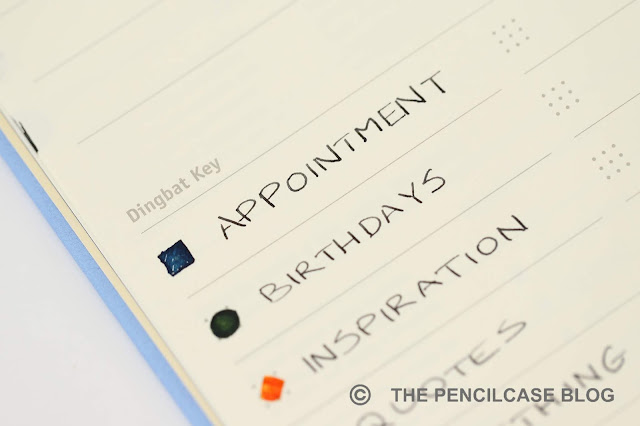
The bullet journal aspect is integrated into the Earth notebooks in a handy, but not overly intrusive way. The first pages let you create a legend for the pagemarkers and tags (the 'Dingbats Key'). These tags can be used throughout the notebook. The tabs on each page can be colored in according to the legend you created. 
Paper review: Dingbats Earth bullet journal notebook
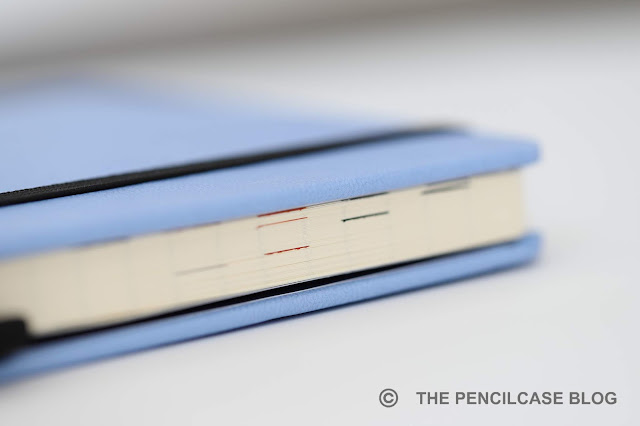
Because the tabs are at the edge of the page, you can see where you marked them even when the notebook is closed (making it easy to find specific entries afterwards). The first five pages are designated as a 'future log', which have guidelines that help you create calendars to track long term projects or ideas. 

The notebooks are pretty feature-packed. Along with the BuJo features, they also contain the usual features: elastic closure, an index table, two bookmarks, a pen loop, numbered pages, and a back pocket for cards or loose papers. 

Dingbats' attention to detail is impressive, the environmental theme adds a good bit of story to the product, and the classification system makes it an ideal BuJo. But of course a well-designed notebook is worthless if the paper is no good, so they paid special attention in that department as well! 
Paper review: Dingbats Earth bullet journal notebook
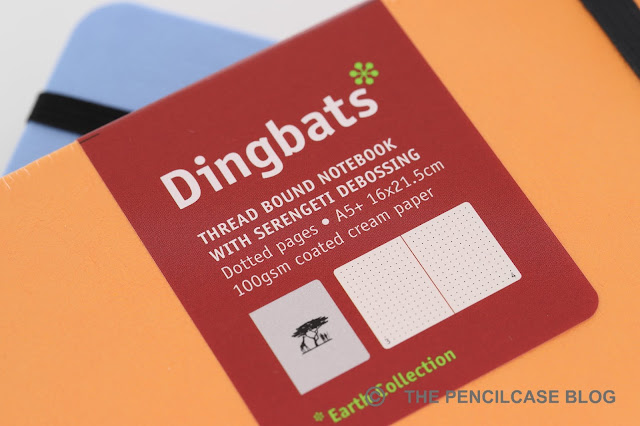
All Dingbats notebooks come with their 100gsm acid-free 'fountain pen friendly' paper in cream color. From experience, I know that the term 'fountain pen friendly' is often used quite freely, but Dingbats paper ranks quite high on my list. 
Paper review: Dingbats Earth bullet journal notebook
Not the worst, but also not the best paper for use with pencil
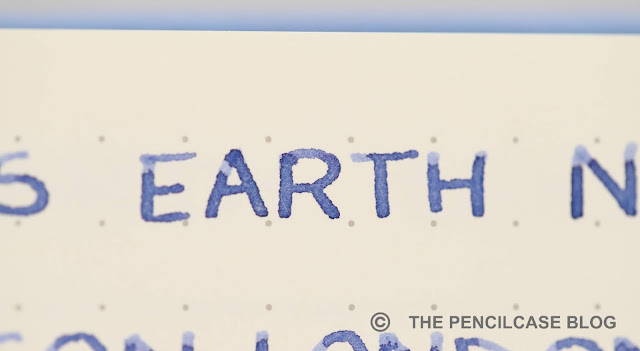
The smooth paper is very pleasant to write on with fountain pen, yet it is not too slick, so I encountered relatively little skipping or hard starts in my testing. Because it's a heavyweight paper, it shows though only a little bit, even with wet writers. Bleedthrough is also relatively well-contained, or not present at all with fine or not-too-wet nibs. It also depends strongly on what inks you use, as some inks are just notorious for bleeding and feathering on most paper types. 
Paper review: Dingbats Earth bullet journal notebook
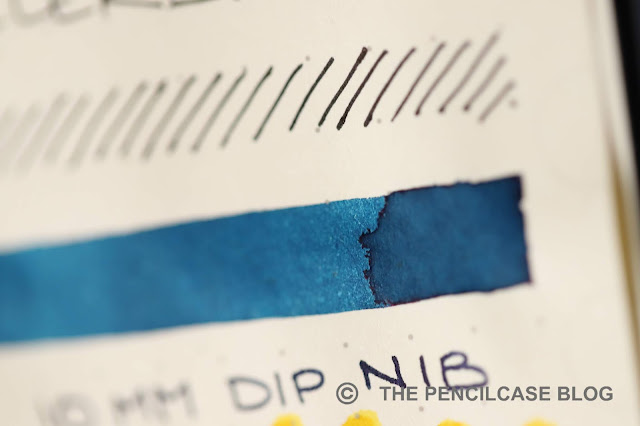
The paper held up quite well in my stress test: a 10 mm dip nib left no feathering and only some bleedthrough, mostly where the ink pooled. Ink swabs behaved well too, with minimal bleedthrough. 
Paper review: Dingbats Earth bullet journal notebook
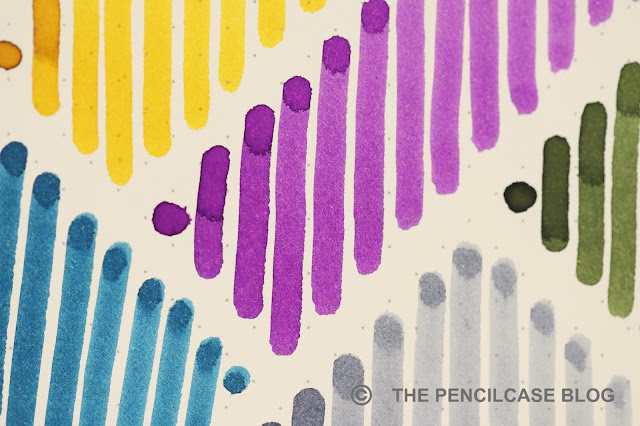
The paper brings out a fair bit of shading, although not with as much depth as some paper types are able to. Sheen is not overly present in normal writing, and even in the ink swabs I had to look closely to  find any.

My overall experience with this paper is excellent. It's definitely fountain pen friendly and holds up well, even with very wet writers. I encountered little to no feathering at all. 
Paper review: Dingbats Earth bullet journal notebook
Both the Wildlife notebooks and this one, show that Dingbats puts a lot of thought and effort in their products. They created a notebook that looks great (IMHO even better than the Wildlife) and has excellent paper. On top of that, the bullet journal aspect is very cleverly worked out and adds a lot of functionality in a subtle way. Even if you don't specifically use it as a BuJo, the classification system is perfect to catalog notes and scribbles. 

Coming in at 20€ / 22$, the Dingbats Earth notebooks are quite reasonably priced. It's cheaper than other BuJo alternatives (such as the Leuchtturm Bullet Journal), but still a bit more expensive than regular notebooks.

This product was sent to me by Dingbats so I could write this review. I was in no way influenced in the making of this review, the opinions shared in this review are completely my own! This post does not contain affilate links.
Paper review: Dingbats Earth bullet journal notebook