Showing posts with label flex nib. Show all posts

Wednesday, October 7, 2020

REVIEW: MONTBLANC MEISTERSTUCK 149 CALLIGRAPHY FLEX NIB FOUNTAIN PEN

REVIEW: MONTBLANC MEISTERSTUCK 149 CALLIGRAPHY FLEX NIB FOUNTAIN PEN
For probably the first time in the history of this blog, I'll try to keep it short today (keyword: "try"). Why? Well, the pen we'll take a look at today is really nothing different from the Montblanc 149 I already reviewed a few years ago (HERE)... except for the nib! This is Montblanc's Calligraphy special edition of their iconic flagship fountain pen, which comes with a specially developed flexible nib!

The Calligraphy Meisterstück with flexible nib is a special edition in a new series of "Calligraphy" pens with unique nibs (a new version with different specialty nib will supposedly still launch this year, effectively replacing the flexible nib variant). And I'm a bit late to the game with this review. My particular pen (that I purchased from site sponsor La Couronne Du Comte - Check out their new website, BTW!) took an unfortunate - and long - detour via Hamburg (Montblanc's HQ) because the nib slit was cut off-center. I typically don't complain about that sort of thing as long as it's not too bad or doesn't hamper performance. But on a 900€ pen, I feel like a little nitpicking is permitted. Oh, and it did actually make the nib noticeably scratchier, so I guess having it out of my hands for 6+ months to be replaced (perhaps it took the scenic route?) was the right - and necessary - judgment call to make. But it did, of course, delay this review to the point where this pen is nearing the end of its availability (sorry for that!).
REVIEW: MONTBLANC MEISTERSTUCK 149 CALLIGRAPHY FLEX NIB FOUNTAIN PEN
Anyway, as I said, this is just a plain, stock Meisterstück 149. The box has a custom imprint for the Calligraphy release on the outer sleeve, but inside is just the normal large clamshell box for a regular 149. A bottle of Montblanc's calligraphy ink isn't included, either. Even though Montblanc released two special edition inks along with the Calligraphy pens. A spectacular special edition 146 with gold leaf decoration was also available, which did set itself apart in terms of aesthetics. Combine the words 'gold leaf' and 'Montblanc' in a single sentence though, and the price gets steep... So I settled for the 149, which I imagine has the upper hand for flex writing anyway, since the larger #8-sized (in Montblanc's numbering #9) nib is already soft on its own. 
REVIEW: MONTBLANC MEISTERSTUCK 149 CALLIGRAPHY FLEX NIB FOUNTAIN PEN
Let's get straight to the business end: the flex nibs look fantastic. I think the monotone nib with simple but elegant figure-eight swirl is one of the best Montblanc nib designs I've seen in a while (maybe close second to the Heritage Rouge Et Noir's Snakehead design!). Montblanc typically excels in nib designs though, so I guess it's hardly a surprise that this too is an aesthetically pleasing release. 
REVIEW: MONTBLANC MEISTERSTUCK 149 CALLIGRAPHY FLEX NIB FOUNTAIN PEN
Functionally, I had high expectations for this pen. Montblanc typically goes for reliable performance with their nibs, so I was curious to see how that'd translate into their first venture in a modern flex nib. The answer is: good. Maybe even great. But as you'd expect, not without its limitations.

The nib tipping is ground noticeably finer than their typical nibs. It's supposedly an EF, but with a line as fine as 0.2 -0.3 mm without pressure, I'd say it's more like an EEF in Montblanc's standards. The fact that it's so fine is also why even the slightest off-center slit is an issue, the right tine was extremely thin on my faulty pen. Anyway, on the replacement pen I received, the nib is actually very pleasant to use, even for normal writing. It's surprisingly smooth for such an extremely fine nib, although of course, you should still expect a bit more feedback than with Montblanc's regular nibs. If you have a very light hand, it could serve for normal writing. 
REVIEW: MONTBLANC MEISTERSTUCK 149 CALLIGRAPHY FLEX NIB FOUNTAIN PEN
With the slightest pressure, the nib immediately starts opening up and you get a slightly wider EF to F line width, with noticeably heavier ink flow. The Calligraphy flex nib is positively soft when you start pushing it more. It takes a small but balanced amount of pressure, enough to give a controlled writing experience, but not too much as to cause fatigue. It's quite a responsive nib with good snapback, meaning that the tines close back up fairly quickly when varying pressure while writing - it doesn't feel mushy.

In terms of line variation, the internet says 0.3 mm EF (EEF) to 1.6 mm (BB), but I find that optimistic. I could consistently go up to 1.0-1.3 mm lines without feeling like I'm pushing the nib too far. In the grand scheme of things, this qualifies the Calligraphy Flex as a 'semi-flex' nib, not quite vintage full-flex. That said, the nib definitely benefits from the extremely narrow tipping. It automatically gives more impressive line variation even though the maximum line width isn't necessarily outlandish.
REVIEW: MONTBLANC MEISTERSTUCK 149 CALLIGRAPHY FLEX NIB FOUNTAIN PEN
The Calligraphy Flex nib seems to be mated to the standard, plastic 149-style feed. I don't know if it's adjusted to suit this nib's ink demand better, but I don't think so (it's relatively wet but not necessarily gushier than my 149 with BB nib). The plastic feed does a fair job - more than fair, actually - but it's definitely the weak link of this pen. Performance is a bit hit or miss. Sometimes it keeps up great, but often it buckles under rapid and continuous flexing, especially when you push the line variation to the max. It helps to take your time when writing, which holds true for any flex pen, really.
REVIEW: MONTBLANC MEISTERSTUCK 149 CALLIGRAPHY FLEX NIB FOUNTAIN PEN
I performed my writing "stress test" (see above) with Pelikan Edelstein Onyx, an ink I use for testing all flex nibs for a fair comparison. Onyx is a fairly well-behaved, wet ink, but you can see that at the end of the test it couldn't keep up with the relatively fast pace and heavy flexing. For a worst-case scenario like this, the feed's performance isn't half bad. Yet I can't help but think that an ebonite feed (like the 149 used to have!) could've helped in providing a richer, more consistent ink flow that's more able to keep up with a demanding nib like this.

Overall, the Calligraphy Flex performs very similarly to the Pilot #15 FA nib that I tried on the Custom 743 (review HERE), despite being two very different pens. Both have nibs that are very responsive and capable of providing excellent line variation. The Montblanc Calligraphy nib has maybe a slight edge over the FA nib because the line thickness starts out a bit finer. They are, however, also both limited by the performance of their feeds. 
REVIEW: MONTBLANC MEISTERSTUCK 149 CALLIGRAPHY FLEX NIB FOUNTAIN PEN
Montblanc being Montblanc, The Meisterstück 149 Calligraphy Flex is not a cheap gateway into modern flex pens. You have to be certain that flex nibs are the thing for you - and you specifically want one with a white star on the cap! - before putting 905€ (roughly 875$ without VAT, from La Couronne Du Comte) on the table for one. I think that speaks for itself. 905€ translates into a 100€ premium over the standard 149, a serious chunk of change for just a different nib! 

I do like it though. It's a pretty pen (if you like the classic Montblanc look) with a beautiful nib design IMHO. The extra-fine nib grind and very decent flexibility make for one of the more expressive line variations I've come across in modern flex nibs, and it's a pleasant writer overall. I've yet to find a modern flexible fountain pen without a single compromise, so even with the middling performance of the feed, the Montblanc's 149 Calligraphy Flex manages to rank quite highly in my search for the perfect modern flex!

PS: I failed to keep this post short, didn't I?
REVIEW: MONTBLANC MEISTERSTUCK 149 CALLIGRAPHY FLEX NIB FOUNTAIN PEN
Note: I purchased this product at a discount from site sponsor La Couronne Du Comte, so I could write this review. I was in no way influenced in the making of this review, the opinions shared in this review are completely my own! This post does not contain affiliate links.
REVIEW: MONTBLANC MEISTERSTUCK 149 CALLIGRAPHY FLEX NIB FOUNTAIN PEN

Thursday, June 25, 2020

REVIEW: NOODLERS AHAB FLEX NIB FOUNTAIN PEN

REVIEW: NOODLERS AHAB FLEX NIB FOUNTAIN PEN
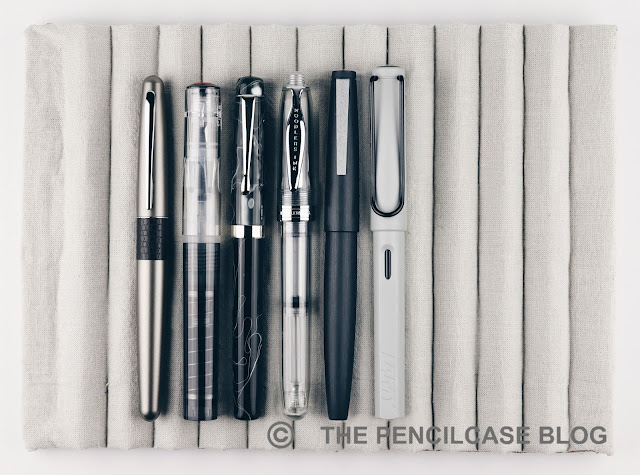
As you may (or may not) have noticed, I'm sort of on the search for the perfect modern flex nib fountain pen these days. I've reviewed a few flexy pens already, the most recent ones being the Pilot Custom 743 FA and FPR Himalaya, but today it's the turn of the Noodlers Ahab - Thanks to La Couronne Du Comte for sending this one over for review!

The Ahab is somewhat of a long-standing icon in the fountain pen hobby - although not always for the right reasons. The Ahab has sort of a bipolar reputation: some people love it, some people hate it. Me? I'm probably somewhere in the middle between those two camps. On the one hand, it's hard not to like it. For 20$ you get a lot of pen, with a couple cool features to boot. But it's far from the perfect everyday writer, either. 
REVIEW: NOODLERS AHAB FLEX NIB FOUNTAIN PEN
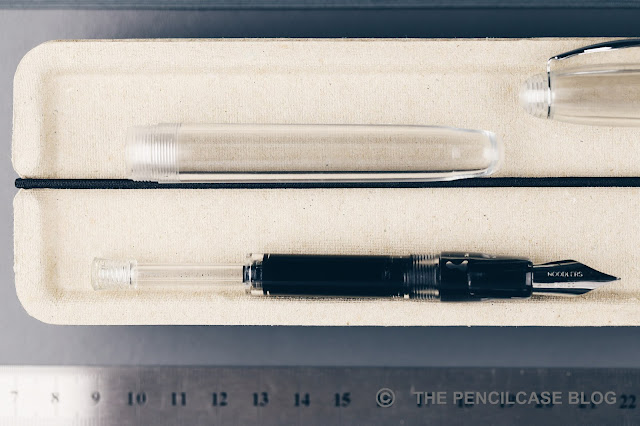
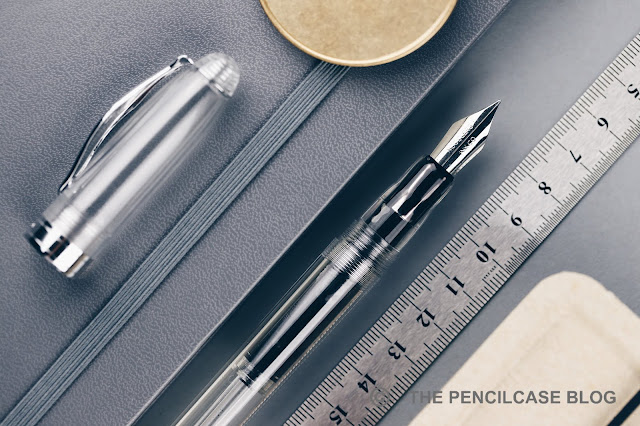
Let's start at the beginning though, and that's the looks. Surprisingly, I ended up appreciating the Ahab's design considerably more than I thought  I would. The Ahab has a story to tell, that of Moby Dick, to be more specific! The clip is modeled after the top view of a sperm whale (Google it, the resemblance is actually quite convincing!). The barrel, shaped after captain Ahab's prosthetic leg (made out of whalebone), is perhaps a bit more far-fetched, but I do very much appreciate the thought that went into the design of this pen. The demonstrator finish is definitely my favorite, as it shows the unique plunger-filling mechanism in all its glory. Apart from the metal trim and ebonite feed, every single part of this pen is transparent by the way, which makes for a pretty cool see-through and clean design. 
REVIEW: NOODLERS AHAB FLEX NIB FOUNTAIN PEN
Talking about the material this pen is made of... It may also be the first item on my list of negatives, unfortunately. Noodlers describes the material as some sort of 'vegetal resin', but unfortunately doesn't go on to specify which exact one. It looks good (maybe not as smooth and polished as I'd liken but that probably has more to do with the low price point than anything else), it feels warm to the touch and durable... but it SMELLS. SO. BAD. 

The best way I can describe it is sort of a putrid, sickly sweet smell. The smell is terrible out of the box - and may put people off of buying this pen - but it luckily lessens over time (although the parts on the inside of the cap, section, and barrel remain smelly on my review pen to this day - even though it has been continuously on my desk for the past 6 months or so). Some people apparently like the smell - I don't. 
REVIEW: NOODLERS AHAB FLEX NIB FOUNTAIN PEN
The Ahab is a nicely sized pen, I feel. It measures 14cm (5.5") capped, and 12.8cm (5") uncapped. The barrel is not too thin, and the section has that comfortable 'stepped' shape like we also see on the Leonardo pens nowadays (although Noodlers did this design first, I should add!). 
REVIEW: NOODLERS AHAB FLEX NIB FOUNTAIN PEN
The Ahab is certainly a comfortable pen to use, It's a good, balanced size, the all-resin construction is lightweight, and the threads are not that obtrusive to my grip. The cap posts, but not very deep and it often sits crooked on the back of the barrel...which annoys me a little bit. 
REVIEW: NOODLERS AHAB FLEX NIB FOUNTAIN PEN
In terms of construction and build quality, I really don't have much to complain about. I mean it's a 20$ pen and I view it as such. But for the price, everything fits together nicely and feels sturdy. Even the clip has a really nice and solid spring to it. 

I also particularly like the plunger-type filling system. It has a very high capacity (approx. 2mL) and is designed properly with a breather tube so it fills up completely with minimal effort (a night and day difference over the so-so mechanism of the FPR Himalaya). You can also remove the plunger and use the Ahab as an eyedropper. But you can't use regular cartridges or converters with this pen. Overall, I've seen a few Indian-made pens at this point (Noodlers pens are made in India, btw) and none have been quite as nicely made as this one. 
REVIEW: NOODLERS AHAB FLEX NIB FOUNTAIN PEN
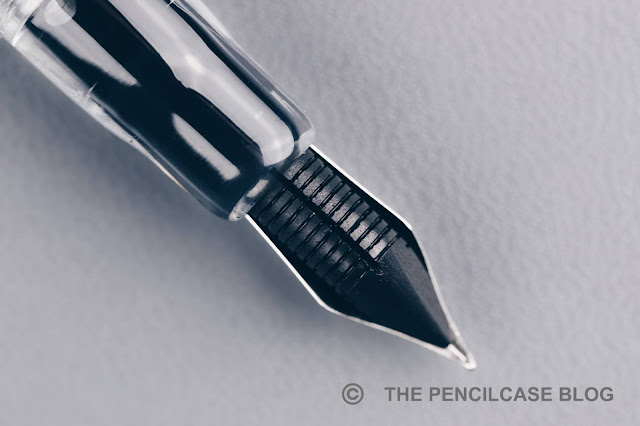
And then we get to the nib. This is another area of the Ahab where I'm a little divided. On one hand, I'm excited to see a flexible steel nib and ebonite feed on an affordable pen like this, on the other hand, it's not without its flaws. You see: I'm lazy and spoiled, and I expect some kind of instant gratification when I buy a pen, especially a modern one. Admittedly, fountain pens never really are the ideal choice for ease of use. But I at least expect a pen to write properly out of the box, and Noodlers pens have never been known for their nib consistency (I've had the same issues with the FPR Himalaya that has a similar nib and feed). 

Frankly, it might as well be borderline impossible to provide a flawless writing performance with a highly specialized nib and feed setup like this, at this price point. It's difficult to make a flex nib work, you know. So to keep costs down, you - as a customer - are more or less expected to take care of the nib tuning yourself. It's probably a bit of a nib lottery, some nibs might be good out of the box, some might take some tinkering. Mine fell under the latter category.
REVIEW: NOODLERS AHAB FLEX NIB FOUNTAIN PEN
Heat-setting the feed, and adjusting the nib to get a proper ink flow (especially for flex writing!) took me more than a couple tries and some swearing definitely was involved. I got it to a point where I can live with the writing performance, although  I  probably could've done a better job. This flex nib (fine-ish size) is smooth, but not buttery, and it can keep up with a decent amount of flexing (it opens up to about 1mm line widths). Solely for flex performance, the FPR Himalaya and it's custom modified 'super-flex' nib and feed certainly give much more dramatic line variation. The ink flow is not super heavy but manages to keep up most of the time. You definitely have to take your time when flex writing to avoid railroading, but that's a general remark for most flex pens. 
REVIEW: NOODLERS AHAB FLEX NIB FOUNTAIN PEN
The Noodlers Ahab costs 23€ (23$). That's not a lot. In fact, at that price, I'm willing to forgive the finicky flex nib and smelly resin as a trade-off for a cool design and decent potential if you put in some effort to get the performance dialed in. Is this the perfect modern flex pen? Nah, but it sure is a fun pen if you're willing to give it a try! 
NOTE: This product was provided by La Couronne Du Comte, so I could write this review. I was in no way influenced in the making of this review, the opinions shared in this review are completely my own! This post does not contain affiliate links.
REVIEW: NOODLERS AHAB FLEX NIB FOUNTAIN PEN

Tuesday, March 31, 2020

REVIEW: PILOT CUSTOM 743 FOUNTAIN PEN & FA NIB

Review: Pilot Custom 743 fountain pen + Falcon FA nib
In my - possibly neverending - search for the best possible modern flex nib, we've arrived at a very cool pen from Pilot that I've been wanting to try out for a very long time: the Pilot Custom 743. The only thing standing in my way up until this point has been Pilot Europe's ongoing ignorance (or restrictions from higher up?) of their luxury writing branch, leaving European vendors behind empty-handed on a lot of awesome products.

Early this year - about 3 years too late, mind you - the Pilot 823, 845 urushi and Custom urushi FINALLY made it over to the European market. While an improvement for sure, we're still eagerly waiting for the rest of Pilot's offerings (the Custom 912 or 743, for example) especially with Pilot's exquisite specialty nibs like the Waverly (WA), Posting (PO), Stub (SU), or the nib I'll be showing today: the Falcon (FA)!

Because chances of getting the Custom 743 here in Europe are slim for the time being, I instead sourced it from a Japan-based retailer. The only problem - as some of you will know - is that most Japanese web stores can be really difficult to navigate, even with help from Google Translate. So, luckily, I found out about PenSachi! With their English website (and English-speaking staff), PenSachi aims to make hard-to-get special and limited editions from Sailor, Platinum, and Pilot more readily available for customers outside Japan. My thanks to them for helping me get my hands on a 743 for this review!
Review: Pilot Custom 743 fountain pen + Falcon FA nib
Pilot Custom 743 (bottom) and 823 (top)
The Custom 743 leans very close to the Custom 823 (that I reviewed a few years ago), especially in terms of the overall design. But there are some key differences as well, particularly on the inside!
Review: Pilot Custom 743 fountain pen + Falcon FA nib
Enamel-filled letters on the center band complete the low-key appearance of the 743
I'd categorize the 743 as a 'business'-style design, fitting right in with the rest of Pilot's rather understated Custom and Custom Heritage pens. A no-frills, black+gold pen that doesn't try to stand out between analogs like the Montblanc Meisterstück, Sailor 1911 or Platinum Century 3776. If anything, I find that the design appears a bit more streamlined and retro than its competitors - probably due to Pilot's typical ball end clip.
Review: Pilot Custom 743 fountain pen + Falcon FA nib
Pilot Custom 743 (bottom) and 823 (top)
I think there's something to be said for the simplicity of the Custom 743. On the outside, it's an elegant and slender cigar-shaped pen in black resin, detailed with plenty of gold trim without looking gaudy. The 743 and 823 are identical except for the semi-translucent resin of the 823 (although the smoke grey 823 appears almost black in person) and a slightly longer, more tapered barrel finial on the 823 which is actually the blind cap for the vacuum filling mechanism, as opposed to just an aesthetic detail on the 743. 
Review: Pilot Custom 743 fountain pen + Falcon FA nib
The vacuum filling system of the 823 is an excellent choice when you absolutely want/need a high ink capacity (2.5 mL) for daily use. But the 743's con-70 converter is not at all a bad alternative, with more than adequate capacity (about 1 mL, almost twice as much as a standard international converter), and a practical pump filling system. Another way to look at it is this: with the 823 you have to stick to one ink for a considerable time, the 743 gives you the ability to change inks a bit more frequently.
Review: Pilot Custom 743 fountain pen + Falcon FA nib
L to R: Pelikan M805, Platinum Century 3776, Pilot Justus 95, Pilot Custom 823, Pilot Custom 743, Lamy 2000, Lamy Safari
The Pilot Custom 743 is a large pen that doesn't feel large. It's light (26 g total) and nimble in the hand, and about a fraction slimmer than a Pelikan M800. Those things, combined with the excellent grip shape and unobtrusive threads, make for an excellent pen to use. In terms of length (14.8 cm/ 5.8" capped, 13.1 cm/ 5.16" uncapped), it's a touch longer than a Montblanc 149, making it ideal even for people with larger hands (unless you have a strong preference for girthier pens). Comfort-wise, it's hard to knock these pens.
Review: Pilot Custom 743 fountain pen + Falcon FA nib
FA nib on the 743 (left), medium nib on the 823 (right)
We've finally come to the ACTUAL reason why you'd choose the 743 over the 823: the nib! Both use Pilot's 14k gold, #15-size nib (same size as a #6 nib from other brands), but as I already mentioned, the 743 gets a few more interesting options than the 823, in this case the flexible Falcon (FA) nib. Confusingly, it's not the same as Pilot's similarly named Falcon fountain pen. Whereas the Pilot Falcon PEN has a nib that's best described as springy and soft, the FA NIB on the 743 comes closer to a true modern flex nib.

The FA certainly has the design cues of a flex nib: a slender profile with long and strongly tapered tines, cutouts on the side, and very minimal branding on the nib face (I was told once that the less intricate stamping is done to prevent structural weak points, which is of course very important on a flexible nib!). It may look a bit bland in comparison to the regular scrollwork on Pilot's nibs, but that's a trade-off I'm willing to make for a flexible writing experience.
Review: Pilot Custom 743 fountain pen + Falcon FA nib
The FA nib is definitely suitable for everyday use, provide you don't have a heavy hand. With normal writing pressure, the nib is just stiff enough to still provide a pretty comfortable writing experience. The EF-F tipping provides a noticeable (and audible) amount of feedback while writing.

Looking at the FA purely for flex writing, it does come with a little side note: since it's a Japanese-made nib, it's designed for the short brush-like strokes of Japanese calligraphy, not really for Western writing styles. Continuously flexing the nib will make it railroad because the feed isn't designed to keep up.

If you take it slowly though, this nib is pleasantly springy and responsive and produces excellent results as far as line variation goes. The tines open up quite easily to a little over 1mm, or 1.3mm when pushed to the limit. It's probably worth suggesting, given that this is not a cheap pen like a Noodler's or the FPR Himalaya I reviewed last week, I'd probably suggest not pushing the nib to the limit (never a great idea). Still, variation from EF to BB is nothing to be scoffed at. Because it starts off as a rather fine line, that's more than enough variation to give a dramatic effect to your writing.
Review: Pilot Custom 743 fountain pen + Falcon FA nib
I'm generally not one to make a case for matching pen and ink of the same manufacturer. However, with some Pilot pens, like this one, I've noticed slight improvements sticking with Iroshizuku inks (I haven't really systematically tested this theory though, so your mileage may vary!). I wrote this review with Pelikan Edelstein Onyx (generally a good performing ink for flex nibs), but there were some occasional skips on downstrokes and as expected the feed starved after writing a few words with heavy flexing (pushing the limits of the nib, mind you). Switching to Iroshizuku Tsuki-Yo made a noticeable improvement. Even with fast flex writing, the feed seemed to recover faster from getting starved (It will still railroad periodically, but the flow immediately picks up again), and the nib no longer skipped.
Review: Pilot Custom 743 fountain pen + Falcon FA nib
The Pilot 743, just like the 823, manages to impress in so many ways. The no-frills, workhorse design means serious business, and under the hood, it packs some serious performance. The FA nib adds a bit of playfulness to the mix. It's an excellent option to get your hands on modern flex: a pleasantly soft and responsive flex nib, that gives plenty of line variation.

Given that the 743 and 823 are identical in design and price - both retail for 265$ at PenSachi - deciding between the two will boil down to choosing either a high-capacity filling system or one of Pilot's many interesting specialty nibs, you can't have both. Either way, you're getting a lot of pen for essentially (less than) half the price of a Pelikan M800 or Montblanc 146!

Note: PenSachi provided this product at a discount, so I could write this review. I was in no way influenced in the making of this review, the opinions shared in this review are completely my own! This post does not contain affiliate links.
Review: Pilot Custom 743 fountain pen + Falcon FA nib

Monday, March 16, 2020

REVIEW: FOUNTAIN PEN REVOLUTION HIMALAYA ULTRA FLEX FOUNTAIN PEN

REVIEW: FOUNTAIN PEN REVOLUTION HIMALAYA ULTRA FLEX FOUNTAIN PEN
Ok. I'll admit, Indian fountain pens are a blind spot of mine. They have always been on my radar, but I didn't get around to actually trying some. It's never too late to change though, so for today, we're taking a look at an excellent option for getting into Indian pens: the Fountain Pen Revolution Himalaya.

Fountain Pen Revolution is a USA-based company that both sells Indian brands like Kanwrite, Guider, and Airmail, and also partnering with these manufacturers to create their own line of affordable, Indian-made fountain pens, sold under their own brand name. The Fountain Pen Revolution (FPR) pens start at just 7$, which is commendable on its own, but it also turns out that they have some excellent options if you're looking for an affordable flex pen... so that's more or less what we'll focus on in this review!
REVIEW: FOUNTAIN PEN REVOLUTION HIMALAYA ULTRA FLEX FOUNTAIN PEN
Just to be clear, the Fountain Pen Revolution Himalaya costs more than 7$, but it still sits at a very budget-friendly entry-level price point. You can tell that it's more expensive because they used a fancier acrylic instead of injection-molded parts. It's actually a good-looking pen, I have to say. The acrylic is a dark greyish-green with white swirls and beautiful pearlescent streaks throughout. It certainly doesn't come across as a budget pen, at least not from afar. 

Looking closer though, the metal trim kind of gives away that this isn't a 100$+ pen. The finish on the center band is a bit rough, and the cap lip is a bit sharp. The bent metal clip looks and feels a bit flimsy. Although in its defense, it IS nice and springy and therefore very easy to use. This particular pen had "gold plated" trims, but the plating is not great at all, it's even just non-existent in certain areas. The plating came right off with a quick polish, and I frankly like it a lot better now that it has a uniform chrome color. Chrome trim is an option as standard, so I'd pick that any day of the week.
REVIEW: FOUNTAIN PEN REVOLUTION HIMALAYA ULTRA FLEX FOUNTAIN PEN
Apart from the mediocre metal trim, the overall build quality is actually quite good. I expect that this pen -like many other Indian pens- is made by hand, which is pretty impressive at the price point we're seeing, but it also means that it's not all as impeccable as if it were injection-molded and completely machine-made (like a Lamy Safari, for example). Even so, the build quality is quite good. Every part fits together precisely, feels solid, and has a nicely polished finish
REVIEW: FOUNTAIN PEN REVOLUTION HIMALAYA ULTRA FLEX FOUNTAIN PEN
L to R: Pelikan M805, Pilot 78G, Platinum Prefounte, FPR Himalaya, Lamy 2000, Lamy Safari.
The Himalaya is a medium-sized pen that strikes an excellent balance between a not-too-large form factor, and still being very comfortable in the hand. It measures 13.4 cm (5.2") closed, and 12.4 cm (4.88") uncapped. Despite not typically posting my pens, this is one that does post quite comfortably without adding weight or too much length. At just 16 grams, it's a very lightweight pen. It's a fairly slender pen but the section retains a comfortable diameter and has a pleasant tapered shape. There's hardly any transition from section to barrel, and the threads are noticeable but not sharp to the touch -overall, this pen has all the right ingredients for a comfortable writing experience.
REVIEW: FOUNTAIN PEN REVOLUTION HIMALAYA ULTRA FLEX FOUNTAIN PEN
The piston is made from the typical smelly plastic you often find in Indian-made pens, and discolors quite easily.
For this review, I was sent the first version of the Himalaya, but they made some minor improvements shortly after. Both versions one and two are currently available for purchase, but I'd recommend paying the 3 to 6 dollars extra to get the updated version. 

Aesthetically, they remained completely identical, but the new version receives a more traditional screw-type converter. My review pen still has the push-pull piston converter, and it's a tricky one to get a full fill with it (even after multiple attempts). Another option would be to remove the converter altogether and use the pen as an eyedropper (some silicon grease on the barrel threads is all it takes to get a proper seal), but I'm not a huge fan of eyedroppers for daily use. 
REVIEW: FOUNTAIN PEN REVOLUTION HIMALAYA ULTRA FLEX FOUNTAIN PEN
An ebonite feed, impressive on a pen this price!
Let's talk about the part that actually impressed me most about this pen: the nib!

First of all, every FPR pen comes with a hand-cut ebonite feed. You'll typically only see ebonite feeds on very high-end pens, so this is a very nice thing to see on a pen this price.

The Himalaya v1 is available with a slightly smaller #5.5 (roughly the same as a #5 nib) or an upgraded #6-sized nib. The new version (v2) does away with the #5.5 nib option, which I think is a good decision because the larger nib fits the pen better, aesthetically.

Nib options are extensive: EF to M, B (+4$), stub (+4$), flex (+4$) and EF ultra flex nibs (+14$) are available in stainless steel, as well as fine, medium and flex in 14k gold (+119$). I went with the ultra flex nib for this pen because I'm currently exploring modern flex nib options (Spoiler alert, more flex pen reviews are coming in the near future!).
REVIEW: FOUNTAIN PEN REVOLUTION HIMALAYA ULTRA FLEX FOUNTAIN PEN
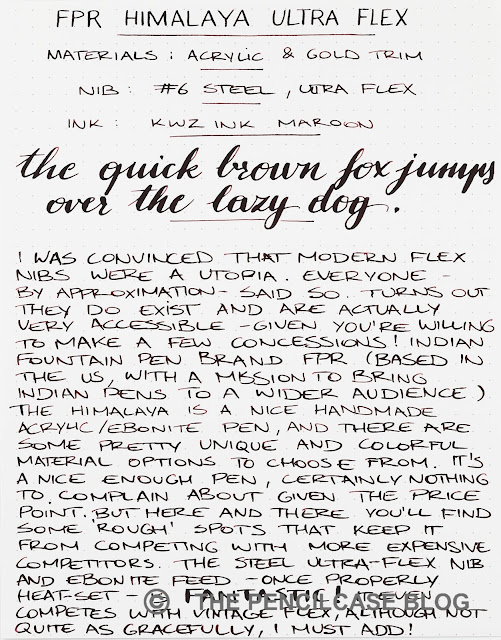
So what does "Ultra" flex mean? For 10$ extra, Kevin from FPR manually modifies each nib with additional cutouts on the sides of the nib and a widened ink channel on the ebonite feed. This improves the flexibility of the nib and creates a wetter ink flow that can keep up with the more demanding nib setup.

Line variation with this modified nib is impressive. VERY impressive even, down to the point where it can start to seriously compete with vintage flex -no small feat! You're looking at line variation from a western fine, to almost 2mm at the very maximum. The most impressive part is that it doesn't require nearly as much pressure as I expected. The cutouts effectively give this steel nibs a much more springy character than similar nibs without the modification, and it also seems a bit more forgiving in terms of snapback.

BUT, there is a catch! Affordable flex nib fountain pens like this one, have a reputation for being a bit finicky (think about Noodlers pens, for example), and may or may not require some work to get the most out of them. I think the nib and feed are heat-set out of the box, but I did it again a couple of times to optimize the position of the feed for the best possible ink flow. Heat-setting ebonite feeds is actually not that difficult (there are plenty of tutorials online, FPR also has instruction videos on their own website!), but it takes some time and willingness to tinker a little bit, which is not something every fountain pen user is looking for when buying a new pen.

Even when I was satisfied with the heat-set, ink flow could still sometimes behave temperamentally. Especially with heavy flex writing, it is prone to railroading and hard starting, and you can starve the ink flow when writing too fast. It's very picky about the ink you're using, the paper you're writing on, and even your writing angle... In short: there are a lot of factors that influence its behavior. 
REVIEW: FOUNTAIN PEN REVOLUTION HIMALAYA ULTRA FLEX FOUNTAIN PEN
Before buying, make sure that you're willing to tinker and experiment with this pen (that's part of the fun, even). This is certainly not the kind of 'plug-and-play' modern flex nib fountain pen that writes perfectly out of the box. In fact, one could argue that the perfect modern flex fountain pen doesn't even exist, there's always some kind of trade-off. In this case, you're giving up some ease-of-use and reliability in exchange for pretty excellent line variation.

With those sidenotes out of the way, would I still buy this pen? Yes. From what I've seen and tried so far, the FPR Himalaya Ultra Flex comes extremely close to the kind of line variation you'd expect from a vintage wet noodle flex nib. That's impressive for a 49$ pen (35$ for the pen + 14$ for the ultra flex nib), no matter how you look at it.

NOTE: This product was provided by Fountain Pen Revolution, so I could write this review. I was in no way influenced in the making of this review, the opinions shared in this review are completely my own. This post does not contain affiliate links.
REVIEW: FOUNTAIN PEN REVOLUTION HIMALAYA ULTRA FLEX FOUNTAIN PEN