Showing posts with label Urushi. Show all posts

Sunday, February 28, 2021

REVIEW: TACCIA POLAR LIGHTS FOUNTAIN PEN

REVIEW: TACCIA POLAR LIGHTS FOUNTAIN PEN
We're taking a look at another new - to me - brand today: Taccia! Despite only having been around for about 20 years, the history of Taccia is rather convoluted. The TL;DR is that they started as a US-based company, but they're now part of a larger Japanese stationery conglomerate (Nakabayashi). 

Taccia's earlier products - mostly in the sub-200$ range - never really managed to captivate me. Though things certainly became a bit more interesting once they started getting into urushi, Raden, and maki-e, which seems to have really gained them some more traction within the pen community. Even though they might not (yet) enjoy the 'cult status' of big brands like Nakaya, Namiki, or Sailor in the Urushi game, Taccia's urushi work really deserves some attention, as I think they're doing some really interesting and creative things with traditional lacquering techniques! 
REVIEW: TACCIA POLAR LIGHTS FOUNTAIN PEN
Packaging is just packaging... But damn, this is a really nice box!
Some of those urushi and Raden techniques make an appearance on the Taccia Polar Lights fountain pen collection, which we'll be looking at today. My thanks go out to Catherine from Sakura Fountain Pen Gallery (one of our site sponsors!) for trusting me with these beauties for a short while!
REVIEW: TACCIA POLAR LIGHTS FOUNTAIN PEN
The Polar Lights pens are based on a standard ebonite base shape that Taccia uses for most of their urushi collections. The design of the pen itself is kept quite simple and straightforward (which isn't too uncommon for Urushi and maki-e pens, as it puts more emphasis on the urushi finish itself): a straight, cylindrical pen with flat finials. The barrel is quite long, which makes for a rather unusual cap-to-barrel ratio. The cap is slightly wider than the barrel, though it transitions smoothly into the barrel with a rounded off edge. 
REVIEW: TACCIA POLAR LIGHTS FOUNTAIN PEN
Taccia's urushi pens all have clips. Practical? Sure, but I find that clips tend to interfere with the urushi finish (especially on more complex Raden and maki-e finishes) so I'd have preferred a clipless option. Besides, it's not like I tend to casually clip thousand-dollar pens to my shirt pocket anyway (that's a bit too much livin' on the edge for my taste). That said, I do have to admit that this particular clip looks quite good. The curvy and rounded shape of the clip provides a stark contrast with the straight and angular design of the rest of the pen.
REVIEW: TACCIA POLAR LIGHTS FOUNTAIN PEN
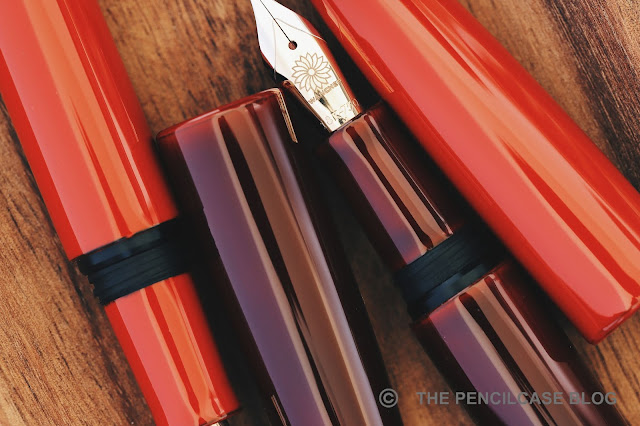
As mentioned at the beginning of this review, Taccia's urushi pens really caught my eye through the wild and uncommon combinations of different lacquering techniques. For the Polar Lights series, the base is lacquered with an Akebono-like gradient of urushi that transitions from a dark color in the center, towards a brighter color at the finials. They overlaid that with precisely arranged Raden strips, applied lengthwise around the top of the cap and end of the barrel. 
REVIEW: TACCIA POLAR LIGHTS FOUNTAIN PEN
The Polar Lights is available in three colorways: red (Amairo Haruakane), green (Amairo Jiu), and blue (Amairo Hekiku), and they really outdid themselves on the colors of the urushi. The colors are vibrant, but not too bright, and the finish is consistent.
REVIEW: TACCIA POLAR LIGHTS FOUNTAIN PEN
Upon closer inspection, there's actually more to the finish than you may think. It looks like only the finials are red, green, or blue, and it fades out to black towards the center of the pen, but that's actually not true. It's very subtle, but the base color is actually dark green, red or blue, to match the rest of the pen. Less subtle are the Raden strips, which are color-matched to the pen (if I'm not mistaken, they do this by painting the back of the mother of pearl). The end result is a striking pen with more than enough shimmering Raden to get around, and yet it's not too crazy for my - typically subtle - taste.
REVIEW: TACCIA POLAR LIGHTS FOUNTAIN PEN
L to R: Montblanc 149, Scribo Feel, Eboya Houga L, Sailor Pro Gear, Taccia Polar Lights, Lamy 2000, Lamy Safari
The proportions of the Taccia Polar Lights are quite interesting. With 15 cm/ 5.9" capped, it sits comfortably amongst other large, oversized pens like the Montblanc 149. The straight, untapered shape of the Polar Lights doesn't allow for the cap to be posted. Though, with an uncapped length of 13.2 cm/ 5.2", I've never missed the ability to post the cap, anyway. 
REVIEW: TACCIA POLAR LIGHTS FOUNTAIN PEN
So they're not small, and not particularly slim either (though not quite as chubby as the Montblanc 149 or Eboya Houga Large, pictured above). BUT! The section is surprisingly narrow compared to the rest of the pen. At the narrowest point, it measures just 9.7 mm/ 0.38", which is a bit on the skinny side for my taste. 

With a narrow section like that, you do get quite a transition towards the barrel, but it's quite gradually stepped and the block threads aren't sharp, so you don't notice it too much in the hand. All in all, it's not an uncomfortable pen to write with, though I certainly would've preferred a slightly wider section. With a total weight of 30 grams, it's not too heavy for a pen this size.
REVIEW: TACCIA POLAR LIGHTS FOUNTAIN PEN
The Polar Lights fills via Sailor's standard cartridge converter. Frankly, these converters aren't the best on the market and the ink capacity isn't huge, but they do the job. And especially with one of Sailor's finer nibs, ink capacity isn't really a big concern, anyway. 
REVIEW: TACCIA POLAR LIGHTS FOUNTAIN PEN
On the inside of the cap, you'll find a spring-loaded inner cap, similar to those found on Wancher and Esterbrook pens, to prevent the nib from drying out. Though the implementation on the Taccia pens seems a bit more subtle (the spring tension isn't so strong) making it more practical and easy to use.
REVIEW: TACCIA POLAR LIGHTS FOUNTAIN PEN
A particularly interesting point about most, if not all, Taccia pens - and presumably also a firm selling point for those who like Japanese fountain pens - is that Taccia actually uses Sailor-made nibs in their pens. Western brands that manufacture their own nibs, don't typically share them with other brands, but it's cool to see that Sailor has a more open mindset towards this.
REVIEW: TACCIA POLAR LIGHTS FOUNTAIN PEN
L to R: Taccia Polar Lights, Sailor Pro Gear, Montblanc 149
REVIEW: TACCIA POLAR LIGHTS FOUNTAIN PEN
Again, the proportions of the Taccia are quite interesting. Look at that tiny nib!
What you get under the hood is a 14k gold, small bicolor nib, the same size as the nibs found on Sailor's 1911S or Pro Gear Slim. Yes, that's exactly how you'd imagine it in your head: a very tiny nib, on a pretty huge pen! Because the section tapers down quite strongly, the nib does manage to still look somewhat balanced on this massive pen. Though, needless to say, this pen at the very least deserved one of Sailor's larger 21k nibs. The nib received a custom engraving with the Taccia logo, and it's bi-color plated. 
REVIEW: TACCIA POLAR LIGHTS FOUNTAIN PEN
To be honest, the nib performance was not quite as spotless as I had anticipated. Although Japanese nibs are usually worshipped as the pinnacle of consistency (and to be honest, they typically are more consistent!), my experience with these nibs illustrated that any brand can have nib issues out of the box, not just Western brands. I tried two hard Fine (H-F) nibs, and the first one was considerably drier and finer out of the box, which in turn also made it more feedback-heavy. The second one matched my expectation pattern, with a more balanced ink flow, and a line width comparable to a narrow Western EF. To be fair, both nibs were consistent, skip-free writers, and the ink flow (though dry on one of the pens) never hesitated.
REVIEW: TACCIA POLAR LIGHTS FOUNTAIN PEN
The Taccia Polar Lights fountain pens sell for 875€ (incl. VAT, at our sponsor Sakura Fountain Pen Gallery). Oh, and it's a limited edition as well, with only 100 pieces per color being made. To call it a bargain would perhaps be a slight overstatement. But for an urushi pen with Raden decoration, that's actually quite a competitive price!

These products were provided on loan by Sakura Fountain Pen Galleryso I could write this review. I was in no way influenced in the making of this review, the opinions shared in this review are completely my own! This post does not contain affiliate links.
REVIEW: TACCIA POLAR LIGHTS FOUNTAIN PEN

Wednesday, August 28, 2019

REVISITING THE WANCHER DREAM PEN URUSHI FOUNTAIN PEN

REVISITING THE WANCHER DREAM PEN URUSHI
Wancher's Dream Pen True Urushi project left quite an impression on the community last year. For a very good reason of course. A way to get your hands on 'affordable' urushi fountain pens? Count me in! 

I reviewed one of the early prototypes of the Dream Pen Urushi back then (you can find this review HERE). But I wanted to revisit my original thoughts about it in a follow-up once the production pens that my father and I ordered, arrived. At this point I've had the Dream Pen with me for about five months, and it's been inked ever since it got here -that on itself is already quite a testimony to how much I like it. 
"...if Wancher can make their promises true and deliver a product as good as the prototype I have in my hands right now, this can become a game changer for the Urushi fountain pen industry..."
Back in early 2018, judging by the prototype they sent me, I knew Wancher had a great product in their hands. But of course at that point they still had to prove that they could provide the prototype-level quality on the final production version.
REVISITING THE WANCHER DREAM PEN URUSHI
Now having those final pens in hand, I think it's safe to say they succeeded in creating a quality product. The urushi laquer is perfectly applied, and the level of craftsmanship is easily on par with that of a Nakaya or Danitrio. The finish is smooth and consistent, perfectly polished, and the colors are vivid.

The pens come with a certificate on who actually did the urushi work: a laquerware studio in Wajima called Taya Shikkiten. Wajima is regarded as the capital of Urushi laquer, and has a high reputation for the quality laquer that comes from this region. 
REVISITING THE WANCHER DREAM PEN URUSHI
So how did Wancher manage to cut costs? I have a theory: Judging from my dad's Aka-Tamenuri ("Aka"=red, "Tamenuri"=pooled laquer) , and comparing it to a Nakaya in the same finish, the Dream Pen seems to have fewer laquer layers. Aka-Tamenuri is created by covering a red base color in many layers of semi-transparent smoke-grey laquer to create a darker finish. By sanding each layer, the edges reveal more of the red base, creating the effect of a pooled liquid on the surface of the pen. So in the case of the Dream Pen, less semi-transparent top layers create a more transparent finish and thus a lighter overall color. On the Shu ("Shu"=red) finish of my own Dream Pen, the fewer layers also show on the edges, where the black ebonite of the pen shows through slightly. 
REVISITING THE WANCHER DREAM PEN URUSHI
While this is just a hypothesis (read: I do not know if what I'm saying is actually true!), it would make sense. Urushi takes up to months to apply because many consecutive layers have to be applied, dried and sanded one by one. Cutting the amount of layers in half for example, would translate into twice the production capacity and half the cost. At the same time, I think the sacrifice of a few coats is relatively harmless and not at all detrimental to the quality. Urushi laquer is incredibly durable when it hardens, so the Dream Pen -regardless of how it was actually made- should last a very long time.

So what else is new? 

For one, the cap threads were updated since the original prototype. I already discussed this in my review of the Dream Pen Ebonite. The block threads are smooth and easy on the fingers. The step behind the threads is a considerable jump up from the section, and it's definitely noticeable. Although the edge is not super sharp because of the rounded edges that the urushi finish provides. Despite being a larger pen, I still find this a really comfortable writer. The section is nicely shaped and the ebonite construction is lightweight. 

Having had this pen inked up continuously, I can say the spring-loaded inner cap works great. I haven't had any issues with the nib drying out, and it starts up as soon as it hits the paper. 
REVISITING THE WANCHER DREAM PEN URUSHI
Left: Wancher 18k gold nib, Right: JoWo 18k gold nib.
Talking about the nib, this is really the highlight of the Dream Pen I think. After the Kickstarter there was some fuzz about Wancher not being able to outsource all nibs from JoWo, and they would reside to using their own, new 18k gold nibs on some orders. Some people were not at all pleased that this would mean their original nib choice would change....

Well having received one of Wancher's nibs (made in-house, which is pretty awesome), I can say I'm VERY glad that they took the decision to go this way! 
REVISITING THE WANCHER DREAM PEN URUSHI
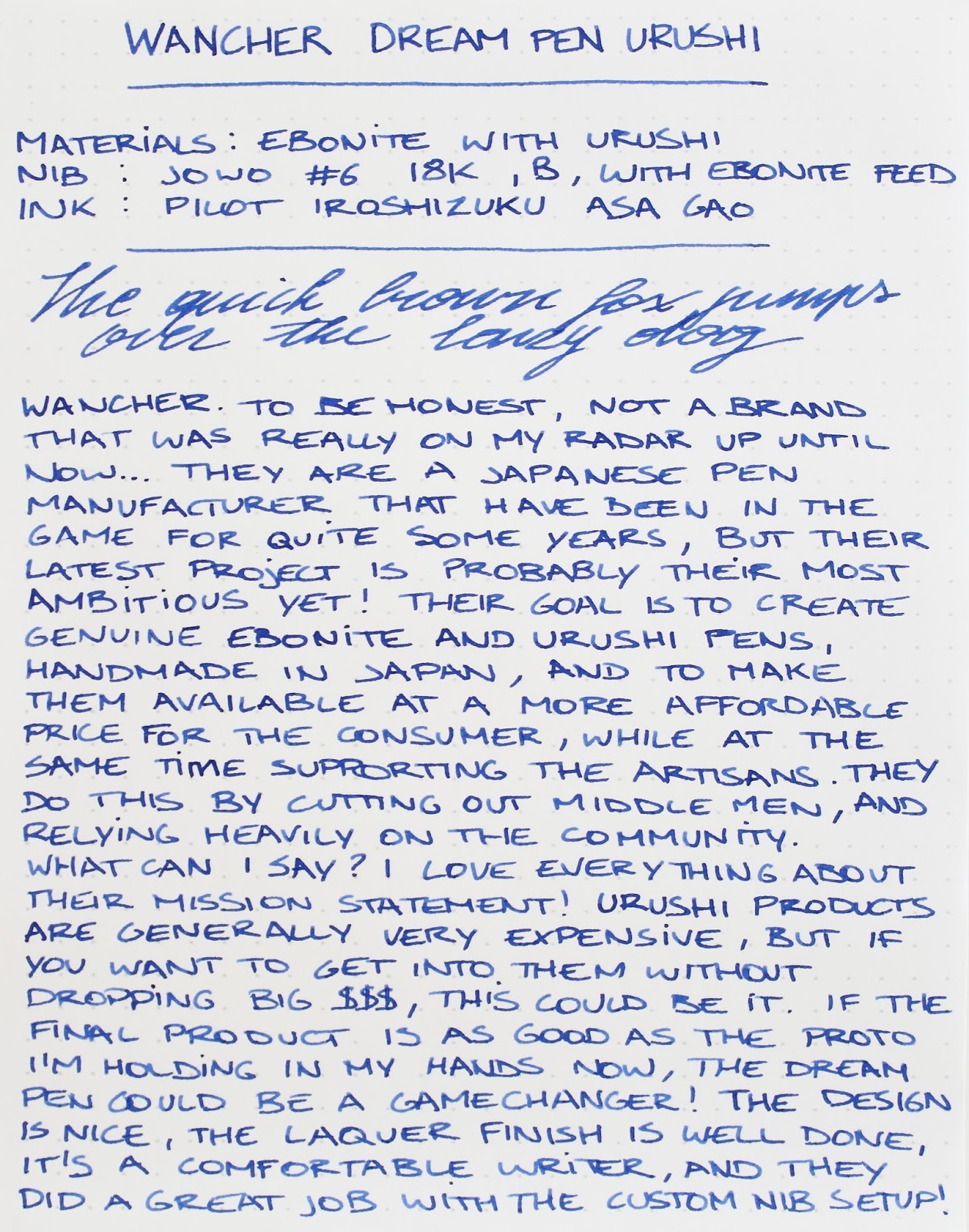
The nib is fantastic. It's a straight-out perfect nib in almost any way. Like most Japanese nibs, it runs about one size finer than Western nibs, so my broad is more like a medium. However unlike most Japanese nibs, it's very smooth, has almost no feedback (compared to something like a Sailor, which has more of a pencil-like feedback) and provides a rather wet ink flow, regulated by the same custom ebonite feed from Flexible Nib Factory that we've seen before. It also has a distinct bouncy softness that adds some character to your writing. Wancher warns not to put too much pressure on it, but there is certainly some line variation with mild pressure.
REVISITING THE WANCHER DREAM PEN URUSHI
The only thing I don't like about it is the laser-engraving. For some reason it looks a bit fuzzy on my Wancher nib, whereas on the JoWo nibs it's perfectly crisp. Overall though, I think they made the Dream Pen even better by complementing it with their own gold nibs. If you order a True Urushi dream pen from their website now, they will automatically come with their own Wancher gold nibs.
REVISITING THE WANCHER DREAM PEN URUSHI
So that's it. I was a bit wary to put a final conclusion on Wancher's Dream Pen Urushi project, as I wasn't sure if they were going to be able to live up to the hype. Now I'm completely certain: Wancher created a beautiful pen with a fantastic nib to boot. Even at full retail price, they managed to keep the cost about 300$ below a comparable Nakaya. Even though a 450$ pen (480$ with ebonite feed) can hardly be called inexpensive, it's a great deal for the quality you get, and it serves as a fantastic gateway into Urushi pens! 

Note: This post does not contain affiliate links.

Monday, February 12, 2018

WANCHER 'THE DREAM PEN' URUSHI FOUNTAIN PEN REVIEW

Wancher 'The Dream Pen' Urushi fountain pen review
Wancher. Chances are, you've seen this Japanese brand pass by on several blogs or social media in the past few weeks. And that's all due to the Kickstarter campaign for their latest product: 'The Dream Pen'

I don't know about you, but before their announcement of the Kickstarter, I had never really heard of the brand. They cleverly used a strong social media campaign to advertise the Kickstarter. And they also reached out to me, and about half a dozen other bloggers, to take a look at the early production prototypes of The Dream Pen. 

I have to give it to them, they did a very solid job with publicity and marketing for their Kickstarter campaign, which showed in the ridiculous pace at which their project got funded (and blew past their goal)!
Wancher 'The Dream Pen' Urushi fountain pen review
Anyway, I kind of missed the start of the Kickstarter with my review due to exams taking the upper hand. As it's a completely new brand to me, I had no clue what to expect so I didn't want to rush it either. It quickly became clear that Wancher is onto something impressive though. 'The Dream Pen' might be a slightly strange name, but after spending some time with it... there might be some truth in it.

Let's start at the beginning. With The Dream Pen project, Wancher set out to make a true ebonite and urushi fountain pen at a competitive price (and even a Maki-e version, albeit at a serious premium). At the same time, they want to honor the Japanese craftsmen who specialise in Urushi and Maki-e, by including them in the manufacturing process instead of turning to large scale industrialized production methods.

At first, those two things don't seem to go together, low price but labor-intensive manual production? Wancher says they achieve this by diverging from the traditional marketing and retail scenario. Instead of investing in advertisement, and selling through distributors and retailers (who of course each want a profit margin), they sell directly through the public, and do their own advertisement.
Wancher 'The Dream Pen' Urushi fountain pen review
I'm not an economist, so I don't know how viable this plan is in the long run, but so far it seems as if they have everything exactly figured out. Their successful advertisement campaign says enough in that regard.

As a Japanese manufacturer, they have been in the pen industry for over 25 years. But despite having one or two urushi and maki-e products in their assortment, their focus seems to be mainly on more affordable pens. The Dream Pen is an 'affordable' Urushi pen, but affordable is relative of course. Other urushi pens like Nakaya or Danitrio, go for at least twice as much easily. Even with a price many times higher than most of their usual products, they still managed to stay far below the usual retail price for urushi products. 
Wancher 'The Dream Pen' Urushi fountain pen review
In the Kickstarter campaign, you have a wide variety of finishes to choose from. 'The True Ebonite',  made out of solid ebonite (without urushi finish). 'The True Urushi', solid urushi colors (red, blue, black, green, purple,...) and red Tamenuri. And finally 'The True Maki-e', urushi with a cherry blossom Maki-e finish. 

I received a production prototype of the black urushi finish. Even though it's not so much a photogenic pen (almost impossible to properly capture the lustre of this perfectly polished laquer), it's a sight to behold. The Dream Pen is a large, cigar-shaped pen. The cap is slightly wider than the barrel, so the cap doesn't sit flush against the barrel. It's very remniscent of a Danitrio Mikado round-top (but smaller) or Namiki Yukari. There are no markings or artist signatures on the barrel or cap, which gives the pen a clean and minimalist appeal.
Wancher 'The Dream Pen' Urushi fountain pen review
Underneath the cap, there's still a surprisingly large step towards the section. Considering the design with the wider cap diameter, they probably could've made this a little less pronounced. But on the upside, the walls of the cap are thick and the entire pen has a solid and robust feel in the hand. The step and threads are noticeable when you run your finger over them, but the transition from section to barrel is gradual. I found my grip to be more towards the front of the long and nicely tapered section, so I didn't personally encounter any discomfort during writing.

The urushi laquer is applied evenly and sanded and polished to perfection. I couldn't find any flaws in the finish on this review unit. I even let Catherine of Sakura Fountain Pen Gallery check it out. She's an expert on Japanese handmade pens, and she was very impressed with the quality of the craftsmanship. If Wancher can keep up this level of detail and finesse at their current pricing, they will have created something remarkable. I'd almost dare call it revolutionary, but in the grand scheme of things it's not yet on the level of a cure for cancer or world peace...sorry Wancher!
Wancher 'The Dream Pen' Urushi fountain pen review
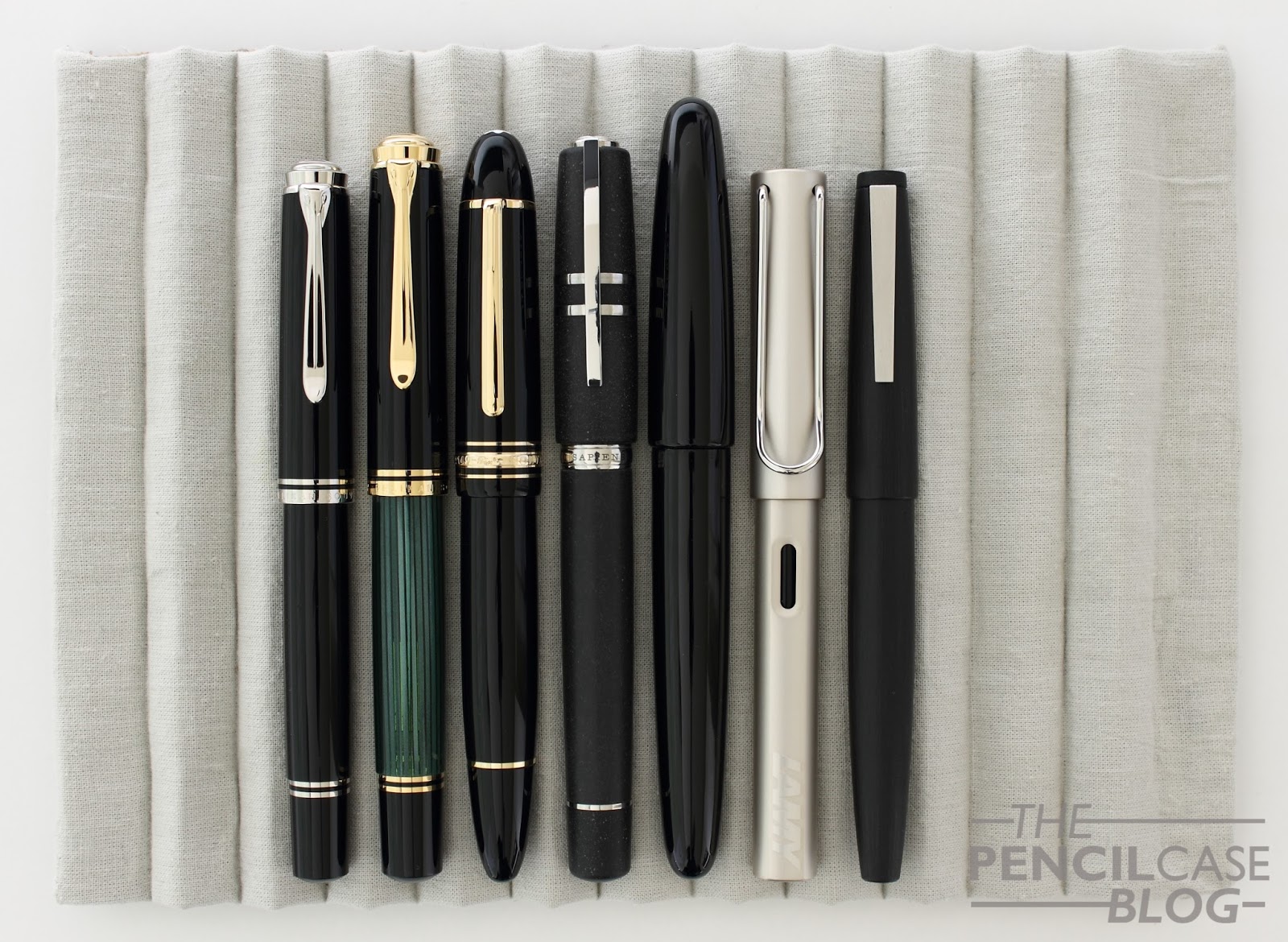
L to R: Pelikan Souverän M805, M1000, Montblanc 149, Visconti Homo Sapiens Oversize, Wancher The Dream Pen, Lamy Lx, Lamy 2000.
Wancher 'The Dream Pen' Urushi fountain pen review
Measuring 15.6cm (6.14") closed, and 13.2cm (5.20") uncapped, The Dream Pen is a serious pen. The cap cannot be posted, but since the pen is more than long enough as-is, I never felt like this was needed anyway. The widest part of the cap has a diameter of 1.7cm (0.67"), but the width drops down to a relatively average and comfortable 1.1cm (0.43"). A lot of urushi pens tend to be on the larger side, which makes it easier for intricate Maki-e patterns to be applied. But due to the lightweight ebonite construction (total of just 22 grams!), they remain comfortable and lightweight in use. 

Uncapping the pen, you can feel the spring-loaded insert in the cap. They used a similar system to the slip-and-seal mechanism Platinum uses in their 3776 pens, which prevents the nib from drying out. I found this feature to work excellent. The pen started each time, even after several days without use.
Wancher 'The Dream Pen' Urushi fountain pen review
For the writing end, Wancher decided on a pretty unique team-up with JoWo and Flexible Nib Factory. JoWo is of course well-known and widely used, and they produce excellent steel and gold nibs. But seeing Flexible Nib Factory involved was a pleasant surprise. This small startup company based in the US, specialises in custom feed and nib housings for existing nib/pen combinations. 

The resulting writing experience is honestly superb. The symbiosis of the 18k rhodium-plated gold nib (a broad nib in this case), and the precisely machined ebonite feed, make for a flawless setup. The nib is shockingly smooth but responsive with a wet ink flow due to the feed. A lot of superlatives, I know, but I honestly can't say a single bad thing about the business end of The Dream Pen. 
Wancher 'The Dream Pen' Urushi fountain pen review
Filling is done through a conventional standard international cartridge or converter. This is really my only hiccup I had with my review sample, as the converter that came included...wouldn't fit? A bit strange, but I suppose the custom nib unit has a slightly different diameter. I ended up using a Schmidt converter which fits snugly, but it works. 
Wancher 'The Dream Pen' Urushi fountain pen review
Of course you're probably curious to find out how 'affordable' they are exactly. The price obviously depends on the finish and choice of nibs. For a 'True Ebonite' pen with steel nib, the Kickstarter price is 155 EUR (185 USD), a gold nib adds 100 USD. The 'True Urushi' pens are available for 320 EUR (385 USD) and come with a 14k or 18k gold nib of choice. Finally the 'True Maki-e' will set you back 912 EUR (1100 USD). 
Wancher 'The Dream Pen' Urushi fountain pen review
Personally, I find the ebonite pens on the expensive side, given the retail price after the Kickstarter will go up even more. I think the true value is at the urushi pens, even the full retail price (450 USD) is still a lot lower than any other urushi pen currently on the market. The Maki-e I can't really judge on value for money, since the quality and technique of Maki-e has a great impact on its' value (literally the difference between a 1000 dollar pen, or a 40.000 dollar one!). 

Participating in a Kickstarter is of course always somewhat of a risk, especially with a brand that has never done this before. But since Wancher is not at all new to the business, I think they knew what they were getting into. If you want to get your feet wet into the world of urushi pens but don't feel like dropping big $$$ for it, The Dream Pen might very well be the way to go! I sincerely can't say enough positive things about it, if Wancher can make their promises true and deliver a product as good as the prototype I have in my hands right now, this can become a game changer for the Urushi fountain pen industry... especially if they can keep those prices low once the Kickstarter is over.

Want to join in on the Kickstarter? Better act fast: at the time of publishing this review, there's only a little over two weeks left on the clock... You can find the Kickstarter page HERE.

Note: This product was provided on loan by Wancher, free of charge, so I could write this review.  I was in no way influenced in the making of this review, the opinions shared in this review are completely my own! This post does not contain affilate links.
Wancher 'The Dream Pen' Urushi fountain pen review

Saturday, October 14, 2017

DANITRIO MIKADO FLAT-TOP FOUNTAIN PEN REVIEW

Danitrio Mikado Flat-top fountain pen review
When you think about it, there really aren't that many pen brands out there that focus solely on handlaquered urushi and Maki-e fountain pens. Off the top of my head I only know two: Nakaya and Danitrio! Of course there are others, but these two account for the majority of the pens that you will come across. 

Especially Nakaya is by far one of the most well-known brands out there, but I think that is mainly due to their more reasonable pricing. I've personally always found Danitrio's designs to be more interesting, unfortunately they do come at a cost!
Danitrio Mikado Flat-top fountain pen review
One of the designs from this American/Japanese brand (While the craftsmen and techniques are Japanese, their HQ is in California) that I have always been particularly fond of is the Mikado flattop. And it just so happens that I got the opportunity to try one, courtesy of Sakura Fountain Pen Gallery, so big thanks to them! 

Danitrio puts out a lot of very unique and intriguing designs: from a straight cylinder, or a dodecagonal faceted pen, to a pen with a ridiculously bulbuous shape (almost as if the pen is about to explode). They have a thing for exaggerated shapes, and even more so for very large pens! There are a couple relatively smaller and more 'normal' designs as well, but even those can be considered 'oversized' compared to typical western pens.

The Mikado has, what I think is a relatively traditional design, But it's the size that makes it special. It has a slightly bulbuous cigar shape, with flattened ends as the name suggests. 
Danitrio Mikado Flat-top fountain pen review
The Mikado doesn't have facets, and it has a single-color urushi paintjob. It can be had clipless or with clip, with the clip itself also often being laquered to match or contrast the rest of the pen. Danitrio only uses a single clip design for all their pens. The simple, curved shape matches the design of the Mikado particularly well.

I'm drawn to the simplicity of the Mikado. The reddish-brown urushi on this pen is called 'Ki-Dame', and it's made with the Tame-Nuri technique. I'm writing this as if I know a bunch about these laquering techniques, but I honestly don't understand a single word!

What I do understand is that urushi can be quite deceiving. In this case, Ki-dame stands for yellow Tame-Nuri laquer, however this doesn't look much like yellow at all. With the Tame-Nuri technique, a colored base layer -yellow in this case- is covered with multiple colorless layers. The colorless layers start out as a smoke brown color, but under the influence of light they become completely colorless over time. This means that, over use, the pen will become lighter and the yellow base color will show through more. An interesting bit of Wabi-Sabi!
Danitrio Mikado Flat-top fountain pen review
The yellow base color of the Ki-Dame Tame-Nuri adds some depth to the finish
Urushi laquer is applied in many thin layers, and each layer is sanded before the next one is applied. The cool thing with Tame-Nuri finishes is that the edges of the pen have a thinner layer of laquer, so the base color shows through more. This contrast is simple yet playful, and it provides some visual interest to an otherwise monotone pen. I like the combination of a big pen with a subtle finish like this. It's a stately pen and it's quite an eye-catcher, but it doesn't overdo it.
Danitrio Mikado Flat-top fountain pen review
Each pen has a maker's signature at the bottom of the pen
As I said earlier, Danitrio makes some pretty big pens. 'Big' might even be an understatement. Put the Mikado next to any standard 'western' pen -even a large one like the MB 149- and it completely dwarfs them!

There's actually a pretty sound explanation for why these pens are often so large. You see, most Danitrio pens -including the Mikado- are also used as a basis for Maki-e laquer art. The bigger the pen, the more intricate paintings can be made on it.

An oversized pen like this might not be everyone's cup of tea, and it sure isn't practical to take with you as it doesn't fit most pen cases. But from a comfort point of view, it does get away with it's size quite well. And with this I mean that, despite the size, it actually manages to be quite a comfortable pen to hold and write with.
Danitrio Mikado Flat-top fountain pen review
L to R: Pelikan M800, Montblanc 149, Danitrio Mikado, Danitrio Takumi, Lamy Safari, Lamy 2000
Coming in at 16.3 cm (6.42") closed, and 14.2 cm (5.49") without the cap, and with a diameter of 2cm (0.78") at the widest point of the cap, this really is unlike anything else! The section is a good bit less wide, compared to the rest of the pen that is. With a total weight of 45g (27g uncapped), it feels solid but it's far from heavy. Of course that's to be expected from an ebonite pen.
Danitrio Mikado Flat-top fountain pen review
In terms of comfort, I actually like the bulky overall shape. The section may be a little on the short side, given that there's a relatively large step behind the threads. But all in all it hasn't bothered me that much when in use. The wider diameter of the section makes me grip the pen more relaxed, as opposed to having a death-grip on thinner pens. But that could just be me. Suffice to say, I didn't ever think about posting the cap, it's obviously more than long enough without that.
Danitrio Mikado Flat-top fountain pen review
A quick word about the filling system: the Danitrio Mikado is equipped with a Japanese eyedropper. It's the first time I ever used this specific filling system. A Japanese eyedropper is similar to a normal eyedropper, but additionally it features an integrated mechanism that resembles a vac filler. Inside the barrel, you'll find a plunger that closes off the ink flow towards the feed. But instead of operating the plunger up and down to fill the pen -as you would with a vacuum filler-, the only function of the plunger is to act as an ink shut-off.

To fill the pen, you simply unscrew the section and fill the entire barrel with ink using an eyedropper or syringe. To write, you unscrew the blind cap at the back of the barrel a few turns to move the plunger away from the feed, which allows the ink to flow. Usually, vac fillers can be used without loosening the blind cap. But especially when I picked up the pen after a day of not being in use, I found the flow quite dry and it would hard start without the shut-off valve opened.
Danitrio Mikado Flat-top fountain pen review
love the design of the large #8 nib!
You might think pens like this are just for show, but nothing is less true! Danitrio equips their pens with German Bock nibs, and they are absolutely fantastic in every way! The Mikado is a large pen, so it comes with the larger #8 nib. I love the two-tone design, it's by far the most beautiful I've ever seen, and the intricate design is meticulously plated to create the two-tone design.

But they don't just look great, they write great as well. Of course you shouldn't expect anything less on a 1500 dollar pen, but this 18k nib is tuned to absolute perfection. The large nib sits on an ebonite feed that provides a generous (sometimes perhaps a bit too generous) and consistent ink flow. I encountered a hard start every now and then, when the pen had been unused for a while. But I suspect this is most likely due to the ink shutoff which causes the remaining ink in the feed to dry out. The nib itself is not to blame for this, as it wouldn't hard start when I'd open up the valve before putting the pen to paper. In any case, a gentle shake was is all it took to get the flow back to normal again.As I said, I do recommend opening up the piston knob each time you write.

The nib is smooth, very smooth even. Yet despite the above mentioned occasional hard start, I never had any issues with skipping or inconsistency. Smoothness vs. consistency is a balance that proves to be difficult to maintain, yet Danitrio does this quite well.
Danitrio Mikado Flat-top fountain pen review
1575 Euros, that's the pricetag we're looking at here. Undoubtedly a ridiculous amount of money to spend on a pen, but knowing the amount of craftsmanship and time that went into making it, kind of justifies the price for me. It's a bit rich for my blood for now, but a Danitrio Mikado has definitely been added to the (ever growing) wishlist! 

This product was sent to me on loan by Sakura Fountain Pen Gallery so I could write this review. I was in no way influenced in the making of this review, the opinions shared in this review are completely my own! This post does not contain affilate links.
Danitrio Mikado Flat-top fountain pen review