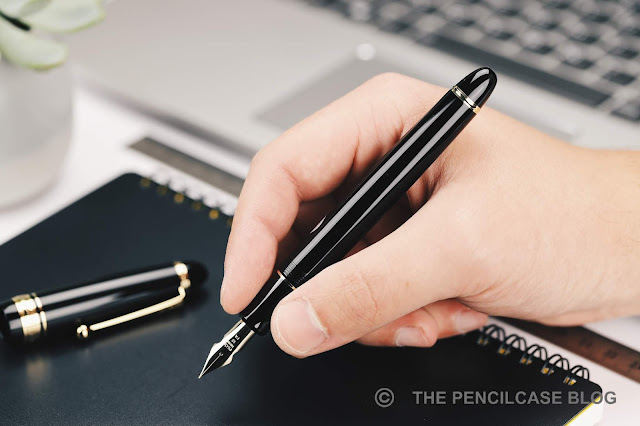
Showing posts with label Pilot. Show all posts

Saturday, April 9, 2022

REVIEW: PILOT CAPLESS LS FOUNTAIN PEN

REVIEW: PILOT CAPLESS LS FOUNTAIN PEN
For as long as I can remember, the Pilot Capless and I have had quite a love-hate relationship. They're fantastic pens, bombproof, great writers - sure! But, as I highlighted in my re-review of the Capless, none of the Caplesses (Caplessi?) that have gone through my hands managed to captivate me. So I sold mine a long time ago, and never really looked back... Until Pilot released the Capless LS!
REVIEW: PILOT CAPLESS LS FOUNTAIN PEN
While the new Capless LS is quite an interesting pen, I doubt that it made the splash that Pilot was hoping for when it came out. After all, it banks on the vast success of their evergreen Pilot Capless. The LS aims to be a more luxurious version of the Capless' success story (even the name LS, 'Luxury Silent', says so) and has a price tag to match! But does it actually manage to be a better pen than the already very good original one? And does it manage to keep my attention longer than the original?
REVIEW: PILOT CAPLESS LS FOUNTAIN PEN
The LS departs a fair bit from the purely utilitarian design of the original Capless. Purely in terms of form, the Capless LS does away with the more classic design elements, replacing them with more modern and angular lines. It's also a slightly more chunky-looking pen because of that. 

I've always found the sleek and futuristic design of the vintage Capless very befitting for a technically advanced pen like the Capless. The classic lines of the original don't really do it for me. So the modernized look of the LS is already an improvement, at least in my opinion.
REVIEW: PILOT CAPLESS LS FOUNTAIN PEN
The knurled center ring is quite literally the center of attention: it's big and accentuated by the fact that it sits recessed into the barrel. This interesting design choice stands out and creates a very strong visual break between the section and barrel of the pen. 
REVIEW: PILOT CAPLESS LS FOUNTAIN PEN
The front of the Capless LS got a thorough redesign as well, again showing more angular, clean lines. The clip sits a bit further back. But ultimately, it's the slimness of the redesigned clip that makes this a better, more comfortable design to hold - at least in my opinion.
REVIEW: PILOT CAPLESS LS FOUNTAIN PEN
L to R: Lamy Dialog 3, Leonardo MZ Grande, Pelikan M805, Pilot Capless, Pilot Capless LS, Lamy 2000, Lamy Safari
The LS grew a bit bigger, chunkier, and heavier than the regular Capless. While the regular Capless is a rather heavy pen already (30 grams), I find that the slightly larger dimensions of the LS help offset the additional weight (40 grams). It doesn't really feel that much heavier. The LS measures 14.5 cm, compared to the 14 cm of the original, though both are roughly the same length - 13.8 cm - when 'open'. The LS may seem wider around the section (because the entire pen is thicker), but the section actually has a longer taper. So, around one-third down the length of the section (around where I grip it in the above image), both pens are actually almost the same diameter (the LS is just a fraction of a millimeter thicker). 

I find the slight added thickness of the LS quite pleasant, but what's even better is the change to a much narrower clip. It's much less intrusive on your grip than the beefy clip of the standard Capless, to the point where I almost don't notice it while I write. I'm sure that's a selling point for a lot of people.
REVIEW: PILOT CAPLESS LS FOUNTAIN PEN
Hm, what do we call this? A knock with a swiveling ring with a thumb stud... yeah, that seems to be about the dumbest, most accurate description I can think of!
The LS' updated click mechanism is the main attraction of this pen. The knock is now almost entirely silent, with the swiveling ring around the knock acting as sort of a dampener as it rotates 270° back and forth. That ring has a kind of protrusion on one side (a thumb stud?) accentuated by a line that runs along the edge, filled with black paint (on the matte black pen, it's red for a nice accent. I wish they'd use glow-in-the-dark photoluminescent paint like on a watch dial!).
REVIEW: PILOT CAPLESS LS FOUNTAIN PEN
While it is cool, the LS certainly trades in some usability for the coolness factor of seeing that ring swivel around the barrel. While 'opening' the pen is still done by clicking the knock, the nib can only be retracted by flicking the ring and letting it unwind on itself. It's a bit finicky and definitely slower than just pressing the knock again (add to that, the dampened mechanism also takes a surprisingly long time to retract). I wish it'd just click both ways for easier and faster use, but with the added dampening and silence of the rotating mechanism. I also suspect that it's not quite as practical for lefties, as the thumb stud on the ring is oriented so that it's in the correct position for right-handed writers. 
REVIEW: PILOT CAPLESS LS FOUNTAIN PEN
Getting under the hood, this is where I've always enjoyed the Pilot Capless - a very user-focused EDC pen with a fantastic 18k gold nib. The nib may be tiny, but it's an excellent writer as with all Pilot pens! I chose a broad nib this time, as I find Pilot's medium nibs a bit too wide for EDC yet not wide enough for a fun broad writing experience (the F is a much better choice for a daily writer). As expected, it's buttery smooth and juicy, as it glides across the page (it even sings, really!).
The Pilot Capless LS has a couple of cool features left and right: the design is a bit more modern and clean, the clip is much more comfortable, and the knock mechanism is quite cool and quirky (albeit not as practical and straightforward as the original). Purely in terms of function, the LS doesn't really improve over the original. But its design certainly makes the LS a more interesting and cool pen to me. 

Whether or not it's cool enough to justify the massive price tag of 475€ (at La Couronne Du Comte, get 10% off with discount code 'Penthusiast') or 440$? I'd recommend looking out for a sale on the LS, which is how I got a hold of mine at a much more reasonable price. At full MSRP - more than twice the price of a regular Capless - the LS does not sound like a sensible purchase at all... But then again, sensible is not always what we're after in this hobby, is it? 

Note: La Couronne Du Comte is a sponsor of this site. I received a discount on this purchase, which enabled me to write this review. I was in no way influenced in the making of this review, the opinions shared in this review are completely my own! This post does not contain affiliate links.
REVIEW: PILOT CAPLESS LS FOUNTAIN PEN

Tuesday, March 31, 2020

REVIEW: PILOT CUSTOM 743 FOUNTAIN PEN & FA NIB

Review: Pilot Custom 743 fountain pen + Falcon FA nib
In my - possibly neverending - search for the best possible modern flex nib, we've arrived at a very cool pen from Pilot that I've been wanting to try out for a very long time: the Pilot Custom 743. The only thing standing in my way up until this point has been Pilot Europe's ongoing ignorance (or restrictions from higher up?) of their luxury writing branch, leaving European vendors behind empty-handed on a lot of awesome products.

Early this year - about 3 years too late, mind you - the Pilot 823, 845 urushi and Custom urushi FINALLY made it over to the European market. While an improvement for sure, we're still eagerly waiting for the rest of Pilot's offerings (the Custom 912 or 743, for example) especially with Pilot's exquisite specialty nibs like the Waverly (WA), Posting (PO), Stub (SU), or the nib I'll be showing today: the Falcon (FA)!

Because chances of getting the Custom 743 here in Europe are slim for the time being, I instead sourced it from a Japan-based retailer. The only problem - as some of you will know - is that most Japanese web stores can be really difficult to navigate, even with help from Google Translate. So, luckily, I found out about PenSachi! With their English website (and English-speaking staff), PenSachi aims to make hard-to-get special and limited editions from Sailor, Platinum, and Pilot more readily available for customers outside Japan. My thanks to them for helping me get my hands on a 743 for this review!
Review: Pilot Custom 743 fountain pen + Falcon FA nib
Pilot Custom 743 (bottom) and 823 (top)
The Custom 743 leans very close to the Custom 823 (that I reviewed a few years ago), especially in terms of the overall design. But there are some key differences as well, particularly on the inside!
Review: Pilot Custom 743 fountain pen + Falcon FA nib
Enamel-filled letters on the center band complete the low-key appearance of the 743
I'd categorize the 743 as a 'business'-style design, fitting right in with the rest of Pilot's rather understated Custom and Custom Heritage pens. A no-frills, black+gold pen that doesn't try to stand out between analogs like the Montblanc Meisterstück, Sailor 1911 or Platinum Century 3776. If anything, I find that the design appears a bit more streamlined and retro than its competitors - probably due to Pilot's typical ball end clip.
Review: Pilot Custom 743 fountain pen + Falcon FA nib
Pilot Custom 743 (bottom) and 823 (top)
I think there's something to be said for the simplicity of the Custom 743. On the outside, it's an elegant and slender cigar-shaped pen in black resin, detailed with plenty of gold trim without looking gaudy. The 743 and 823 are identical except for the semi-translucent resin of the 823 (although the smoke grey 823 appears almost black in person) and a slightly longer, more tapered barrel finial on the 823 which is actually the blind cap for the vacuum filling mechanism, as opposed to just an aesthetic detail on the 743. 
Review: Pilot Custom 743 fountain pen + Falcon FA nib
The vacuum filling system of the 823 is an excellent choice when you absolutely want/need a high ink capacity (2.5 mL) for daily use. But the 743's con-70 converter is not at all a bad alternative, with more than adequate capacity (about 1 mL, almost twice as much as a standard international converter), and a practical pump filling system. Another way to look at it is this: with the 823 you have to stick to one ink for a considerable time, the 743 gives you the ability to change inks a bit more frequently.
Review: Pilot Custom 743 fountain pen + Falcon FA nib
L to R: Pelikan M805, Platinum Century 3776, Pilot Justus 95, Pilot Custom 823, Pilot Custom 743, Lamy 2000, Lamy Safari
The Pilot Custom 743 is a large pen that doesn't feel large. It's light (26 g total) and nimble in the hand, and about a fraction slimmer than a Pelikan M800. Those things, combined with the excellent grip shape and unobtrusive threads, make for an excellent pen to use. In terms of length (14.8 cm/ 5.8" capped, 13.1 cm/ 5.16" uncapped), it's a touch longer than a Montblanc 149, making it ideal even for people with larger hands (unless you have a strong preference for girthier pens). Comfort-wise, it's hard to knock these pens.
Review: Pilot Custom 743 fountain pen + Falcon FA nib
FA nib on the 743 (left), medium nib on the 823 (right)
We've finally come to the ACTUAL reason why you'd choose the 743 over the 823: the nib! Both use Pilot's 14k gold, #15-size nib (same size as a #6 nib from other brands), but as I already mentioned, the 743 gets a few more interesting options than the 823, in this case the flexible Falcon (FA) nib. Confusingly, it's not the same as Pilot's similarly named Falcon fountain pen. Whereas the Pilot Falcon PEN has a nib that's best described as springy and soft, the FA NIB on the 743 comes closer to a true modern flex nib.

The FA certainly has the design cues of a flex nib: a slender profile with long and strongly tapered tines, cutouts on the side, and very minimal branding on the nib face (I was told once that the less intricate stamping is done to prevent structural weak points, which is of course very important on a flexible nib!). It may look a bit bland in comparison to the regular scrollwork on Pilot's nibs, but that's a trade-off I'm willing to make for a flexible writing experience.
Review: Pilot Custom 743 fountain pen + Falcon FA nib
The FA nib is definitely suitable for everyday use, provide you don't have a heavy hand. With normal writing pressure, the nib is just stiff enough to still provide a pretty comfortable writing experience. The EF-F tipping provides a noticeable (and audible) amount of feedback while writing.

Looking at the FA purely for flex writing, it does come with a little side note: since it's a Japanese-made nib, it's designed for the short brush-like strokes of Japanese calligraphy, not really for Western writing styles. Continuously flexing the nib will make it railroad because the feed isn't designed to keep up.

If you take it slowly though, this nib is pleasantly springy and responsive and produces excellent results as far as line variation goes. The tines open up quite easily to a little over 1mm, or 1.3mm when pushed to the limit. It's probably worth suggesting, given that this is not a cheap pen like a Noodler's or the FPR Himalaya I reviewed last week, I'd probably suggest not pushing the nib to the limit (never a great idea). Still, variation from EF to BB is nothing to be scoffed at. Because it starts off as a rather fine line, that's more than enough variation to give a dramatic effect to your writing.
Review: Pilot Custom 743 fountain pen + Falcon FA nib
I'm generally not one to make a case for matching pen and ink of the same manufacturer. However, with some Pilot pens, like this one, I've noticed slight improvements sticking with Iroshizuku inks (I haven't really systematically tested this theory though, so your mileage may vary!). I wrote this review with Pelikan Edelstein Onyx (generally a good performing ink for flex nibs), but there were some occasional skips on downstrokes and as expected the feed starved after writing a few words with heavy flexing (pushing the limits of the nib, mind you). Switching to Iroshizuku Tsuki-Yo made a noticeable improvement. Even with fast flex writing, the feed seemed to recover faster from getting starved (It will still railroad periodically, but the flow immediately picks up again), and the nib no longer skipped.
Review: Pilot Custom 743 fountain pen + Falcon FA nib
The Pilot 743, just like the 823, manages to impress in so many ways. The no-frills, workhorse design means serious business, and under the hood, it packs some serious performance. The FA nib adds a bit of playfulness to the mix. It's an excellent option to get your hands on modern flex: a pleasantly soft and responsive flex nib, that gives plenty of line variation.

Given that the 743 and 823 are identical in design and price - both retail for 265$ at PenSachi - deciding between the two will boil down to choosing either a high-capacity filling system or one of Pilot's many interesting specialty nibs, you can't have both. Either way, you're getting a lot of pen for essentially (less than) half the price of a Pelikan M800 or Montblanc 146!

Note: PenSachi provided this product at a discount, so I could write this review. I was in no way influenced in the making of this review, the opinions shared in this review are completely my own! This post does not contain affiliate links.
Review: Pilot Custom 743 fountain pen + Falcon FA nib

Sunday, January 26, 2020

REVIEW: PILOT CUSTOM NS FOUNTAIN PEN

REVIEW: PILOT CUSTOM NS FOUNTAIN PEN
Ever heard of the Pilot Custom NS? No? Well, neither had I before the writing of this review!

The Custom NS sits at the lower end of the fairly extensive range of Custom-line fountain pens from Pilot. Having been out for a few months now, It's somewhat strange how little talk this pen has received online so far. The NS is a bit of a strange bird in the lineup of rather business-y pens that Pilot is generally known for, and to top it off the value proposition is sort of... interesting. I'll explain later.

UPDATE #1: NS stands for North-South of a compass because the founder of Pilot was a sailor (no, not THAT Sailor!).
REVIEW: PILOT CUSTOM NS FOUNTAIN PEN
We'll start with the good stuff though. The Custom NS is a slightly more cheerful design in an otherwise quite bland line of does-the-job-but-nothing-more pens that the 92, 74, 912, 823,... generally tend to be. It's still a fairly simple design overall, and it stays true to many aspects that tie together Pilot pen designs: such as the triangular, ball-end clip that can also be found on the 74, 743, etc.

The more tapered and curved cigar shape is a bit of a departure from the more subtle torpedo shape with rounded finials that you're used to seeing with many Pilot pens. At first look, the NS looks a bit distorted because it's 'different' from the rest - kind of weird how you get used to a certain design style over time.
REVIEW: PILOT CUSTOM NS FOUNTAIN PEN
The trim of the NS is quite different from the other Custom pens, too. The center band on Pilot pens usually gets wider, the more expensive the pen. On the Custom NS however, the center band is a very wide single (instead of double) ring and extends all the way to the cap edge. 
REVIEW: PILOT CUSTOM NS FOUNTAIN PEN
The barrel lacks an ornamental ring, but both cap and barrel finial are finished with a small metal insert. The cap finial has a blue dot in it -leftover from the highly coveted Pilot M90 of yore, perhaps?- that I think looks a bit out of place on this red colorway.

UPDATE #2 (I really should've read the Pilot website before I wrote this review!): To quote Pilot: "The cap finial has blue parts that resemble the sea, and is designed with the hope that the heart that cares for someone will be connected without interruption as if the river were connected to the sea."

Speaking of colorways: the NS is available in a nice range of opaque colors (dark and light blue, beige, red or black) that are not often seen on Pilot pens.
REVIEW: PILOT CUSTOM NS FOUNTAIN PEN
Platinum Procyon, Pilot Custom 74, Pilot Custom 743, Pilot Custom NS, Lamy 2000, Lamy Safari
The thing that attracted me most to the NS is its size. The Pilot Custom range goes pretty much from small to large when you go up in price... but the NS is again an odd one out. With its 14.4 cm (5,67") length, it's a hair longer than the more expensive Custom 74 and considerably longer than the Custom 91 and 92. Uncapped it's a respectable 12,6 cm (5,0") in length. I feel like the NS is a good-sized pen for everyday use, whereas I always found the Custom 92 a bit on the short side. The plastic construction keeps the overall weight down. The construction feels solid, mainly due to the metal trims.
REVIEW: PILOT CUSTOM NS FOUNTAIN PEN
The one thing you can always rely on with Pilot pens is their excellent writing comfort. The section design is pretty much always the same on all of their pens, yet of all Pilot pens I had on hand, the NS had a noticeably longer section. It's a comfortable pen to use, in part due to the very unobtrusive threads right behind the section. 
REVIEW: PILOT CUSTOM NS FOUNTAIN PEN
The NS comes equipped with the Con-40 converter, which is so bad that I'd honestly rather stick to refilling cartridges with a syringe. Luckily it does fit the much better Con-70, but you'll have to buy it separately.
REVIEW: PILOT CUSTOM NS FOUNTAIN PEN
The nib is a steel size 5 (the same as on the Custom 92 and 74) and aesthetically shares the exact same design as the more expensive gold nibs. Sizewise, it feels a bit out of place on a pen this large. The performance is exactly where you'd expect it from a Pilot pen - consistency is definitely a key strength of Pilot's nibs. The ink flow is average but never feels dry, and the ink flow is as consistent as it gets. The medium nib is smooth and lays down a line that is pretty true to the average western medium. If anything, it's perhaps a bit bland and characterless. On the flip side, as far as reliability goes this is not a bad choice.
REVIEW: PILOT CUSTOM NS FOUNTAIN PEN
The Pilot Custom NS is an all-round good pen. The design is classic Pilot, but with a colorful twist. It performs the way you'd expect a Pilot pen to perform: a solid, workhorse pen. A lot of positives...

But why would you buy one? In Japan, it retails for around 80-90$, but here in Europe that price goes up to 100€ and in the US it's a ridiculous 140$. On the European market, the price sort of makes sense because it's still a good bit cheaper than the gold-nibbed Custom 74 and 92. If you're buying outside the EU though, the price jump towards a gold nib is too small to even consider the NS as a valid option. Also compared to pens from other brands, I'd say the NS feels a bit bland for the relatively high price you pay. You can't really go wrong with it, but unless you're really set on the Custom NS, I think there are better options out there.

So maybe that's the reason why you're not hearing more about the Pilot Custom NS?
This product was sent to me by Casa Della Stilografica so I could write this review. I was in no way influenced in the making of this review, the opinions shared in this review are completely my own! This post does not contain affiliate links.
REVIEW: PILOT CUSTOM NS FOUNTAIN PEN

Friday, May 26, 2017

PILOT CUSTOM 823 FOUNTAIN PEN REVIEW

Pilot Custom 823 fountain pen review
The Pilot Custom 823 is close to what I'd call a grail pen. Or maybe something more like a 'long-term wishlist' pen. A lot of people think that a grail pen should only be something extraordinarily expensive, something you probably won't ever be able to afford. I disagree. 

Case in point: the Custom 823. People outside of Europe probably won't understand me when I'm talking about how much of a pain it is to get one of these pens. Frankly, because Europe is apparently the only part of the world where Pilot decided to not sell any of their interesting pens (such as the Custom 912, 823,etc.), don't ask me why... 
Pilot Custom 823 fountain pen review
Anyway, the Custom 823 has been on my wishlist for over three years, and despite having asked pretty much every pen store in Europe (more than once), not a single one of them could help me. Perhaps you're wondering why I didn't just buy one from Japan or the US directly, which is a completely valid thought, apart from the fact that Belgian Customs charge ridiculous amounts of money for imported goods (think approx. 50% of the retail value!).

Luckily there's one shop that dares to take the lead, and work around the limitations of Pilot's import by importing directly from Japan: Casa della Stilografica, based in Italy. 
Pilot Custom 823 fountain pen review
The downside to importing directly from Japan, means that they also have to pay import duties. The benefit is that they can also get a hold of the Japan-exclusive smoke grey demonstrator version of the 823 (and perhaps also the clear demonstrator, but I'm not entirely sure about that). 

But enough about Pilot's stupid retail strategies! It's an issue that needs to be adressed for sure, but we're all really here to talk about the star of the show: The notorious Pilot Custom 823! 

Where to start? The Custom 823 might not look like a pen that's worth all that trouble to get it. It's a pretty plain pen, designwise. I don't mean anything wrong with that, it's just a very typical, classic cigar-shaped design with tapered ends and gold trims. Something you can also find with brands like Montblanc, Sailor, Platinum,...
Pilot Custom 823 fountain pen review
Original or not, the Pilot does a really splendid job with the small details. The material is a slightly translucent acrylic, in this case grey, but more commonly they are seen in a translucent brown material. The amount of translucency is fairly minimal, but just enough to catch a glimpse of the inner workings of the pen (the nib is covered by a solid black inner cap, so unfortunately you can't see the nib when the pen is closed). The 823 has gold-plated trims, and the typical triangular clip with ball end that can be seen on many Pilot/Namiki pens. One really small detail I particularly enjoy is the enamel-filled engraving on the center band. It's a small detail, but it's tastefully done and it makes the text stand out.
Pilot Custom 823 fountain pen review
L to R: Sailor Pro Gear, Pilot Custom 92, Pilot Custom 823, Pelikan Souverän M805, Lamy Safari, Lamy 2000
The Custom 823 is among the largest pens in Pilot's luxury product lineup. It measures 14,9 cm (5.86") when closed, and 13,1 cm (5,16") without the cap. However it doesn't feel overly large, both because of the comfortable weight (29g total), and the relatively average diameter (1.05cm/0.41" at the grip, 1.25cm/0.49" at the barrel). 
Pilot Custom 823 fountain pen review
The lack of an annoying step or transition from section to barrel, and the shallow threads, combined with the comfortable dimensions and weight, make this an excellent pen to write with. And because of the decent size, it's easily usable without the cap posted. Though if preferred, the cap does post, and while it adds a good bit of length, it doesn't weigh down the back of the pen too much. 
Pilot Custom 823 fountain pen review
Filling a vac-filler is easy: just dip the nib into the ink, and push the plunger down completely!
The Custom 823 is unique from other Pilot pens because of the vacuum filling mechanism. This is the same mechanism as with the TWSBI Vac 700, or Visconti's Powerfiller, and it provides a massive amount of ink in one fill. The entire barrel can be filled with ink, to give a maximum ink capacity of well over 2 ml, which is at least three or four times as much as a regular cartridge or converter! 

On top of that, vacuum fillers are also ideal for travelling, when you want to take your pen with you on a plane, because the piston plunger doubles up as a shut-off valve towards the feed when the mechanism is fully closed. To write, the piston knob has to be turned a couple times to allow ink to flow towards the nib. 
Pilot Custom 823 fountain pen review
But then we come to the most important part: the writing experience. Pilot makes great nibs, that's generally known. But I never had a Pilot before that really amazed me... This one does. The large monotone 14k gold #15 (Pilot's equivalent to a western #6) nib is not only pretty to look at, it writes beautifully out of the box. I chose a medium nib on this one, expecting it to be on the finer side, but it's actually almost the same as a Western medium. It's very smooth, yet responsive at all times. It writes at all times without stuttering, skipping or hard starts, and it has a consistent, wet flow.
It's not at all hard to see why the Pilot Custom 823 has grown to become one of the absolute favourite pens of so many people around the world. It's a crowd pleaser, a design that will suit many, a comfortable shape and size, and a nib that is absolutely fantastic! At a price that is roughly half that of some top-of-the-line pens from other Brands, such as Pelikan, Montblanc, Sailor,... the Custom 823 offers incredible value for money, even though it's still a 300$ pen.

Current retail prices outside the EU vary between 288 and 300 USD. Within the EU, because of the import duties, that price goes up to 388 EUR when you buy it from Stilografica.com. While that may sound like much, it's still cheaper than if you'd import it directly (import duties may vary by country), and you can buy directly from a 'local' pen store instead of having to buy overseas. 
Note: Casa Della Stilografica is a sponsor of this blog. This product was sent on loan, free of charge, so I could write this review. I was in no way influenced in the making of this review, the opinions shared in this review are completely my own! This post does not contain affilate links.
Pilot Custom 823 fountain pen review

Thursday, December 15, 2016

TOP 5 BEST BEGINNER FOUNTAIN PENS

As with any hobby, starting out with fountain pens can be a bit scary. Where to start? The wide variety of brands, materials, sizes, nibs,... can be difficult to choose from. Even pricing and price differences can be confusing. It's perfectly possible to find a very decent pen in the 15-50$ price range, but you need to know where to look.

In this buying guide I'll show you around five of the best fountain pens to start off with. These are some of my personal favourites in the 15-50$ range. They should give you a head start into the fountain pen world, without breaking the bank.

Something mportant to keep in mind though: These are five pens that are generally quite well-regarded, but your mileage may vary. Personal taste and preference plays a huge role in finding the perfect pen, so you might have to experiment with a few different styles, sizes, materials before you find out what you're looking for.
At the bottom of the page, you can find a few size comparisons. More in-depth reviews can be found through the links underneath each section.

You can purchase all the pens discussed above from any of my sponsors. As an added bonus, some will give you a small discount when you use the provided discount code at checkout!


KAWECO SPORT

PRICE: 17.5 EUR / 25 USD

Kaweco's 'sport' pens are recogniseably by their distinct pocket design with the large cap. This small plastic pen (more expensive metal versions are also available) is meant to be used with the cap posted on the back to transform it into a full-sized pen that is comfortable to use. If you're looking for a valid EDC choice, you should look no further and go with one of these! They come in a wide variety of colors and finishes (Each finish has it's own name: Classic, Ice and Skyline), and you can choose from a bunch of nib sizes (extra fine to double broad).


LAMY SAFARI

PRICE: 18.5 EUR / 29.6 USD
PURCHASE: Penworld | La Couronne Du Comte | Appelboom | Fontoplumo

Lamy is one of the most widely recognised brands in the world, and part of their succes is based on the iconic Lamy Safari fountain pen. The Safari is a sturdy plastic fountain pen with a unique, modern design, and comes in a bunch of bright colors (shown above is the transparent 'Vista'). The grip section has a triangular shape, which helps you to hold the pen at the correct angle. Nibs can easily be replaced and are sold separately, so you don't have to buy a completely new pen if you want to change the nib size. 


PILOT METROPOLITAN

PRICE: 19 EUR / 15 USD

Moving on to the Pilot Metropolitan. Possibly the best value for money of all the pens listed here! For just 15 dollars you get a stylish metal pen with a japanese quality nib. The benefit of Japanese pen brands is that they make really fine and precise nibs. If you like to write small, you might want to check out the fine nibs on the Pilot Metropolitan. 


FABER-CASTELL LOOM

PRICE: from 29 EUR / 40 USD

We're moving up the ladder with the Faber-Castell Loom. If you are willing to spend a little more, the Loom will provide you with a modern and cool design and a sturdy metal body. The nibs are the biggest selling point for me. Every pen in this top 5 writes good, but Faber-Castell knows how to deliver just that little bit more! Not only do the steel nibs look good, they write super smooth, and can easily compete with pens many times its price! 


TWSBI ECO

PRICE: 35 EUR / 29 USD
PURCHASE: Scrittura Elegante | Fontoplumo |  La Couronne Du Comte | Appelboom

Last but not least, a pen from the Taiwanese company TWSBI. As one of the younger pen manufacturers around, they gained worldwide popularity for their affordable piston-filled fountain pens. What that means is that you can fill this pen directly from a bottle of ink with the plunger system inside (You can't use it with traditional ink cartridges like the previous pens, which is something to keep in mind). They use transparent materials which allow you to look at the piston mechanism inside the pen, and you can keep track of how much ink is left.

Lamy 2000 as a reference on the far right.
Note: This post does not contain any affilate links.