Showing posts with label Opus 88. Show all posts

Friday, May 21, 2021

REVIEW: OPUS 88 JAZZ DEMONSTRATOR FOUNTAIN PEN

REVIEW: OPUS 88 JAZZ DEMONSTRATOR FOUNTAIN PEN
No matter how many Opus 88 pens go through my hands, time and time again I'm impressed with their fun designs and impeccable quality! I particularly enjoy seeing their demonstrator models whenever they come up with a new model, those always inevitably pop up, though sometimes only after a while. 

In the case of the Opus 88 Jazz, it took them a short while to move on from the translucent tortoiseshell acrylics they first released this model in, but they did make up for the lost time by immediately releasing two demonstrator versions instead of one: The Opus 88 Jazz 'Clear', and the frosted Jazz 'Holiday Clear'! My thanks go out to Opus 88 for sending me both pens to check out!
REVIEW: OPUS 88 JAZZ DEMONSTRATOR FOUNTAIN PEN
The Design of the Jazz is possibly one of the most 'classic' approaches to a fountain pen that we've seen from Opus, yet. It takes after traditional cigar-shaped pens, with a slightly tapered bulbous shape and large rounded finials. In fact, it has some likeness to the Penlux Masterpiece Grande I reviewed not too long ago (HERE)

The Jazz features a bit more ornamental trims than you typically find on an Opus pen, with a decorative band on the cap, above the clip (separate from the ring that actually connects the clip to the cap) and above the blind cap. 
REVIEW: OPUS 88 JAZZ DEMONSTRATOR FOUNTAIN PEN
The rounded center band is a new addition for Opus 88, and its minimal logo engraving perhaps looks a bit empty on the standard opaque colorways of the Jazz - but it does match to the clean look of the demonstrator versions, I find. The teardrop-shaped clip with knurled sides makes its return from one of the first pens that kicked things off for Opus, the Koloro. 
REVIEW: OPUS 88 JAZZ DEMONSTRATOR FOUNTAIN PEN
I firmly expected Opus to follow their current trend of releasing demonstrator pens with matte black trims, but the Jazz is the exception to that rule, with standard silver-colored trims. This once again adds to the more classic design of the Jazz, and it's not a bad choice IMHO, if not that it does make it the odd one out when put next to the Demonstrator and Omar Demonstrator.
REVIEW: OPUS 88 JAZZ DEMONSTRATOR FOUNTAIN PEN
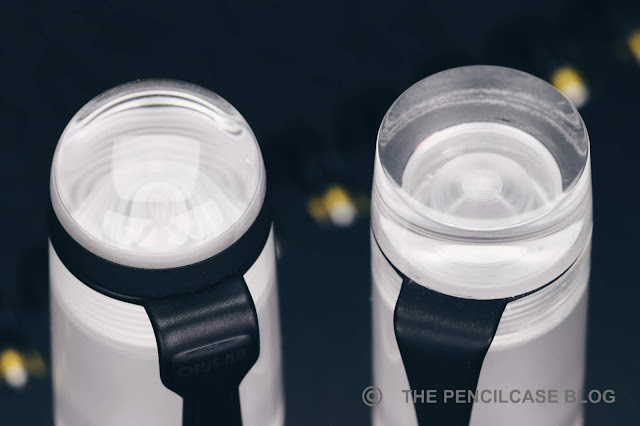
The Jazz 'Holiday Clear', which is the frosted/matte version of the Jazz demonstrator (I don't quite understand the reasoning behind the name?) gets ruthenium-colored trims - though polished, so still not quite like the matte black trims of the other Demonstrator pens. All demonstrator pens from Opus already come with frosted innards, though the addition of a matte finish on the outside gives the Holiday an even more uniform and opaque look, contrasting strongly with the polished, dark trims. Of course, the biggest difference is how the Holiday Jazz FEELS in the hand, the soft matte surface texture sets it apart completely from the other versions. The matte finish is quite uniform across the entire pen, living up to the excellent construction standards of Opus, once more.
REVIEW: OPUS 88 JAZZ DEMONSTRATOR FOUNTAIN PEN
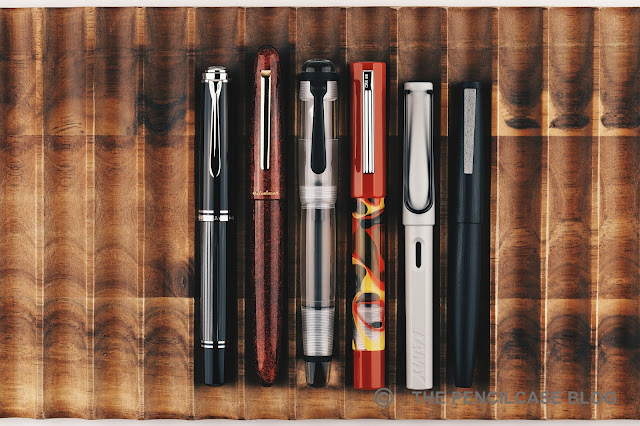
L to R: Leonardo Momento Zero Grande Pura, Penlux Masterpiece Grande, Opus 88 Omar, Demonstrator, Jazz, Montblanc 149, Pelikan M805, Lamy Safari, Lamy 2000
It's no secret that Opus 88 likes to create large -very large-, oversized pens, so it'll come to no surprise that the Jazz is also a very big pen. Though, even besides the already large Demonstrator and Omar, the Jazz is still a decent bit longer. Strangely though, because of the more streamlined design, it doesn't feel too big (though of course that boils down to personal preference!).

At 15.1 cm/ 5.95", it's unapologetically oversized, though, that's more or less a given with Opus. Without the cap, you're left with a pen that's 13.3 cm/ 5.24" long, which is more than comfortable for even a large hand. If you're feeling adventurous, you could still post the cap, though it doesn't post awfully deep so you'll end up with a ridiculously long pen! At 28 grams, the Jazz is surprisingly quite a bit lighter than the smaller Opus 88 Omar. 
REVIEW: OPUS 88 JAZZ DEMONSTRATOR FOUNTAIN PEN
L to R: Opus 88 Demonstrator, Omar, Jazz
The section design of the Jazz is again (almost) identical to those on a lot of their other pens: a decently sized section with a nicely pinched taper that transitions smoothly into the threads. There's a bit of a step behind the threads and it can be quite sharp depending on how you hold the pen, a bit unfortunate on an otherwise very comfortable pen!
REVIEW: OPUS 88 JAZZ DEMONSTRATOR FOUNTAIN PEN
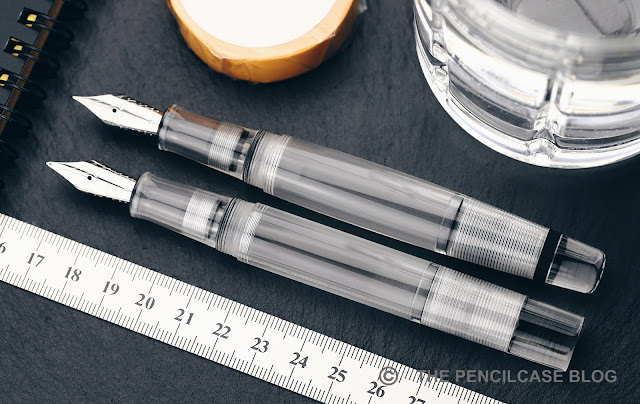
The barrel size of the Jazz is visibly shorter than the Demonstrator and Omar
Interestingly, despite the Jazz being the largest of the three, it still loses to the Demonstrator and Omar when it comes to ink capacity. You can actually see that the barrel part of the Jazz is noticeably shorter, likely due to the proportions of the pen. 
REVIEW: OPUS 88 JAZZ DEMONSTRATOR FOUNTAIN PEN
Now admittedly, 3 mL is hardly anything to scoff at, but it is indeed less than the 3.5mL of the other two models. The Japanese eyedropper filling mechanism continues to be a fantastic trade-off between huge ink capacity, while still keeping a practical advantage over traditional eyedroppers.
REVIEW: OPUS 88 JAZZ DEMONSTRATOR FOUNTAIN PEN
Compared to the last Opus 88 pen I reviewed -the Opus 88 Flow-, the Jazz returns to the camp of JoWo for the nib choice (in fact, all demonstrator models so far have exclusively used JoWo nibs). An excellent nib choice that also implies that this pen should be suited for conversion to a Pilot parallel nib (a fun feature I've discussed extensively in my review of the Omar). The broad nib I tested on the Jazz Clear worked flawlessly out of the box, and pairs great with the large ink capacity Japanese eyedropper.
REVIEW: OPUS 88 JAZZ DEMONSTRATOR FOUNTAIN PEN
The Opus 88 Jazz takes all the elements that I've liked before -and continue to like- about Opus' oversized, demonstrator, Japanese eyedropper-filled fountain pens, and crams it into a design that's actually remarkably traditional and 'normal' (for their doing). Their interpretation of a classic cigar-shaped fountain pen works well, even though it's not quite as eye-catching as the more unique styles of the Omar, Flow, or Bela. It's an inoffensive design and it works especially well in these two clear demonstrator finishes. As always, one of the main reasons of appeal for me continues to be the competitive pricing of Opus pens: for 108€/ 104$ (at site sponsor Appelboom, use discount code 'friend' for 10% off!), you really do get a whole lot of pen for your money!

Note: This product was sent by Opus 88, so I could write this review. I was in no way influenced in the making of this review, the opinions shared in this review are completely my own! This post does not contain affiliate links.
REVIEW: OPUS 88 JAZZ DEMONSTRATOR FOUNTAIN PEN

Friday, August 21, 2020

REVIEW: OPUS 88 FLOW FOUNTAIN PEN

REVIEW: OPUS 88 FLOW FOUNTAIN PEN
With Opus 88 creating pens that LITERALLY look like a flower vase these days, it's quite clear that they don't mind thinking outside the 'conventional design' box from time to time. The new (ok, new-ish, I'm late to the game, as usual!) Opus 88 Flow shows some signs of the creative madness, but is all in all still a rather tame beast - and I like it for that! The Flow is more or less the perfect balance between the oversized footprint of the Demonstrator (reviewed HERE) and Omar (reviewed HERE), combined with the funky, colorful, occasionally whacky, design of pens like the Fantasia (reviewed HERE) and Flora.
REVIEW: OPUS 88 FLOW FOUNTAIN PEN
Of all the Opus pens, the Flow has perhaps the least 'flowing' shape, with a straight overall profile. The Flow does get creative with a mix of both a decagonal faceted cap and blind cap, and a round section and barrel. It's enough to create a unique pen, but doesn't overdo it (read: it's not a vase!). The design is emphasized by a colorful material choice, combining an opaque colored resin for the decagonal parts and section, and transparent swirled ('Flow-y') resin for the barrel so you can still see the ink inside. 
REVIEW: OPUS 88 FLOW FOUNTAIN PEN
The red colorway I have here is a clear departure from the colorless demonstrator Opus pens I tend to stick with. I would personally go for the slightly more understated grey colorway, but I do have to admit that this red/yellow/black color scheme is quite fun and catches the eye, especially when filled with an equally colorful ink!
REVIEW: OPUS 88 FLOW FOUNTAIN PEN
The Flow doesn't have decorative metal bands like the Omar does, but instead receives a shiny chrome coin insert in the cap finial, with the words 'Flow - Opus 88' laser-engraved on it. Opus has a tendency to use a different clip design for every pen they create, most of which I tolerate but don't particularly love. While the clip on the Flow does follow the overall straight profile of the pen quite well, the grooved design is a bit too much in my opinion. The Flow is perhaps a missed opportunity to go for a clipless design, since the faceted cap prevents the pen from rolling away uncontrollably. Besides, the Flow isn't an ideal candidate for vest or pocket carry anyway, as it's quite a big pen.
REVIEW: OPUS 88 FLOW FOUNTAIN PEN
L to R: Pelikan M1000, Esterbrook Estie Oversized, Opus 88 Omar, Opus 88 Flow, Lamy Safari, Lamy 2000
Talking about size, the Flow measures in at 14.9 cm/ 5.83" capped, and 13.6 cm/ 5.35" open. The section is relatively wide - just like the rest of the pen- and tapers down to 1.1 cm/ 0.43" at the thinnest point, before flaring out slightly. With an all-acrylic construction, the Flow is - unsurprisingly - a rather light pen for its size, at just 28 grams.

The words 'well-executed' and 'excellently put together' tend to fall out of my mouth when describing the Flow, because the build quality is excellent. I probably keep repeating it to death with every single Opus 88 pen I review, but it's simply true, and it's certainly one of the things I very much appreciate about their pens. In fact, it manages to put many higher-priced pens to shame!

Just like the other oversized models from Opus, the Flow borrows a few parts from existing Opus pens. A bit like how car manufacturers build different cars on the same platform: it's cheaper to manufacture, and the parts are tried and trusted! In this case, the Japanese eyedropper mechanism, and barrel are plucked directly from the Opus Demonstrator. 

I wrongfully assumed the section to also be identical to that on the Demonstrator and Omar, but it's actually noticeably shorter. Why they decided to change it up, I have no idea, especially because I really like the Demonstrator and Omar for their comfortable section design. That being said, the Flow's shorter section still has a decent size and comfortable shape, and the threads and step don't interfere too much with your grip. Along with its overall substantial size (the Flow isn't made for posting, but doesn't need it), a pleasantly girthy diameter, and lightweight all-resin construction, the Flow still takes a lot of the design ques that tend to make Opus pens excellent for long writing sessions.    
REVIEW: OPUS 88 FLOW FOUNTAIN PEN
As all Opus 88 pens, the Flow is a Japanese eyedropper. The back of the barrel unscrews as you would with a piston filler, but the "mechanism" inside is nothing more than a rod with an o-ring stopper at the end that plugs off the barrel when the pen is not in use, and prevents the pen from leaking. It's a brilliantly simple mechanism, and Opus implements it perfectly in all their pens: the large barrel of the Flow means you won't run out of ink anytime soon, and the o-ring on the section prevents leaks.
REVIEW: OPUS 88 FLOW FOUNTAIN PEN
Interestingly, Opus has recently made a switch to Bock nibs for some of their pens - a bit like Leonardo does. The only reason I could think of that warrants using both nib brands, would be to lower the dependence on a single supplier? In any case, the Flow only comes with a Bock nib, that means no more Pilot Parallell hack, no more swapping in the awesome Franklin-Christoph music nibs, and probably some people that will hold off on buying simply because it has a Bock writing end. 

The Bock nibs come with a simple laser-engraved logo engraved on the nib face, which looks cleaner and in my opinion suits the overall design of the pen much better than the classic flourishes engraved on stock JoWo nibs. It's a small detail, but I do appreciate it.
REVIEW: OPUS 88 FLOW FOUNTAIN PEN
Regardless of your nib preference swinging towards the Bock or JoWo camp, there's not much to say against the performance of this medium Bock nib. The Japanese eyedropper filling mechanism certainly does output a steady flow of ink, but it doesn't feel like it has a substantially wetter flow than any other Bock nib. The medium nib is nothing out of the ordinary, but it's smooth, responsive and... well, it does the job the same way a JoWo nib would. While Bock nibs at a certain point were noticeably more soft and flexible (giving them a slight edge over JoWo IMHO), I've found them to be much stiffer these days (but at the same time, also perhaps a bit more reliable?).
REVIEW: OPUS 88 FLOW FOUNTAIN PEN
The Opus 88 Flow is another cool and unique pen from the Taiwanese company. I especially like the mix of faceted and round profiles in the design. The swirly demonstrator acrylics add a playful character to the pen, although I'd love to see an all-clear demonstrator version of the Flow to match the clear Omar and Demonstrator models! 

At 116/ 135$ (at Appelboom. Sweeten the deal with 10% off using discount code 'friend') retail price, the Flow provides a hard-to-beat value. It's no secret, I continue to appreciate Opus 88's efforts in creating excellent quality products that turn heads, one way or another. And as long as they keep making those incredibly well-made, oversized, and most importantly, affordable fountain pens, I will happily keep reviewing them!
Appelboom pens
Note: This product was sent on loan by our site sponsor Appelboom, so I could write this review. I was in no way influenced in the making of this review, the opinions shared in this review are completely my own! This post contains affiliate links.
REVIEW: OPUS 88 FLOW FOUNTAIN PEN

Friday, December 27, 2019

REVIEW: OPUS 88 OMAR DEMONSTRATOR FOUNTAIN PEN

Review: Opus 88 Omar Demonstrator fountain pen
I've raved about Opus 88 before, and I may just do it again today! Of the -now 4- pens I've tried (three of which I've reviewed before, the Koloro Demonstrator, Fantasia and now this one), Opus has managed to keep up a remarkably high and steady standard across all of them. 

The Taiwanese brand (apparently founded in 1977 already, according to the box?) took off a couple years ago with a refreshing collection of fountain pens that utilized combinations of ebonite and acrylic, excellent JoWo nibs, and a Japanese eyedropper filling system. But I think the real reason they suddenly got so much attention, is because of the excellent quality-to-price ratio. My favorite back then was the Koloro Demonstrator (now just called 'Demonstrator', but I'll refer to it as Koloro to keep things clear): an oversized, completely clear acrylic pen. 
Review: Opus 88 Omar Demonstrator fountain pen
The Omar is one of Opus' latest models, and didn't blow me away right away (although they do come in very interesting combinations of transparent and 'cracked ice' acrylics), but when I heard of a demonstrator version coming out... Now THAT'S something I was interested in!
Review: Opus 88 Omar Demonstrator fountain pen
The Omar Demonstrator is again a seriously large pen. It makes sense that I enjoy it just as much as the original Koloro Demonstrator, because in essence... it's identical. That's to say, all threads and internals are machined to the exact same specifications on both pens. That also means that basically all parts are interchangeable with each other. So if you'd want, you could go around mix-and-matching your own unique design (Pro tip: the cap of the Koloro Demo on the Omar body looks quite sleek!). 

On the outside, the design is obviously different. We're looking at a much more 'sculpted' design, compared to the completely straight and angular Koloro Demo. The Omar has a more elegant, bulbous shape. Although on a pen this size, elegant is perhaps not the right word to use. It's still a chunky-looking, beefy pen.
Review: Opus 88 Omar Demonstrator fountain pen
Opus' pens are generally quite light on trims and decoration -perhaps a way of keeping the cost of the pen down? The Omar has a chunky clip, the shape of which I'm not particularly fond of. Where I found the clip on the Koloro Demo a bit flimsy, this one is too tight. Then again, these pens are probably too big to carry in a pocket anyway. 
Review: Opus 88 Omar Demonstrator fountain pen
The Omar has two wide, matte black metal rings, one at the cap finial, one at the back finial. Together with the large, chunky overall shape of the pen, the trim doesn't look particularly refined either. However, it does look sleek and creates a stark contrast against the transparent acrylic. The only downside about the (powder-coated?) matte black trim is its' proneness to scuffing and becoming glossy with use.
Review: Opus 88 Omar Demonstrator fountain pen
Where I've always been quite impressed with the build quality on Opus pens, the Omar manages to take that to the next level. Threads are crisp (also internally, quite important on a demonstrator pen of course) and machining marks are nowhere to be found. Polishing is exceptionally consistent. Surfaces inside the cap, barrel, and section are again chemically etched to create a nice matte finish, and once again the consistency with which they applied this etching is impressive. Opus can easily compete in a far higher price category when it comes to build quality. 
Review: Opus 88 Omar Demonstrator fountain pen
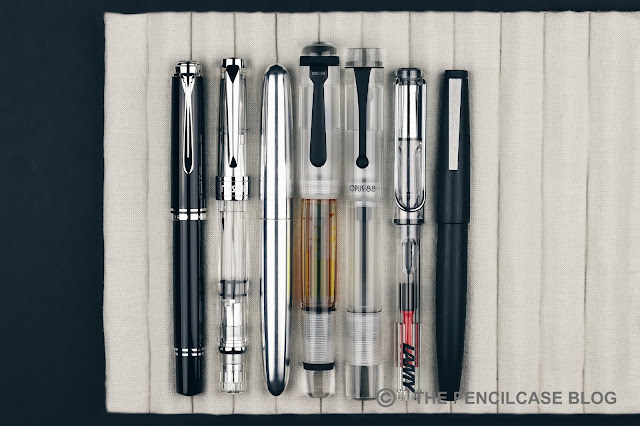
L to R: Pelikan M805, TWSBI 580Al, Ensso Piuma, Opus 88 Omar, Opus 88 Koloro Demonstrator, Lamy Safari, Lamy 2000
I was quite surprised when I realized the Omar is an even bigger pen than the already-large Koloro Demonstrator. It measures exactly 15cm (5.9") with the cap on and 13.7cm (5.4") without. It's a very bulky 1.8cm (0.7") in diameter at the widest point. So both in width and length, it trumps the Koloro Demonstrator or a Montblanc 149 for that matter. With its 34 grams, the Omar has a bit more heft than the Koloro Demo, too. 
Review: Opus 88 Omar Demonstrator fountain pen
Not a fan of oversized pens? Then it's safe to say the Omar may not make your shortlist. But it's not as terrible as it may seem. Despite its' mammoth size, the Omar Demo still manages to be a very comfortable pen to write with. The bulbous shape fits the hand naturally, and it narrows down towards the section to make for a grip section that's not too wide at all. The pen has just enough heft to let you feel it's there, yet not enough to cause fatigue. 

The section is a decent size, and has a nice taper to it, flaring out at the end. The shape of the section invites your grip more towards the front, keeping your fingers away from the threads. The threads themselves never bothered me, but there's a small step right behind them that's a bit noticeable.
Review: Opus 88 Omar Demonstrator fountain pen
I'm not big on eyedroppers, but I do like Japanese eyedroppers. It's still a simple system (it can hardly be called a filling mechanism, I guess), but adds a shutoff valve to temper the massive 3.5ml-ish ink capacity when you need to. It's sealed shut when not in use, ideal for traveling (unlike normal eyedroppers), and the ink flow can be controlled by simply opening or closing the valve while you write. It's pretty great, apart from when you need to clean it out.
Review: Opus 88 Omar Demonstrator fountain pen
The stock JoWo nib that all Opus 88 pens come with is an excellent choice for everyday writers. The nibs are reliable (probably more so than those from Bock), albeit maybe a touch bland. The EF on this pen actually lays down a very fine line, and it has the feedback you should expect with a nib that fine. I quite like it for notetaking, and with an ink capacity like this, it lasts ages before needing a refill. To take better advantage of an ink capacity like this, pair it up with something broad or a stub nib, like the FANTASTIC Franklin-Christoph Music nib... or a Pilot Parallel?
Review: Opus 88 Omar Demonstrator fountain pen
Opus 88 scored massive internet points when the Pilot Parallel pen hack came up, and so I had to give it a go. You just unscrew the stock JoWo nib section as a whole (and remove the rubber o-ring right behind it) and throw in the nib and feed of a Parallel pen. Plenty simple. Congratulations, you now hold a pretty brilliant calligraphy pen with a MUCH more comfortable body than that of the Pilot Parallels and a ridiculously large ink capacity! Although for the OCD peeps like me: the frosted finish on the inside of the section does get messed up a bit when you do this pen hack.
Review: Opus 88 Omar Demonstrator fountain pen
My verdict on the Opus 88 Omar Demonstrator? There's a lot to like about it: First of all, the build quality is bar none. Secondly, I like how Opus has a way of coming up with designs that are exciting and just a little different. And above all -need I repeat it any more- the value proposition is pretty perfect. 108€/ 126$ Is definitely in that 'next-level pen' category, but it's a very fair price for the quality you get in return. I'd be tempted to put this up against the -also great- Leonardo Momento Zero Grande, but then you're looking at a price that's almost three times higher.
Appelboom
Note: This product was sent by Opus 88 and Appelboom, so I could write this review. I was in no way influenced in the making of this review, the opinions shared in this review are completely my own! This post contains affiliate links.
Review: Opus 88 Omar Demonstrator fountain pen

Tuesday, May 15, 2018

OPUS 88 KOLORO DEMONSTRATOR FOUNTAIN PEN REVIEW

Opus 88 Koloro Demonstrator fountain pen review
I must admit that I have a tendency of being rather skeptical towards new brands. However sometimes it's almost impossible to ignore them... especially when they are onto something good!

The brand we're looking at today, Opus 88, isn't even technically a new brand. It has existed for over two  decades, but used to be mainly focused on handmade high-end pens (including some very nice urushi work!). They never had a worldwide breakthrough, until the Koloro pens were launched. 
Opus 88 Koloro Demonstrator fountain pen review
I had the chance to try them out during my recent visit to the new brick&mortar Fontoplumo store, and I fell in love with the Koloro Demonstrator right away. There's a lot about this pen that makes it punch far above its class, while remaining relatively affordable. So let's dive straight in! 
Opus 88 Koloro Demonstrator fountain pen review
The Opus 88 Koloro Demonstrator is, of course a demonstrator pen (duh). The design is very simple: just a straight cylindrical flattop shape. The ends taper ever-so-slightly, but the profile is overall fairly straight. The black matte clip is the only piece of hardware on the outside of the pen, and I really love how it contrasts with the clear acrylic construction of the pen. 
Opus 88 Koloro Demonstrator fountain pen review
The insides of the pen all received a frosted finish to give it a matte appearance. This finish is incredibly even and consistent throughout the entire pen. The finials on top and bottom of the Koloro are polished, to contrast with the rest of the pen. 
Opus 88 Koloro Demonstrator fountain pen review
Let's be clear (pun intended): demonstrators are ruthless when it comes to fit and finish issues. If something is wrong, even by a little bit, it'll inevitably show up. There's no place to hide production flaws. I inspected every inch of the Koloro Demonstrator and I have to say they really nailed the production across the board. All parts are polished perfectly and fit together with tight tolerances. The clip is perhaps the weakest point of the entire pen. It could've been made from slightly thicker steel to give it a sturdier feel, and the matte black coating might wear down over time. 
Opus 88 Koloro Demonstrator fountain pen review
L to R: TWSBI 580Al, Opus 88 Koloro, Opus 88 Koloro Demonstrator, Lamy aion, Lamy 2000, Lamy Vista
The Koloro Demonstrator is a substantial pen, and the imposing design without taper helps to accentuate that. It measures 14.8 cm (5.88") open, and 13.7 cm (5.4") uncapped. Together with the fairly consistent width of 1.5-1.65 cm (0.59-0.65"), this makes for a noticeably oversized pen. However, the all-acrylic construction keeps the weight low (total of just 27g). 
Opus 88 Koloro Demonstrator fountain pen review
Despite the size, it's a rather comfortable fit for my hand. The section has a nicely tapered shape that narrows down a bit compared to the barrel, but not too much. The threads are shallow, but more importantly the step towards the barrel is low enough to not interfere with my grip at all. The writing experience is comfortable and fatigue-free. Of course it's good to keep in mind that I'm partial to large pens, and I'm definitely not saying this will be everyone's taste. But it has to be said that Opus 88 managed to make a large pen that doesn't feel unwieldy or imposing. 
Opus 88 Koloro Demonstrator fountain pen review
On to the filling system: this is probably the area where you could easily mistake the Koloro Demonstrator for a much more expensive alternative. The filling system is what's called a Japanese Eyedropper, something you normally only see on high-end urushi pens and the like. Throughout the barrel, you can see an ebonite shut-off rod that can be moved up and down by twisting the blind cap. 
Opus 88 Koloro Demonstrator fountain pen review
The rubber seal at the end of the ebonite shut-off rod
In the closed position, this rod shuts off access to the feed, which leaves a tiny volume enclosed that can be filled with ink (the writing reservoir, if you will).  Opening it up allows ink from the barrel to flow towards the feed, which creates a wetter ink flow. The entire barrel can be eyedroppered with ink (a ridiculous ink capacity of 3-4 ml, I haven't actually measured it). The pen is made for eyedropper use through rubber o-rings at the nib unit threads, and barrel threads. I added some silicon grease on the barrel threads as well, just to be sure.
Opus 88 Koloro Demonstrator fountain pen review
The nib is a stock JoWo unit, with the Opus 88 brand name laser-engraved across it, and some standard flourishes that I don't think really fit the overall modern appearance of the rest of the pen. 

The plus side of a stock JoWo nib is that you can easily swap it out with any other nib that suits you. No need to do so right away though, because this stock unit is an extremely pleasant writer! It's a broad nib, smooth as butter and with a nice rich ink flow. Depending on the paper, it can be a bit prone to skipping, especially with oils from your hands it can occasionally have a hard time. All in all though, it's a great nib to use that lays down a rather nice broad line. 
Opus 88 Koloro Demonstrator fountain pen review
The best part: 100 EUR (120 USD) for all this! In terms of value for money, I'd put it alongside the TWSBI 580. It's a bit more expensive, but the build quality seems better (seemingly no issues with cracking!), and I'm a big fan of the minimal and clean aesthetic. I'm having a hard time finding any downsides about this pen. It would be an understatement to say I've had a pleasant first encounter with this (not really) new brand!

Note: I received a discount on the purchase of this product from Fontoplumo. I was in no way influenced in the making of this review, the opinions shared in this review are completely my own! This post does not contain affilate links.
Opus 88 Koloro Demonstrator fountain pen review